President Donald Trump joined leaders of the world’s wealthiest democracies Friday morning for a virtual meeting.
The leaders were discussing the fuel crisis squeezing households on both sides of the Atlantic — but nearly every other square on the screen showed a face.
Trumps blank box quickly became the most talked-about part of the call, partly because of what happened the last time cameras spent days trained on him alongside G7 leaders.
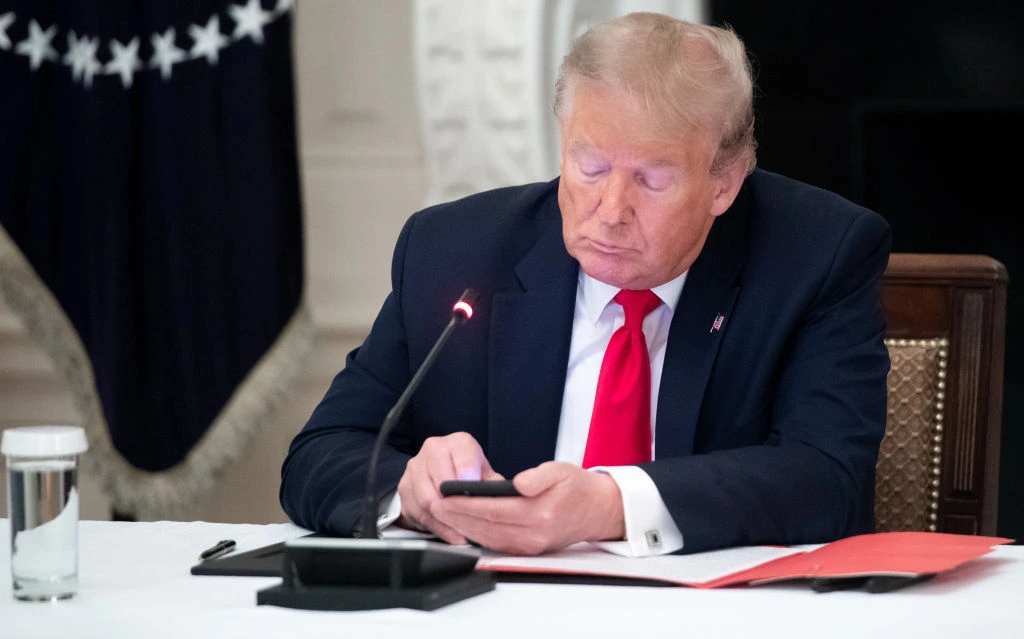
Back in June, that footage turned into a highlight reel of wandering, disoriented moments the White House couldn’t explain away.
The video conference was an emergency session convened by French President Emmanuel Macron, whose country holds the G7 presidency this year, according to NBC News. The topic was diesel. With the Iran war and the Russia-Ukraine conflict squeezing supply, diesel costs are up more than $2 a gallon from a year ago.
Trump wanted Europe to crack open its reserves. NBC News described a weeklong pressure campaign by his administration aimed largely at Germany and France, and a White House official said that Trump spoke with Macron Thursday night and with G7 leaders Friday morning to get a deal done.
Then International Energy Agency chief Fatih Birol posted a photo of the call on X. It showed the leaders of Canada, Germany, Italy, the United Kingdom, Japan, France and the European Commission all sitting in front of their cameras.
Every tile had a person in it, except one.
In the top-right corner, where the president of the United States should have been, there was nothing but a dark rectangle and the words “Donald TRUMP UNITED…”
It isn’t clear whether his camera was off for the entire meeting or only at the moment the picture was taken. Either way, the leader of the world’s most powerful country was the only one the world couldn’t see.
The meeting itself delivered. G7 leaders agreed to release 100 million barrels of oil over four months, including a “front-loaded substantial diesel release” within the first 20 days. Their joint statement even commended the U.S. “for its efforts to ensure the free flow of commerce through the Strait of Hormuz.” Trump reportedly accepted the praise as a black square.
He still took his victory lap to Truth Social, writing, “Europe has just agreed to release a massive amount of their heavily stocked Diesel Oil.” This is the same president who brushed off rising fuel costs last month as a “very inexpensive price to pay” for the war with Iran.
Over on social media, the jokes were writing themselves.
“Either he doesn’t know how to or he’s asleep,” one Threads user wrote. Another person on X had a scheduling note: “They shouldn’t schedule meetings during his nap time.”
A third saw a strategy at work, posting, “Trump really thinks the camera is the one thing he can negotiate with.” Others pointed to the double standard. “Maga’s exploding brains would shake the entire planet if Obama or Biden did this,” one person wrote.
And one user simply asked, “So who is actually representing the US on this call???”
The last time Trump spent real time in front of G7 cameras, the results were rough. The summit in Évian-les-Bains, France, kicked off June 15, the day after his 80th birthday. That afternoon, he struggled to keep his eyes open while appearing before reporters with Macron, and his right hand looked swollen and discolored, according to The New Republic.
The next day, C-SPAN caught him staring blank while seated the conference table while every other leader turned to face a photographer, as seen in this viral X post.
He also strolled late into a working session that was already underway and announced, “I’m the boss.”
During the official group photo, Indian Prime Minister Narendra Modi offered him a hand onto the platform, and moments later Brigitte Macron appeared to nearly lose her footing as she stepped up beside him.
Then he assured reporters he’s “not a big sleeper anyway.”
The heavy eyelids haven’t gone anywhere. Late last month, cameras zoomed in as he fought to keep his eyes open while Chinese President Xi Jinping spoke.
On Friday, there was nothing to zoom in on. For a president who rarely passes up a camera, the black box may have said more than he wanted it to.
View on Threads


