
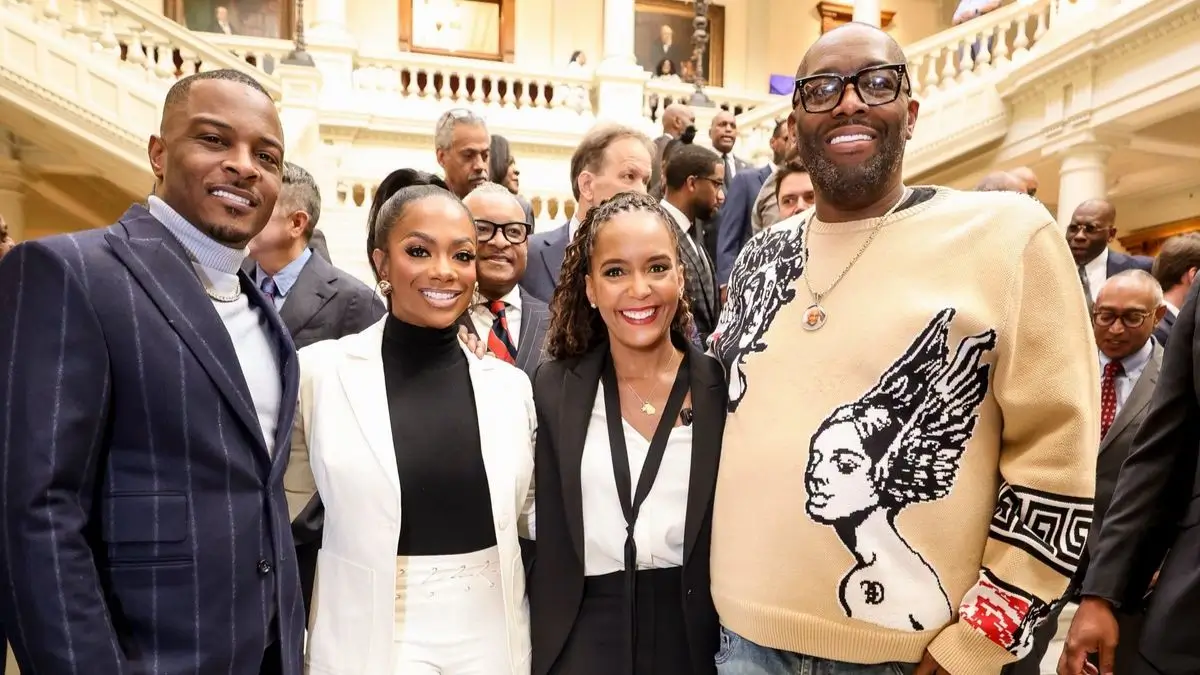
Kandi Burruss has announced that she has joined Keisha Lance Bottoms’ transition team, posting photos from the Georgia Capitol on Nov. 17.
Sure, the images featured some of Atlanta’s biggest names like T.I. and Killer Mike, but they also raised a question:
What exactly did Georgia’s next governor ask them to do?
The official roster lists Burruss, Killer Mike (Michael Render) and T.I. (Clifford Harris) on a broad advisory committee, though their specific policy assignments have not yet been announced.
Tyler Perry and Home Depot co-founder Arthur Blank have more clearly defined responsibilities.
As two of Bottoms’ 10 transition co-chairs, they’ll review candidates’ records and recommend finalists for some of Georgia’s most powerful state jobs. That gives them an early say in whose names reach the governor-elect’s desk.
The transition team is helping Bottoms prepare to take office in January. Its staff will coordinate the transfer of responsibilities from outgoing Gov. Brian Kemp’s administration, while the co-chairs review candidates and recommend finalists for senior positions.
Meanwhile, policy committees will help develop priorities for the incoming administration, including its first budget and legislative agenda.
The cabinet is the group of senior officials who will help run the administration once Bottoms takes office.
However, appointments to state positions follow separate rules depending on the office. Georgians directly elect some executive officials, including the attorney general and state school superintendent.
Perry’s transition role may give him a voice in deciding which candidates receive further consideration, but the title does not give him authority to oversee or run a state agency. He brings the perspective of a studio founder who built a major production business in Atlanta.
Blank brings experience building one of the nation’s largest retailers.
The remaining co-chairs also bring experience across business, government, nonprofit leadership and public service.
Rosalind Brewer offers executive experience from leading Walgreens Boots Alliance and serving as interim president of Spelman College. Carmen Chubb, who leads affordable housing company Columbia Residential, was Bottoms’ mayoral chief of staff.
Delta executive Richard Cox Jr. previously ran the city’s day-to-day operations, and former state Rep. Rashad Taylor advised Bottoms at City Hall.
Former lawmakers Jason Carter and Jane Kidd bring legislative experience, Michelle Nunn comes from the nonprofit sector, and Vicki R. Palmer brings a private-sector management background.
Bottoms has defended Perry’s selection by pointing to the people his studio employs and the small businesses it supports. She also described him as a friend.
His experience building a Black-owned studio gives him firsthand knowledge of an industry Georgia has spent years courting.
The state’s tax credit for qualifying film and television productions also makes the potential overlap between business interests and public influence concrete.
Will co-chairs disclose those interests and step aside if they’re asked to vet someone whose decisions could directly affect their companies? That question applies to executives across the roster, from film to housing and transportation.
Kemp also turned to business leaders, political allies and people he already knew when he built his Georgians First transition team in 2018.
His roughly 40-member group included former aides, Republican officials, conservative activists, businesspeople and clergy. He named five co-chairs: Jamie Reynolds, Harold Reynolds, Chuck Harper, Alec Poitevint and Mark Middleton.
Former U.S. Rep. Bob Barr served on the government relations team, while former U.S. Health and Human Services Secretary Tom Price advised on health policy as Kemp opposed full Medicaid expansion.
His appointments group also included Black commercial real estate executive T. Dallas Smith and Shawnzia Thomas. Kemp said diversity was a priority, although all five of his transition team co-chairs were men.
Bottoms named five women among her 10 co-chairs. The health policy stakes have changed, too. Bottoms has made Medicaid expansion a priority.
That comparison gives Georgians one way to assess who has a hand in choosing state leaders.
The next question is who will shape the recommendations those leaders ultimately inherit?
Bottoms’ broader committee extends well beyond Atlanta, bringing in Savannah Mayor Van Johnson, Hinesville Mayor Karl Riles and Bibb County school board member Amy Morton.
Burruss and Render bring experience in entertainment and entrepreneurship, as well as Grammy-winning artists and philanthropists in the city.
Other members of Bottoms’ transition team include Dr. Jamal Bryant, Dr. Karri Bryant of New Birth Missionary Baptist Church, Augusta Mayor-elect Steven Kendrick, Bishop William Murphy III, Isaac Hayes III, “Married to Medicine” star Dr. Heavenly Kimes, Fulton County District Attorney Fani Willis, and pastor and podcaster Eric Thomas.
As Bottoms fills out the seven policy committees, there’s room to add more people with firsthand experience of the issues.
A rural hospital nurse and an uninsured patient can tell the health committee different things about gaps in care.
A renter facing eviction and an affordable housing executive can tell the housing committee different things about why families are being priced out.
The transition office says it may add members in the coming weeks.
Bottoms will take office as the first Black woman elected governor in U.S. history, with a promise to lower costs, expand access to health care and invest in public schools.
Her transition roster shows who has been invited into the process.
Identifying who serves on each policy committee and tracking which recommendations make it into Bottoms’ first budget would give Georgians a clearer picture of whose input ultimately shapes her administration’s priorities.
We will be standing by to see.


