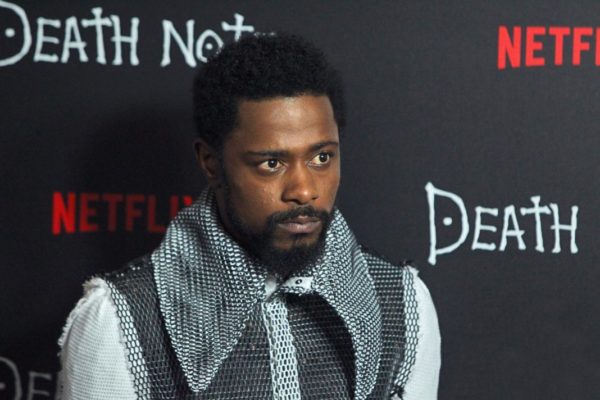
Lakeith Stanfield plays the eccentric investigator named L in “Death Note.”(Jim Spellman/WireImage)
Upon the news that the hit Japanese manga and anime series “Death Note” would be adapted as a live-action film, accusations of whitewashing flooded the interwebs.
https://twitter.com/mikqelq/status/882311048883318784
Netflix, the Death Note canon totally allowed for a spin off played in the US and you decided to whitewash the original story instead. Stop
— SKREEBAT✨🦇 (@SkreeBat) August 21, 2017
https://twitter.com/21lauryns/status/900176267705802752
But according to actor Lakeith Stanfield, the movie about a sociopath who gets a supernatural notebook granting him the power to kill anyone whose name he writes in it isn’t whitewashed at all.
“I think it’s a fundamental misunderstanding,” he told The Verge Tuesday, Aug. 22, of the flick being released Friday. “Especially when applied to this film in particular, because this film takes place in Seattle, [Wash.], in America. So, it would make sense that the cast reflects American demographics.”
Whitewashing Just Won’t Stop:
- Matt Damon Makes Distinction Between ‘Whitewashing’ and White Saviors Following Criticism of ‘The Great Wall’ Film
- ‘Exodus: Gods and Kings’ Sparks Online Boycott After Whitewashing Ancient Egyptians
- Scarlett Johansson’s Whitewashed ‘Ghost In the Shell’ Flops at Box Office
“There is an Asian-American [character] in the film,” he continued. “If people would go out and see it, they would realize that. But the idea that we should turn the whole cast into a Japanese cast just doesn’t fit the demographics of America. And that’s the reason it didn’t happen. It’s not because we were trying to make a conscious decision to not cast — at least, this is my opinion. I’m not the person in charge of it.”
Stanfield, who is known for his roles in the film “Get Out” and the on-hiatus series “Atlanta,” added that the notion of “Death Note” purposely leaving out Japanese creators is “ridiculous,” but he understands why folks would be upset about the changes.
“I totally get that. I’ve been hearing the term ‘blackwashing,’ which is funny, as applied to me with L,” he said. “I just think it’s great. I love that word.”
Stanfield’s laid-back response to the criticism is fitting considering his take on how Hollywood is evolving with the times. “The Incredible Jessica James” actor told the Los Angeles Times in April that Tinseltown has “been racist since its inception. But now it’s opening up. Now, it’s becoming much more real, inclusive.”