President Donald Trump seems intent on projecting strength and dominance, turning a routine exit into an uncomfortable display — until something shifted at the last second.
The 79-year-old’s steps are often watched cautiously in a way that draws attention, not reassurance. His movements felt less like a confident stride and more like something managed, with each step carrying just enough hesitation to spark concern about whether he was fully steady on his feet.
Viral clips from a recent trip away from Washington, D.C., have reignited debates about his health and stamina, even as the White House insists he remains in excellent condition.
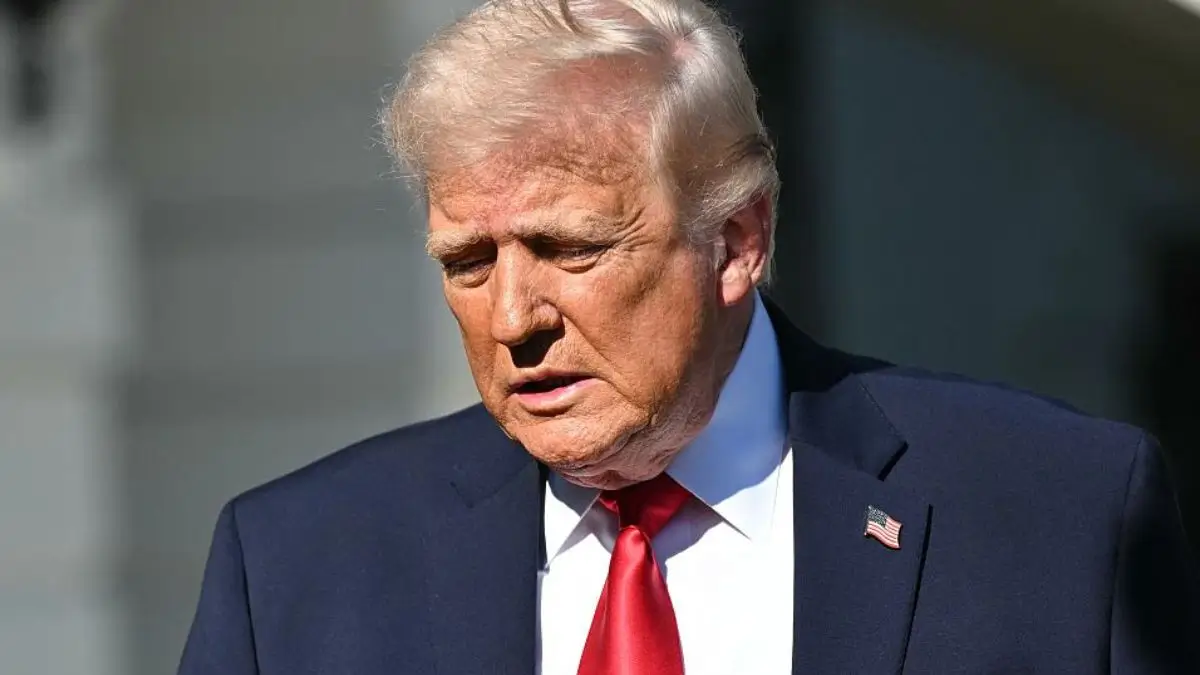
The latest moment came during Trump’s high-profile trip to Miami for UFC 327, his first appearance at a major sporting event since the start of the Iran war.
The travel itself was routine. On Saturday, April 11, Marine One from the White House to Joint Base Andrews, then Air Force One south to Florida — but what happened during his descent from the aircraft quickly became the main event online.
Cameras captured Trump gripping the banister tightly with his left hand as he walked down the stairs, moving carefully enough to make viewers pause and rewind.
An aide suddenly closed in behind him after a quick pause at the bottom of the steps, raising concern tied to his recent diagnosis and whether issues with balance or stability may have played a role.
Threads users zoomed in, speculated, and cracked jokes on how Trump appeared to lean heavily into the railing, while others zeroed in on an aide lingering close in the background.
View on Threads
One person suggested he was holding the rail like “Gorilla glue.” Another cut straight to it: “He fighting them stairs.”
The tone quickly shifted from humor to concern, with one reader writing, “He has to look down for each step, and he also had to double step it not to lose his balance. Trump is sick.”
Others shifted focus to the people surrounding him.
“Was that a slight wobble then?” one viewer asked, while another demanded, “Where is his handler so he doesn’t trip?”
Still many were in flat-out disbelief about what they saw, also expressing concern about Trump constantly waving to someone off-camera when he walks down plane steps or across the lawn. Most times, it’s clear he’s waving toward the press, waiting to speak with him upon landing.
“Whoa! He was walking down the stairs AND waving!! There was nobody there, but still!” That scrutiny didn’t emerge from thin air.
BREAKING – Donald Trump needed two officers to walk him out to midfield at today's Army Navy Game.
— Pissed Off Princess (@Pr17c5) December 13, 2025
He still could not walk in a straight line bumping into them. pic.twitter.com/UIrOC7A4GX
Trump spent years publicly mocking political rivals — particularly former President Joe Biden — over perceived physical weaknesses, making frailty a central talking point of his campaigns. That history has created an unavoidable contrast whenever Trump himself appears unsteady. Critics argue the same harsh spotlight he trained on others is now swinging back on him, frame by frame.
These moments have become recurring. In recent months, videos have surfaced showing aides subtly guiding Trump during public appearances — directing where to stand, when to move, positioning themselves close enough to intervene.
There was also a widely discussed incident earlier this year when Trump returned from an overnight trip and appeared to stumble briefly while descending from Air Force One. Viewers noted how he switched handrails mid-descent after catching his foot, then continued at a noticeably slower pace with someone walking closely on either side.
Even smaller mishaps have carried outsized weight.
A golfing photo of Trump showing an aide — Walt Nauta, who is often compared to Fonzworth Bentley — about to adjust his collar. The closeness and ease of the interaction caught everyone’s attention, turning a routine, unguarded moment into viral commentary, proving even Trump’s off-duty moments never escape public scrutiny.
View on Threads
What makes these episodes hit so hard is the gap between the image Trump has carefully cultivated and the vulnerability captured in unscripted moments. He has long staked his political identity on toughness, confidence, and physical dominance — the kind of alpha-male posturing that made “Sleepy Joe” and “Crooked Hillary” feel like deliberate brand strategy.
Yet the simple act of walking down stairs has repeatedly become the symbol critics reach for when puncturing that image.
That is the real tension underneath all the jokes and clip compilations. In an era where every public movement is recorded, streamed, and replayed from seventeen angles, there is no such thing as a private stumble for a sitting president. For Trump, the stairs have become more than architecture — they are a stage where perception, pride, and accountability converge in real time.
He spent years making other people’s physical moments into political weapons. Now the internet has learned to return the favor, one careful step at a time.


