President Donald Trump’s latest viral moment didn’t come from a speech, a soundbite, or a clash with critics. The latest uproar is about a simple photograph that failed to portray his tough guy image.
During Trump’s stop in Dearborn, Michigan, he toured Ford’s River Rouge plant alongside company leadership and members of his administration.
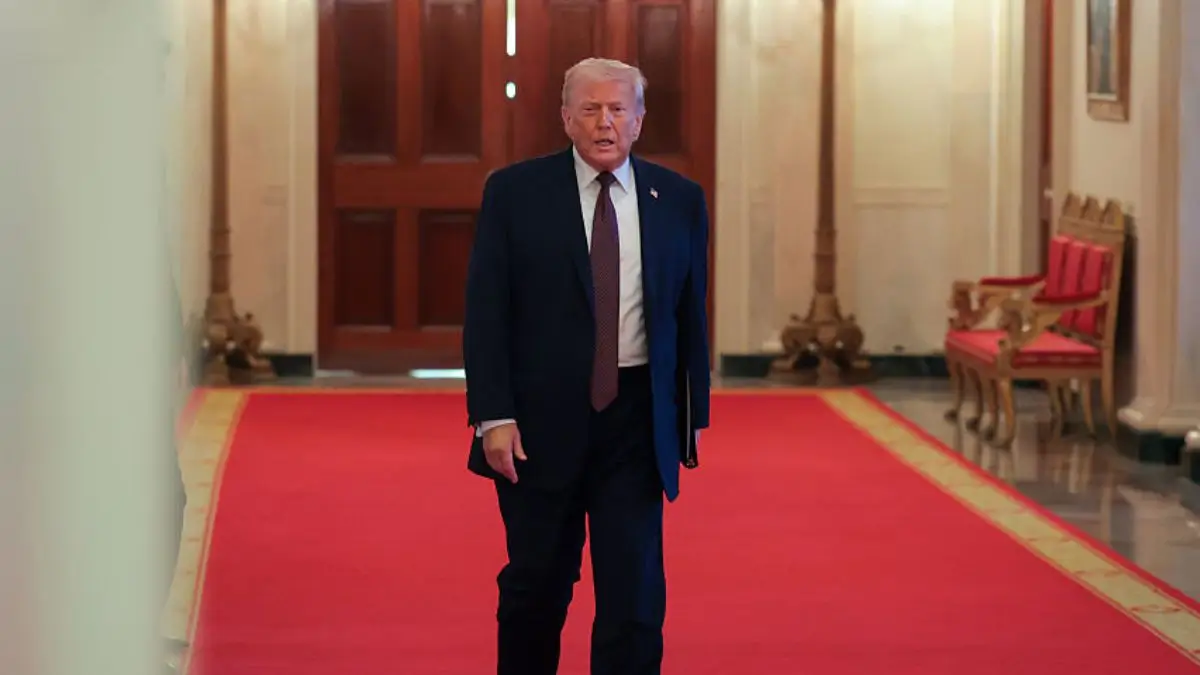
The visit was designed to underscore his economic agenda, highlight U.S. manufacturing, and spotlight Ford’s F-150 pickup truck as a symbol of American industry.
Trump later addressed business leaders in Detroit, framing the day around jobs, production, and domestic manufacturing. While several moments from the visit drew coverage, one image quietly took over the conversation, drawing attention almost immediately to his appearance.
One person wrote, “Got that skin texture of a rotting orange.”
got that skin texture of a rotting orange pic.twitter.com/Mu2Hx8JxJL
— Caitlin⁷ ⊙⊝⊜ (@maltiroo) January 14, 2026
Another added, “The orange is rotting quickly. The real ‘America Liberation day’ is coming soon… more than probably, before the 250th Nation’s birthday.”
Social media users zoomed in on his skin, his eyes, and his expression, turning a routine presidential appearance into a viral spectacle that moved faster than any policy takeaway.
“He’s high as f—k too. His pupils are super small,” one post claimed, while another said, “His eyes look like a predatory lizard’s.”
The reaction that stuck the hardest and spread the fastest distilled the moment into a single line: “Look at that f—king GOBBLER there.”
Trump’s neck piece has long drawn attention from critics, especially around Thanksgiving when he came face to face with someone viewers called his “twin.”
Trump is so funny man.
— johnny maga (@_johnnymaga) November 25, 2025
He channeled his WWE days when pardoning this year’s White House Turkey. 🤣 pic.twitter.com/4MNYzAUjVG
Holiday-season jokes comparing his neck shape to a turkey’s wattle have become a recurring feature of online commentary, resurfacing year after year regardless of the setting. The Michigan image revived that running joke, even though the visit itself had nothing to do with the holiday.
The viral reaction also fit into a pattern that’s followed Trump through recent months.
In December, some viewers watching him speak at a formal White House event quickly stopped focusing on his remarks. Instead, online attention shifted to how tightly his collar pressed into his neck, turning a ceremonial moment into another visual talking point. Screenshots circulated faster than summaries of what he actually said.
The same thing happened again around the new year, when another widely shared photo sparked renewed scrutiny. People dissected his eyes, forehead, and overall appearance, comparing the image to earlier photos and debating what looked different. The discussion wasn’t driven by new information, just a familiar cycle of observation and reaction.
Even earlier appearances followed the same script. Official settings, formal remarks, and carefully staged visuals repeatedly gave way to online fixation once a single detail caught viewers’ attention. Shirts, collars, lighting, posture — nothing escaped commentary once the images hit social media feeds.
By the time the Michigan photo finished making its rounds, it was clear the moment had little to do with manufacturing or economic messaging.
Ultimately, the Dearborn stop underscored a familiar imbalance. Despite the careful staging, industrial backdrop, and economic messaging, the lasting impression came down to optics rather than substance. One photograph reinforced how easily Trump’s public appearances can be overtaken by the visual moments that linger long after the event itself fades from view.


