Actress Meagan Good says that she depended on veteran comedian Whoopi Goldberg for help with her lines while filming her recent project, “Harlem.”
During a recent interview on “The Kelly Clarkson Show,” she told the host that she leaned on the EGOT to remember who to say some of her lines on the new Amazon series.
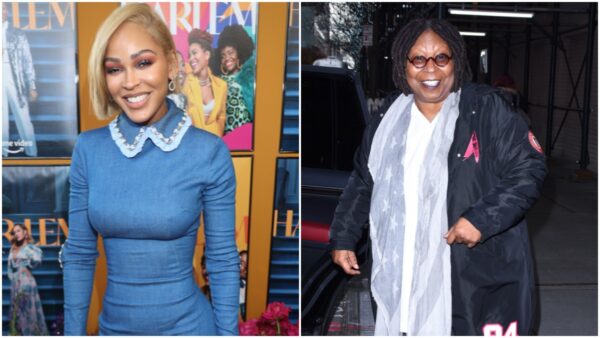
The first season “American Idol” winner asked Good what the coolest thing was about working with Goldberg, and she answered with a smile, “She’s so nice.”
Goldberg plays a Columbia University sociology department head, who comes in as a supervisor to Good’s character Camille. One of the key conversations in the episode was about the historical and sociological changes in New York City. The name of a small settlement of mostly African American landowners in the borough of Manhattan in New York City, founded in 1825 by free Black people, became a stumbling block for the actress.
“I remember there was one day I kept saying ‘Sen-e-ca,’ instead of Seneca Village. And she was like it’s ‘Seneca Village, Seneca Village,’” the actress recalled.
She says that she thought she had the words down pat, but came in and “butchered her coverage” by saying the line incorrectly.
When it came to her to say her part, Good says that “The View” co-host had taped the pronunciation of the phrase across her chest.
At first, she didn’t notice the helpful gesture the icon had afforded her and continued to say the phrase wrong. Then inconspicuously, Goldberg mouthed to her to look down.
Clarkson jumped in, finishing the joke, “Look at my boobs. I am trying to help you.”
This was not the first time she told this story. In an interview with Entertainment Weekly, Good told this story adding, “When we turn around, I come into the room to do my coverage, and I look down, and Whoopi’s written out ‘Seneca Village,’ but she broke it up to pronounce it easier.”
“And it’s taped across her breast for my coverage, just to see me win,” she continued. “And that was the dynamic of our relationship — and dare I say, friendship. She’s so dope. I love her.”
She said that because of that safety, she felt “freer” and pushed “harder on the awkward or the hard stuff.”
Good believed moments like that colored their relationship on set, “We do something and Whoopi afterward is like, ‘I’m sorry!’ And I’m like, ‘It’s good girl, go harder.’ You know? So it was excellent.”
Good said she was excited about working with Goldberg and when the show was shut down because of the pandemic, one of her main concerns was if she would return to the cast, admitting that when she was 10 she was an extra on the star’s 1991 film, “Soapdish.”
“So 30 years later, I’m now sharing the screen with her as an actress that’s in the scene, in the moment,” she said. “I just was impressed by her.”
“Harlem,” produced by Pharrell’s I AM OTHER production house, is a series that follows four Black women in their 30s trying to figure out life. While the show has not been picked up for a second season on the Amazon streaming service, the final episode of season 1 has fans hoping for more.
Tracy Oliver, “Harlem” creator and showrunner, said to TVLine that her team is “already working on scripts for next season.”
More Stories from Our Partners:


