Black Ohio real estate developer Mike Jenkins can’t catch a break. Back in 2024, while Jenkins was inspecting a home, a white neighbor ran screaming from the doorstep and accused him of being an intruder. The doorbell-camera video went viral, and the woman, Michelle Bishop, later posted an apology video.
Now another encounter is making headlines, and Jenkins has had enough.
Jenkins, whose locs fall to his waist, and another Black colleague caught the eye of a white man as they surveyed Jenkins’ latest construction site, a home-building project in central Ohio.
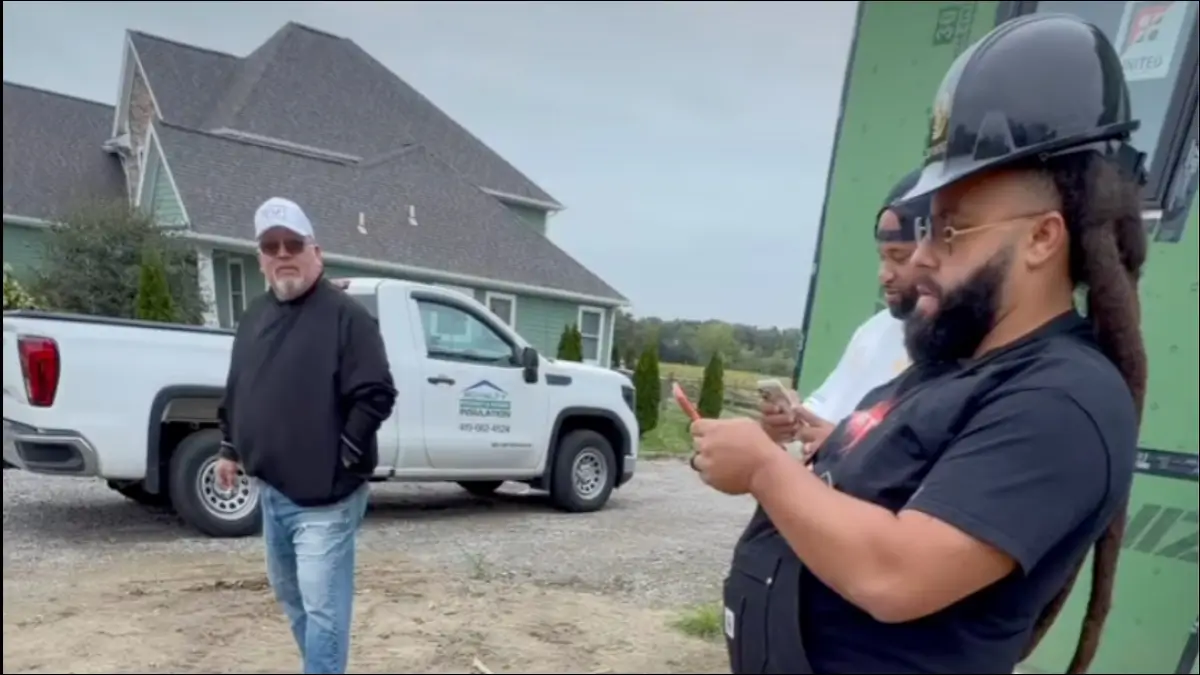
In the Oct. 17 Instagram video, the man appeared suspicious of Jenkins, even though Jenkins wore a hard hat and a vest emblazoned with his company’s logo, 3D Visionz.
“How the hell did you guys get here?” he asked. “Do you guys live around here?”
Attempting to lighten the mood, Jenkins quipped, “You don’t see builders look like us out here, huh?”
“What, Black?” the man responded. “You ain’t dominating the industry, I can tell you that.”
Jenkins knows there’s a lack of diversity in the real estate development industry, but the encounter still left him reeling.
“You all heard what homie just said. They laughing at us,” he later told the camera. “That sh*t really made me mad as f*ck… How they don’t want us out here in these million-dollar neighborhoods. It’s the reason why we’re .5 percent Black developers in the United States.”
He was referring to a sobering statistic from the Initiative for a Competitive Inner City (ICIC) and Grove Impact, two nonprofits focused on driving racial equality and closing the wealth gap. The 2023 study found that of about 112,000 real estate development companies in the United States, roughly 111,000 are white-owned, leaving Black and Latino developers at half a percent.
But the study also finds that Black and Latino developers often surpass their white peers in average revenue.
One of the report’s authors, Howard Wial, said the outsized revenue may reflect POC developers having to work twice as hard to access funding.
“I think overall it is a positive sign, but I would add just one possible cautionary note,” he told The New York Times. “Small Black and Hispanic developers may need to be better than their white counterparts just to be in the industry. And that may partially account for this finding.”
Jenkins shared the encounter on social media to advocate for more Black developers, but also to spark a discussion. “Is this racism, or am I trippin’?” the caption read. Nearly 15,000 people have answered him so far, and many say they’ve lived it too.
One commenter wrote, “People think we be making up these stories of micro-aggressions we face every day. Wake it up!!”
The top comment, with 11,000 likes, put it this way: “Strange that we built the world, now we can’t build homes.”


