If there were a job guaranteed to raise questions about Robert F. Kennedy Jr.’s qualifications, overseeing women’s health would be a job that practically writes its own punchline.
Yet President Donald Trump tapped his health secretary to help lead a new federal initiative aimed at improving medical research and care for women, despite Kennedy’s history of eyebrow-raising health claims and bizarre controversies.
Trump appeared to acknowledge that he might need to explain his choice, introducing Kennedy on Monday with the curious understatement, “He’s a little different” — a description unlikely to inspire confidence among the very people the initiative aims to serve.
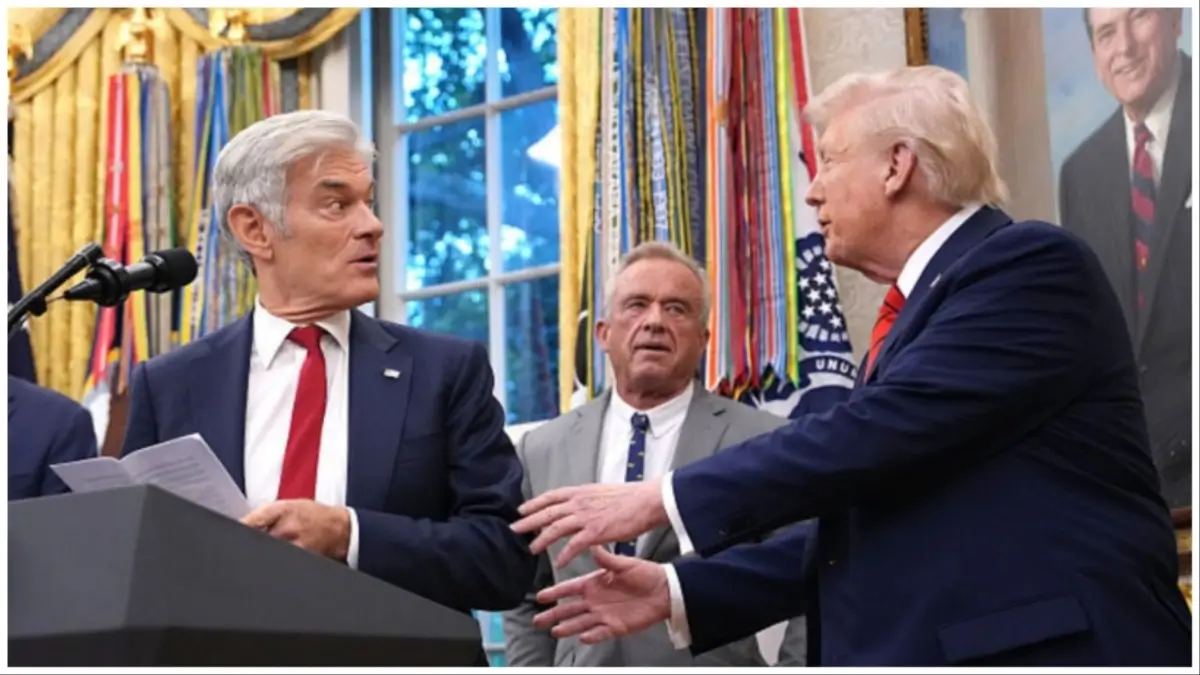
Trump’s remark came as he announced an executive order creating a new NIH Women’s Health Division and the first White House Women’s Health Task Force, co-chaired by Kennedy and White House chief of staff Susie Wiles.
“And this task force will be led by Secretary of Health and Human Services, Robert F. Kennedy, that’s a big one. And, uh, he’s been fantastic, I have to tell you. He’s a little different. We understand that, don’t we? … He’s a little different. But that’s what makes him good. I think. I’ll let you know about it,” Trump said with a laugh as he tried to sell Kennedy as the right man for the job.
The appointment drew immediate ridicule online, with critics questioning the wisdom of putting Kennedy in a position to help shape the government’s approach to women’s health.
One social media user compared the decision to placing an extremist in charge of protecting the very people he has targeted.
“This is equivalent of putting the Grand Master of the KKK in charge of the DOJ Civil Rights Division lol,” one observer wrote.
Another reaction questioned Kennedy’s understanding of basic reproductive biology, writing, “Who’s better for women’s health that the guy who thinks babies are conceived inside of the placenta… Another home run for stupidity.”
A third commenter summed up the skepticism more briefly: “What could go wrong?”
The new initiative aims to address medical conditions that affect women throughout their lives, from adolescence and reproductive health to menopause and aging. The new initiative aims to address medical conditions that affect women throughout their lives, from adolescence and reproductive health to menopause and aging.
According to the Department of Health and Human Services, the division will focus on conditions that uniquely or disproportionately affect women, including cardiovascular disease, cancer, autoimmune disorders, chronic pain, endometriosis, fibroids, infertility, maternal health, menopause, Alzheimer’s disease and osteoporosis. The administration says the effort will strengthen scientific research, increase women’s participation in clinical trials and help move discoveries into medical treatment.
Kennedy defended the initiative in a statement emphasizing gaps in medical knowledge that have left women with unanswered health questions.
“For generations, women have faced unanswered questions about conditions that uniquely or disproportionately affect them. This new NIH division will confront those questions with gold-standard science, accelerate research into prevention and treatment, and turn medical discoveries into better care for women and girls across America.”
NIH Director Jay Bhattacharya also said the division would help researchers address those gaps.
“Women deserve strong research that helps them and their doctors answer key health questions they face at every stage of life,” Bhattacharya said. “This new division will help close lingering evidence gaps, expand and maximize the impact of our research investments, and bring discoveries closer to patients.”
Centers for Disease Control and Prevention Director Erica Schwartz said the order would help turn research into practical improvements in care.
“Today, we’re ensuring women’s needs, experiences, and voices guide the care they receive at every stage of life,” Schwartz said. “This executive order will help us put proven interventions into practice, diagnose conditions earlier, expand treatment options, and prevent disease.”
But the administration’s broader health record has raised questions about how its promises of stronger research and better care fit with its other priorities. Trump’s administration has pursued cuts affecting the NIH, sought to reduce the federal health care workforce and targeted grants for research involving diversity-related subjects. Reports have also indicated that political appointees could gain greater control over health research funding.
The administration has taken other steps that medical groups and health advocates have criticized.
Meanwhile, Kennedy’s history of unorthodox claims and bizarre behavior is fueling questions about why he was chosen to oversee women’s health, according to previous reports.
During his 2023 presidential campaign, he promoted claims that Wi-Fi radiation could cause a condition he called “leaky brain” and that chemicals in drinking water could make children transgender. Scientific experts disputed those claims, with one telling PolitiFact there was no “clear evidence” supporting the Wi-Fi theory.
CNN’s KFile also reported that the transgender claim appeared to stem from research on chemicals that can alter the sex characteristics of some male frogs. One expert cautioned that the findings could not be extrapolated to humans.
Other headlines have been even stranger. Kennedy revealed that he once found a dead bear cub, put it in his car, went falconing and ate steak before leaving the animal in New York’s Central Park, staging the scene to make it look like the result of a bicycle accident.
The New York Times reported that Kennedy said during a 2012 divorce deposition that a worm had eaten part of his brain, which he believed could explain his cognitive difficulties. In a separate report, Vanity Fair said a friend recalled Kennedy sending him a photograph of a cooked animal carcass and suggesting it was a dog. Kennedy maintained that the animal was a goat.
Kennedy has also faced serious personal allegations. Eliza Cooney, a former nanny who worked for Kennedy and his then-wife, told Vanity Fair that he sexually assaulted her in 1998. Kennedy rejected the article as “a lot of garbage,” later saying he had texted Cooney to apologize. These episodes, along with his disputed health claims, have followed Kennedy from his failed presidential campaign into his role as the nation’s top health official.


