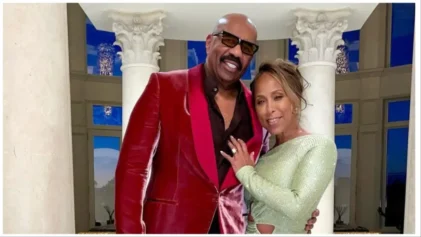
Steve Harvey lost two television jobs in four days in May 2019.
NBC’s own stations had signaled they were done with the first one eight months earlier. Harvey watched the industry shrug, then said almost nothing about it for seven years.
This week he finally explained it, sitting across from his own daughter.

And he did the thing famous people rarely when the subject is a network: say the boss’ name out loud.
What Harvey describes isn’t a ratings call or a scheduling squeeze. It’s a grudge — one conversation, one answer a network boss didn’t want, and a run of small slights he says told him what was coming.
At the time, nobody explained any of it publicly.
The 69-year-old turned up on the Sept. 17 episode of “Vault Empowers Talks,” the podcast hosted by his daughter Brandi Harvey, and walked back through the career that got him there.
He nearly didn’t have one. Harvey said producers handed him a tape of John O’Hurley’s “Family Feud.” He watched it at home and brought it back with a flat no, because he’d been told he couldn’t make fun of contestants.
“Y’all see what I do, I tell jokes,” he recalled saying. An executive producer talked the room into letting him try it his way.
The camera operator laughed too hard to shoot the test. When they asked how he’d stay funny across 200 episodes a year, his answer was two words. Pay me.
It worked. Harvey took over in 2010, and by early 2014 “Family Feud” was up 336 percent in households. He had passed both “Wheel of Fortune” and “Jeopardy!” in the demographic advertisers actually buy.
That was his leverage. What he says he did with it is what cost him everything.
NBC had “Celebrity Family Feud” once already. The network ran the first version in the summer of 2008 with Al Roker hosting, as part of its “All-American Summer” block, and canceled it in March 2009.
ABC revived it seven years later. Harvey took over as host when the second iteration premiered on June 21, 2015, and he has been credited as an executive producer on it since.
The format belongs to Fremantle, so Harvey was never shopping a show he owned. But by his account, he pushed for NBC to get first crack out of loyalty, since “Little Big Shots” was already there.
He said the network president waved it off and told him it would never work.
ABC took it, put it on Sunday nights, and, by Harvey’s telling, started beating NBC in the slot.
Then, he said, Paul Telegdy came back asking for a do-over. Telegdy had built his career running NBC’s alternative programming before rising to co-chairman of entertainment, and his own exit from the network was still a year away.
“Hey man, we made a mistake, can you switch the show from ABC to NBC,” Harvey recalled being asked. He said no. NBC offered to match whatever he was making. He said no again, because ABC had believed in it first.
“That moment right there, I saw it in his eyes, he hated me,” Harvey said. “That white man could not believe I told him no.”
Then the little things stopped. No birthday gift, he said. No Christmas basket, no cigars, nothing. All this from a network headquartered across the street from his own stage on the Universal lot. The stations had already lined up his replacement months earlier, but the formal word came that spring.
“In May, they made the announcement,” Harvey said, “and he said out of his mouth, ‘I’ll show him. I’ll take his whole TV career.'”
Both jobs went within days of each other. “Steve” was syndicated rather than an NBC series — distributed by NBCUniversal, airing on NBC-owned stations, with IMG holding the ownership stake Harvey had taken in 2017. It ended when those stations went to “The Kelly Clarkson Show” and no replacement slots materialized.
“Little Big Shots” was NBC’s own, and that call was NBC’s. Telegdy, then the network’s co-chairman of entertainment, publicly praised McCarthy’s “completely fresh perspective” and said nothing at all about Harvey
Online, the replies split immediately. “Ain’t ever seen a Black comedian name-drop an executive before. Steve Harvey a real one for that,” one user wrote. “Steve Harvey stays winning,” another posted.
“They cancel two of his shows, so he goes and does one show that he makes the same amount of money from, and gets to work way less.”
Another pointed out, “He [Telegdy] has forced out after all the allegations that came against him not too long after that.”
However, not everyone was moved. “Considering how he treated Mo’Nique on his show, I’m not moved by his comments one bit,” one wrote. A fourth pushed back on the whole framing: “Some of y’all act like he lost in this situation when he actually won.”
Harvey’s own ending backs that last one up. Freed of the NBC schedule, he built “Judge Steve Harvey,” which he owned and which premiered on ABC in January 2022. He said it paid him more than the talk show and “Little Big Shots” combined, because he could tape four in a day.
Telegdy’s ending went differently.
In, 2020, The Hollywood Reporter published an investigation built on interviews with more than 30 producers, executives and current and former network insiders, who described a workplace in which racist, sexist and homophobic behavior was, as one put it, par for the course.
The reporting followed a complaint Gabrielle Union filed that June over her time as a judge on “America’s Got Talent,” in which she said Telegdy had threatened her to keep her quiet during an investigation into the show’s workplace. NBC called that allegation categorically untrue.
Sharon Osbourne, another former “AGT” judge, told the outlet he had threatened her career in 2012 after she objected to the network dropping her son from a reality series. Telegdy denied her account through a spokesman. NBCUniversal opened an investigation.
His exit came within that week, in a restructuring that eliminated his role, and he denied the allegations, saying they flew in the face of everything he stood for.
Back on the podcast, Harvey kept circling the same theme; the formats he says slipped through his hands. He created “Steve Harvey’s Big Time” for The WB in 2003. The concept featured regular people, wild talents, judges, a host.
Then, ”America’s Got Talent” premiered a year later.
Harvey has previously said he believes the show took his idea and his producers, a point he reiterated in this interview.
“If I had been a businessman,” he said, “I’d be retired right now.”
“He hated me. That white man couldn’t believe I told him no.”
— The Art Of Dialogue (@ArtOfDialogue_) September 17, 2026
Steve Harvey says former NBC Entertainment chairman Paul Telegdy canceled his hit talk show “Steve” and removed him as host of the TV show “Little Big Shots” because Steve Harvey refused to bring “Celebrity Family… pic.twitter.com/Pk3gPb7Phy