A father has given a first-hand account of a near-death experience his daughter had at a local playground.
In a heart-wrenching video, Ngoc Anh’s young daughter stood at the top of a five-foot-tall play structure, gathering up the courage to go down the slide. Suddenly, an older boy behind her shoved her backward. She flew off the structure and hit the ground hard, suffering serious injuries.
After he rushed his daughter to the hospital, she was diagnosed with an orbital bone fracture and a hematoma on her head. Anh said he is praying for a quick recovery.
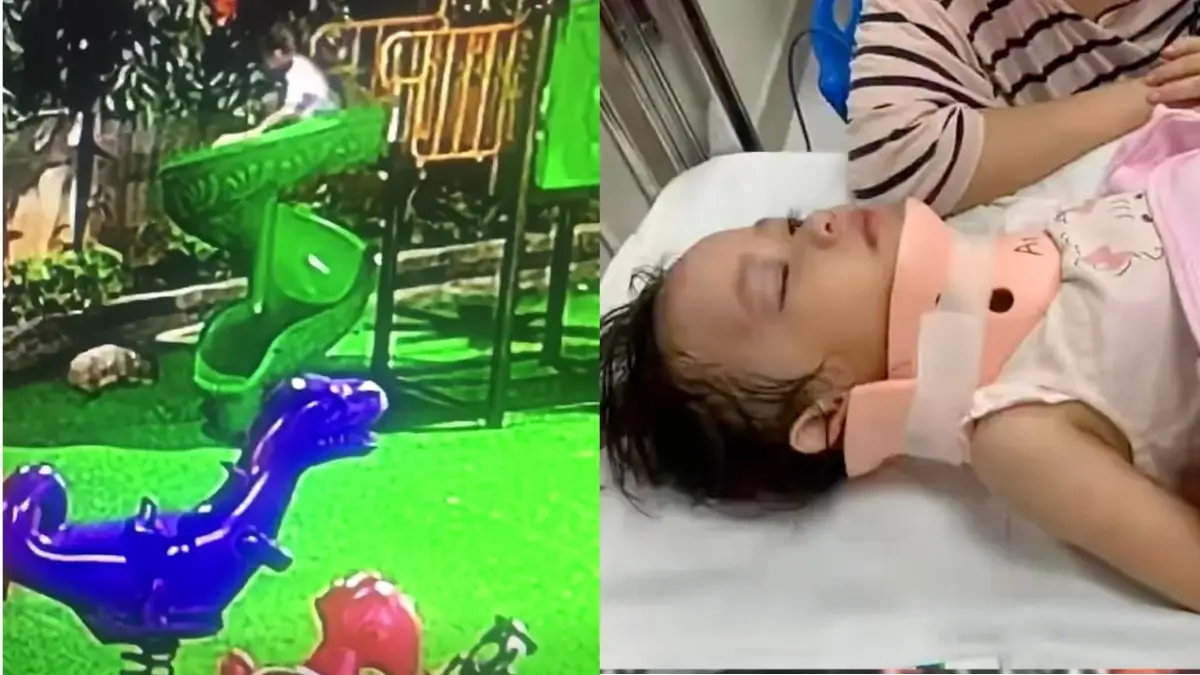
According to Anh, the boy has autism, and he blamed the parents for leaving him unsupervised. He shared his story as a call to action to all parents, himself included.
A little girl was happily sliding down the playground slide when a little boy suddenly charged at her and shoved her hard….The fall caused serious injuries: the girl had to be rushed to the emergency room and was diagnosed with an orbital bone fracture and a hematoma on her… pic.twitter.com/5GZ0W9xMt3
— LASHY BILLS (@LASHYBILLS) June 9, 2026
“Everyone understands that autistic children often have more difficulty controlling their emotions and actions than other kids. But precisely because their child is special, the parents and family must be even more responsible,” he stated in a June 8 post.
He said he also blames himself for not staying by his daughter’s side at the playground.
“No one has the right to use excuses like ‘the kid is sick’ or ‘the kid doesn’t know anything’ to justify neglecting supervision, sowing danger, and directly threatening the life of someone else’s child.”
Anh’s frustration reflects a tension that many families on both sides face at public playgrounds.
Research shows that aggression in autistic children is rarely intentional or manipulative, but is more often due to sensory overload, emotional dysregulation, or communication breakdowns. And playgrounds can be particularly overwhelming, with loud sounds, unpredictability, or crowded areas. It explains why incidents like this happen. But experts agree that parents and caregivers must be responsible for managing risk and supervising their children.
The incident did not stay between the two families for long. After the video went viral, commenters weighed in, showing little patience for playground aggression.
“Autism isn’t an excuse,” wrote one commenter. “I know many severely autistic people. They aren’t prone to violence unless they’re raised with no standards.” Another echoed the sentiment: “If your kid is handicapped enough that you will use that as an excuse, you best be watching and monitoring them.”
Others seemed to speak from personal experience. “We’re always expected to just accept the severe emotional snaps of autistic children around our kids,” one person wrote. “If we bring a concern to the parents it’s ‘well, they’re autistic’ as if it’s all fine. No. It’s not.”
Some responses crossed into anger. “I don’t know if I could hold back if that was my daughter,” one commenter wrote. “To almost have her paralyzed because of some punk a– kid. I don’t know, man.”
Judging by the comments, many parents feel they can’t say anything when a special needs child hurts their own child, as if the diagnosis ends the conversation.
But autism advocates argue that piling onto an entire community over one incident isn’t fair, especially when no one knows the full story of that family.
But Anh’s point is simple: whatever the diagnosis, the adults should have been watching.


