A Black woman who served 11 years in prison for murder was freed this week on bond after the Mississippi Supreme Court sided with a state appeals court decision that prosecutors had failed to prove she was guilty.
A jury convicted Tameshia Shelton in 2015 of fatally shooting her youngest sister’s 21-year-old boyfriend, Danelle Young, despite evidence suggesting he died by suicide. Shelton turned 48 on the day of her release.
The Mississippi Court of Appeals reversed her conviction and granted Shelton a new trial in December 2025, finding that Shelton’s trial lawyer, Rod Ray, failed to introduce Young’s apparent suicide note as evidence.
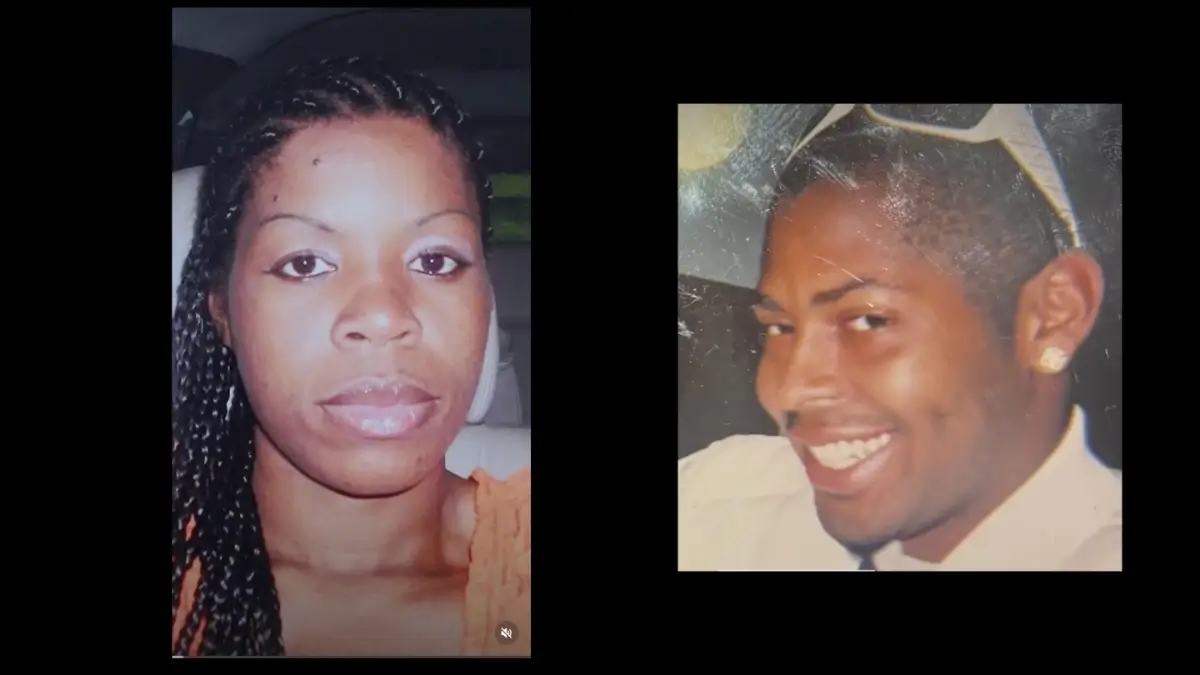
The appeals court also ruled that the lower court erred by denying Shelton relief after a forensic expert revised his opinion. The expert had previously testified that Young’s death was a homicide but later concluded he was wrong, determining that the manner of death was “undetermined, but leaning towards suicide.”
The district attorney has not yet said whether he intends to pursue a new murder conviction against Shelton.
“This nightmare is close to finally being over,” her middle sister, Shenikia Shelton, told Mississippi Today after the Supreme Court’s ruling on June 6. “The missing piece of our family’s puzzle is about to be home.”
A Lovers’ Spat and A Shot In The Dark
The “heartbreaking case” began on Oct. 16, 2009, when 22-year-old Ketina Tutton, Shelton’s younger sister, had an upsetting discussion in her car with Young, her boyfriend who was visiting her in Mhoon Valley in rural Clay County from his home in Forest, Mississippi, about two hours away. According to her appellate filings, Tutton told Young that she had just been hired for a job and would not be moving in with him in a couple of months as they had previously planned.
Tutton then went to her mother’s trailer, and Young went to his older sister Tameshia’s house nearby, where he was staying (because her mother didn’t want the unmarried couple to sleep together in her house).
Later that evening, when it was dark, Young walked over to Shelton’s trailer, knocked on her window, woke her up, and asked her to borrow her handgun to kill a raccoon in a tree, Shelton later told police. He said that he needed only a single bullet.
Believing that it would take more than one bullet to kill a raccoon, Shelton said she loaded her .22 revolver with six bullets, walked to the front door and handed it to Young, asking him to show her the raccoon after he shot it.
Instead, “Young fired a single gunshot to his left chest fired from less than an inch away,” Shelton’s attorneys argued.
Shelton told police she had heard a single gunshot, went outside and found Young lying under an oak tree. In her 17-minute-long call to 911, she begged for help to save his life, and mentioned their discussion about hunting a raccoon, according to her court filing opposing the state’s effort to challenge the Supreme Court’s December ruling. Shelton thought Young had tripped and accidentally shot himself at the time.
A Bombshell Piece of Evidence Never Presented At Trial
Shelton later found an apparent suicide note to her from Young left in a baby book in her home, in which he thanked her for being good to him, spoke of his love for her sister, and wrote, “I have no life without her. These are my last words. … Tell (your daughter) Treasure about me one day. Bye.Bye. ”
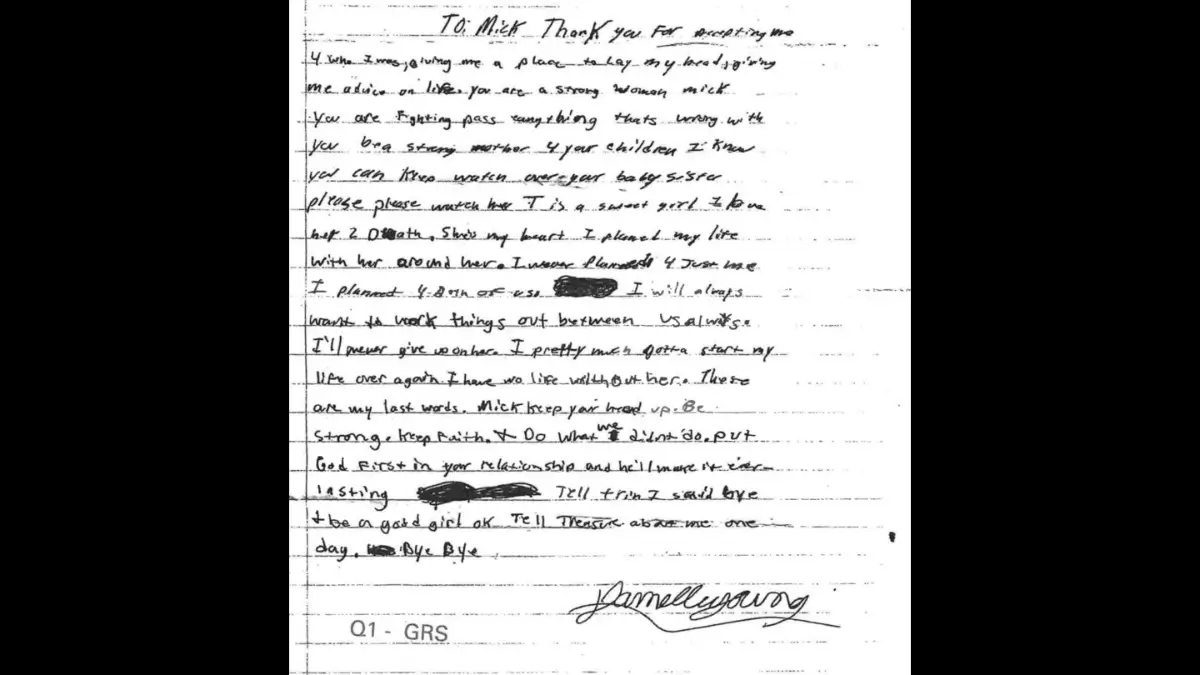
Her defense lawyer did not submit this “potentially exculpatory” letter at her 2015 trial nor seek expert witnesses to determine whether it was in Young’s handwriting. This led the state appeals court to determine Shelton’s attorney had provided ineffective legal counsel.
A Pathologist Admits a Grave Error
The other key ground for overturning her guilty verdict was the reversal of opinion by forensic pathologist Dr. Liam Funte, who originally testified that the manner of death was homicide, based on his autopsy finding of the bullet trajectory through Young’s left chest: straight and down.
Funte originally told a jury that the bullet would have deviated to the left or right if Young had held the gun barrel to his chest because the wrist would constrain a self-inflicted gunshot from going straight.
In May 2021, 12 years after Young’s death, Funte said that having gained more experience in examining suicidal gunshots to the left chest, and from reviewing scientific literature, he now knew that a small handgun fired straight into one’s chest could produce the path of the bullet and the fatal injuries he found in Young.
“I now regard my determination of the manner of death of Danelle Young to be in error … I see no evidence to support homicide,” he attested in an affidavit.
‘Damning’ But Misleading Gunshot Residue Evidence
With no eyewitnesses, the case against Shelton was largely circumstantial, and the grand jury under the former District Attorney did not indict her until April 2011, nearly 18 months after the incident.
It took another four years for prosecutors to bring the case to trial, in part due to systemic scheduling bottlenecks in the 16th Judicial District, and in part because investigators struggled to find compelling forensic evidence to sway a jury.
Besides their flawed thawed theory about the bullet trajectory, the prosecutors used gunshot residue tests to support their case that Shelton shot Young.
Prosecutors told jurors they found one microscopic gunpowder residue particle on the back of Shelton’s hand and four particles on her palms. Investigators also found gunpowder residue on her pajamas.
Young had five particles of gunshot residue on the back of his right hand.
A state crime lab expert, Jacob Burchfield, testified that people can get gunshot residue on their bodies or clothing in three ways: by handling a fired gun, firing a gun, or standing within two to three feet of a gun when someone fires it.
Shelton told deputies she had fired the gun she gave Young earlier in the week to scare a bulldog chasing her nephew, and had handled the gun when loading bullets into it that night, but prosecutors said she was just trying to cover up her crime.
Assistant District Attorney Scott Rogillio told the jury in his closing argument, “Think about the gunshot residue on him. It’s on the outside of his hands. …Somebody shoots a revolver, according to crime lab experts, you would expect …they would have a lot on them. …He didn’t fire the gun.”
In her appellate brief, Shelton’s legal team argued that her trial lawyer Ray had not interviewed Burch or any independent firearms expert who could have countered the prosecution’s arguments.
At a post-conviction evidentiary hearing, gunshot residue expert Crystina Vachon testified that the number of particles does not tell you whether particles were the result of a self-inflicted gunshot or a gun fired by another. She also noted that gunshot residue particles “are typically found on the backs of the hands of the person who fired the weapon.”
Shelton’s attorneys argued on appeal that Ray’s failure to contest the inconclusive gunshot residue evidence at trial (because he believed it was “damning” to Shelton and needed to avoid it, he later testified) was “clearly prejudicial” to her case.
The prosecution never presented a motive for why Shelton would have killed Young.
The Courts Side With Shelton
The Mississippi Court of Appeals found in its 7-3 decision issued on Dec. 15, 2025, that Clay County Circuit Court Judge James Kitchens, Jr. had “clearly erred” in 2024 when he found that Funte’s change of opinion about the manner of death “did not merit relief” and denied her a new trial. It held that prosecutors had failed to prove Shelton was guilty of murder “beyond a reasonable doubt” and vacated the lower court’s decision, remanding the case back to the circuit court.
On June 4, 2026, the Mississippi Supreme Court declined to disturb that appellate court’s decision in a 6-1 vote, clearing Shelton’s path to a new trial.
“We’re very pleased,” one of Shelton’s attorneys, Sandra Levick of the Mississippi Innocence Project, said of the Supreme Court decision. “We look forward to Ms. Shelton returning to Clay County where justice can finally be done.”
Shelton’s attorneys are now asking Circuit Judge Kitchens to dismiss the indictment.
Awaiting A Trial Decision From A Sympathetic DA
Scott Colom, the district attorney for Mississippi’s 16th Judicial District, has not yet publicly stated whether he would prosecute the case again. He previously told Mississippi Today that if the case were returned to his office, he would “look at what the facts show and do justice.”
After reviewing her case at the urging of Shelton’s family in 2018, Colom began to have questions, telling the news site, “The evidence sounded thin. There was not much motive.”
If Shelton were truly guilty of murder, he testified at a 2022 hearing, “Why would somebody call 911 and stay on the phone for, I think it was 17 minutes, begging people to come to the scene to talk to the one person in the world who could say who did or who did not do it?”
Colom later reached out to the Mississippi Innocence Project to look into Shelton’s case and wrote a sworn statement in support of a hearing to determine if she deserved a new trial.
If Shelton’s indictment is dismissed, she would become the seventh person prosecuted in the state’s 16th Judicial District to be exonerated of murder — the most of any district in the state, according to an analysis of data from the National Registry of Exonerations by Mississippi Today.
Like Shelton, prosecutors charged all six previous exonerees under former District Attorney Forrest Allgood, who retired after losing his 2015 reelection bid to Colom.
After officials released Shelton from the Clay County Detention Center on a $50,000 bond Monday, her family, including her four children, greeted her with party blowers, a teddy bear, and hugs.
She celebrated her freedom and her 48th birthday with Popeye’s chicken, hot sauce and white bread.
“I felt numb before, but now it feels real,” she said.


