Donald Trump has not appeared to be at his sharpest since returning to the public eye following his recent medical checkup.
In several appearances, observers have noted what looks like a more swollen face, a voice that occasionally cracks, and moments where his words seem more difficult to make out than usual.
The changes have fueled fresh speculation about his health as the 79-year-old president resumes a busy public schedule.

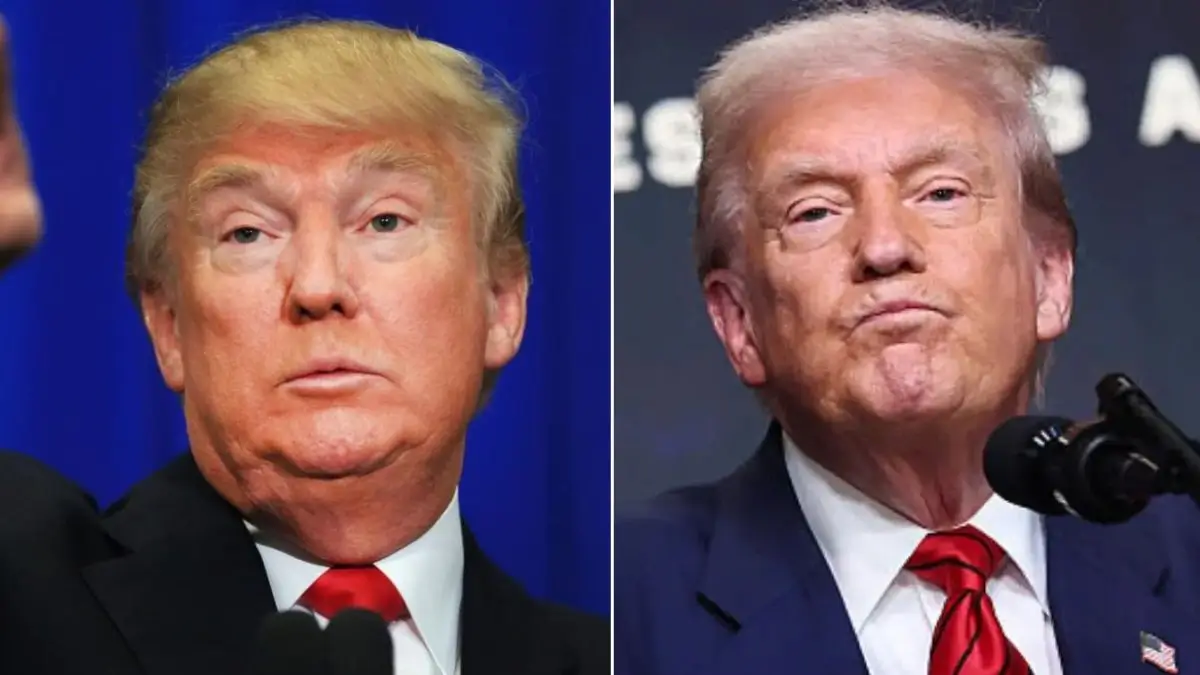
Lately, however, observers have noticed the once-bright blond hair looks increasingly gray with each public appearance.
Trump’s famous blond comb-over doesn’t appear as full as it once did.
Recent photos have convinced social media users that his hairstyle is telling a story all its own.
A new health disclosure has people paying less attention to the fine print and more to what’s happening at the top of their heads.
Critics now believe Trump’s hair may have gotten the memo first after a recent comparison.
While doctors caution against diagnosing anyone from photographs, a newly reported omission from Trump’s medical records has given critics fresh ammunition.
According to a recent Washington Post report, finasteride — the hair-loss drug Trump has relied heavily on for years — quietly disappeared from his official medical disclosures.
To choose how much Trump’s hair has changed in years, the outlet compared two images of Trump’s hair from 2016 to 2025.
The difference was drastic.
The revelation comes as questions surrounding the president’s health continue to mount ahead of his 80th birthday on June 14.
Finasteride, sold under the brand name Propecia, is one of America’s most common hair-loss treatments. Millions use it to slow male-pattern baldness. Trump’s connection to the drug first became public in 2017.
That disclosure happened unexpectedly.
After questions emerged about Trump’s unusually low PSA levels, his longtime physician, Harold Bornstein, revealed that the future president was taking finasteride.
The medication later appeared again in official health disclosures.
In 2018, White House physician Ronny Jackson publicly confirmed Trump took one milligram daily, according to The Asia Business Daily.
Presidential physician Sean Conley reaffirmed that information in 2020. Three separate doctors acknowledged Trump’s use.
Then the medication vanished.
Trump’s "hair" hanging on for dear life 🤣 pic.twitter.com/BhuMuUsBDZ
— Wu Tang is for the Children (@WUTangKids) April 25, 2026
The drug was not listed after Trump’s reelection. It also failed to appear in the latest medical report released following his recent Walter Reed examination. Instead, the report listed cholesterol medications rosuvastatin and ezetimibe, along with aspirin for heart health.
White House physician Dr. Sean Barbabella concluded Trump “remains in excellent physical health.”
The report reignited accusations that White House doctors have long painted overly flattering portraits of Trump’s condition.
One Yahoo News commenter wrote, “Trump’s medical records are doctored.”
Another said, “His hair is noticeably thinner now than in his first term so perhaps he is no longer taking it.”
Others mocked the hair controversy directly, wondering if he “substituted for weave and plugs.” Some even said it looked like a “bad rug on ‘his’ head?!”
“Well it doesn’t work because if you see him in the wind, the long comb over hairs blow away and reveal a bald, pink scalp,” noticed one observer.
The White House declined to clarify whether Trump still takes finasteride, saying only that medications deemed clinically relevant were disclosed.
That explanation raised concerns among medical ethicists.
“It raises important questions about what else is not being disclosed,” Columbia University bioethics expert Robert Klitzman told reporters.
Arthur Caplan, founder of New York University’s bioethics program, was more direct.
“I do not trust the health reports released by the White House,” Caplan said, calling for independent evaluations.
Dermatologists stress that hair alone proves nothing.
George Washington University dermatologist Adam Friedman explained that finasteride helps preserve existing hair and that significant loss can occur after discontinuation.
The speculation comes as Trump continues boasting about his “perfect health.” Critics recently seized on plans for a White House expansion with advanced medical facilities, questioning why they’re needed at all.
Health questions have followed Trump throughout his second term.
Photographs showing his bruised hands triggered just as much concern as his swelling ankles or face.
Last month, another medical report intensified scrutiny.
View on Threads
Trump’s latest physical listed him at 75 inches tall and 238 pounds — a 14-pound increase from earlier figures. Critics questioned how his reported measurements remained relatively stable despite visible aging.
Someone else added, “TACO’S combover starts at the back of his bald head held in place by a case of Aqua Net.”
Despite the jokes, experts caution against drawing conclusions.
Friedman emphasized that medication use can’t be determined simply by looking at someone’s hair.
Still, the timing has sparked curiosity — Trump spent years taking a drug designed to preserve hair, the medication suddenly disappeared from public records, and many observers believe his hair appears thinner. Whether those developments are connected remains unknown.
The White House is staying silent, and that silence may be generating more questions than answers.


