Defense Secretary Pete Hegseth has been trying to project strength at a moment when the ground keeps shifting beneath him — but to many watching, it’s starting to look less like control and more like a leader chasing a narrative that won’t stay put.
With President Donald Trump veering between threats of total destruction of Iran and sudden pivots toward negotiation, even the most disciplined message risks falling apart in real time as the pressure is closing in on Hegseth.
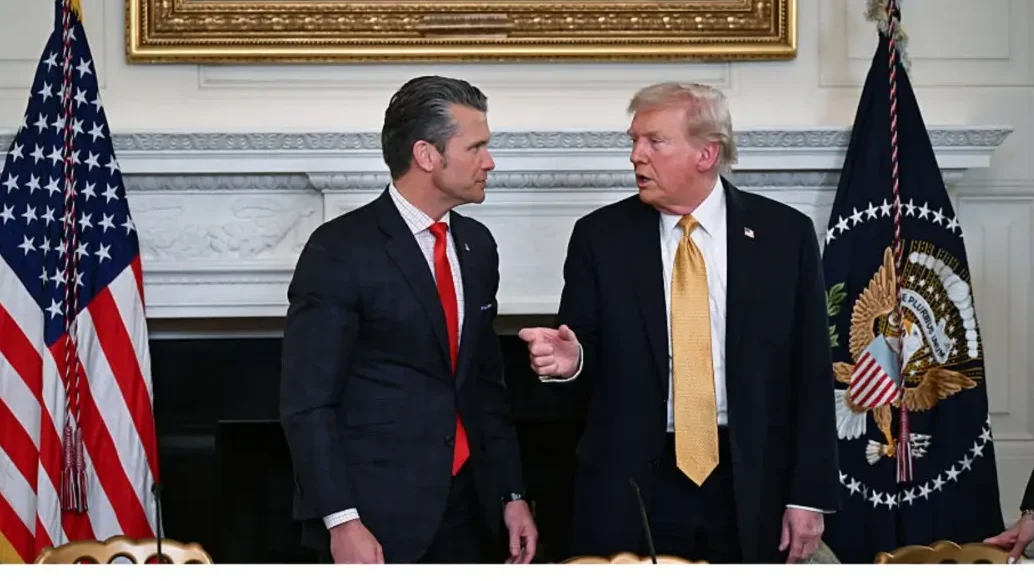
Just hours after threatening to wipe out Iran’s “whole civilization” if it failed to reopen the Strait of Hormuz, Trump abruptly pivoted, announcing that his administration had tentatively agreed to a 10-point ceasefire plan proposed by Tehran, a deal that would halt U.S. attacks, lift sanctions, and allow Iran to retain control of the very waterway Trump had just threatened to destroy over.
Against that reversal, Hegseth, who has already been engulfed in mounting political backlash, stepped to the podium Wednesday morning and tried to sell the moment as something else entirely, a win.
“Iran begged for this ceasefire, and we all know it,” Hegseth insisted during a tense Pentagon briefing, framing the agreement as a military victory despite terms that appeared to directly contradict the administration’s stated war objectives.
The claim was immediately met with ridicule.
Iranian military spokesperson Ebrahim Zolfaghari described the same deal as “a great victory” that forced the United States to accept Tehran’s plan, undercutting Hegseth’s narrative in real time and intensifying scrutiny around whether the defense secretary was now trying to spin his way out of a rapidly collapsing situation.
That scrutiny did not emerge in a vacuum.
In the days leading up to the ceasefire announcement, Hegseth had already become a central target of outrage over the administration’s handling of the conflict.
Arizona Democratic Rep. Yassamin Ansari publicly accused Trump of escalating what she called an illegal war and warned that Hegseth was “complicit,” going as far as announcing plans to introduce Articles of Impeachment against him.
She argued that only Congress has the authority to declare war and cited what she described as reckless endangerment of U.S. servicemembers and alleged attacks on civilian infrastructure as grounds for removal.
The impeachment push quickly fueled speculation that Hegseth’s position inside the administration was becoming increasingly unstable.
By Wednesday, that pressure appeared to follow him straight into the briefing room.
Online, critics piled on almost immediately after his remarks.
“The gaslighting stopped working,” wrote political commentator Brian Krassenstein, while others mocked the briefing as “Operation Wishful Thinking.”
Another observer pointed out that Iran stood to gain sanctions relief and maintain control over a critical oil route, while the United States absorbed massive costs, raising further questions about Hegseth’s insistence that the outcome was a decisive victory.
“Sorry, no one believes you! You attacked Iran two times during the negotiations… You lied hundreds of times since the beginning of this war… And you are continuing to lie again and again…” another person wrote.
But Hegseth’s attempt to project control was already starting to crack — just not in the way he likely expected.
Days earlier, a newly released Iranian propaganda video had quietly begun circulating before suddenly gaining traction online, drawing attention far beyond its initial rollout. Critics say Iran and its supporters have been winning the messaging battle, and this latest video only added to that perception.
The video appeared tailored specifically for the Defense Secretary, zeroing in on some of the controversies that have followed him, including allegations of drinking on the job, past personal conduct issues and claims of a toxic work environment.
And as the clip spread, so did the reaction.
“Ouch!!!!!! The Iranians are good at this!!” one viewer wrote on Youtube.
“This is a level of military strategy that we never expected from Iran. The amount of views these are getting is staggering!” another added.
“Portrayal of trump blowing bubba is diabolical,” another mocked.
Back inside the room, the tension became harder to mask.
When a reporter pressed him on conflicting reports, including continued Iranian strikes despite the supposed ceasefire, Hegseth’s composure visibly slipped.
“What we know is that Iran is gonna say a lot of things,” he said, before growing irritated as follow-up questions cut through his talking points.
“Excuse me? Why are you so rude?” Hegseth snapped at one reporter who interrupted to ask about ongoing missile fire. “Just wait, I’m callin’ on people… so nasty.”
By Wednesday afternoon, hours after Hegseth’s rant, Iran accused Israel of blowing past the very ceasefire framework Trump just announced, claiming Israeli forces have continued strikes tied to the conflict with Hezbollah in Lebanon.
At the same time, Tehran pointed the finger at Washington, alleging the U.S. has already violated multiple provisions of the agreement it helped broker.
According to Iranian state media, officials threatened to escalate, saying Tehran could suspend tanker traffic through the Strait of Hormuz and is actively weighing whether to walk away from the deal altogether over Israel’s actions.
At the White House, press secretary Karoline Leavitt pushed back, saying Trump has been briefed on reports that the strait had already been shut down, but insisted those claims “are false.”
Meanwhile, the situation on the ground appears to be moving in the opposite direction of any so-called ceasefire. Fresh attacks hit U.S. allies in the Persian Gulf early Wednesday, just hours after the announcement, followed by reports of explosions on two Iranian-controlled islands, raising new questions about whether the agreement is already unraveling before it ever fully took hold.


