President Donald Trump thrives in unscripted moments. He barrels through his remarks with the confidence of someone who assumes the room is with him. But sometimes the line that gets a grin in the moment is the same one that starts circulating long after the event ends.
Speaking at an event at the White House, Trump was in full tough-on-crime mode, knocking Democratic leaders and talking about what happens when cities don’t cooperate — before reaching for a phrase about having to “force ourselves upon them” that hit differently in the moment, drawing murmurs in the room and quickly ricocheting online.
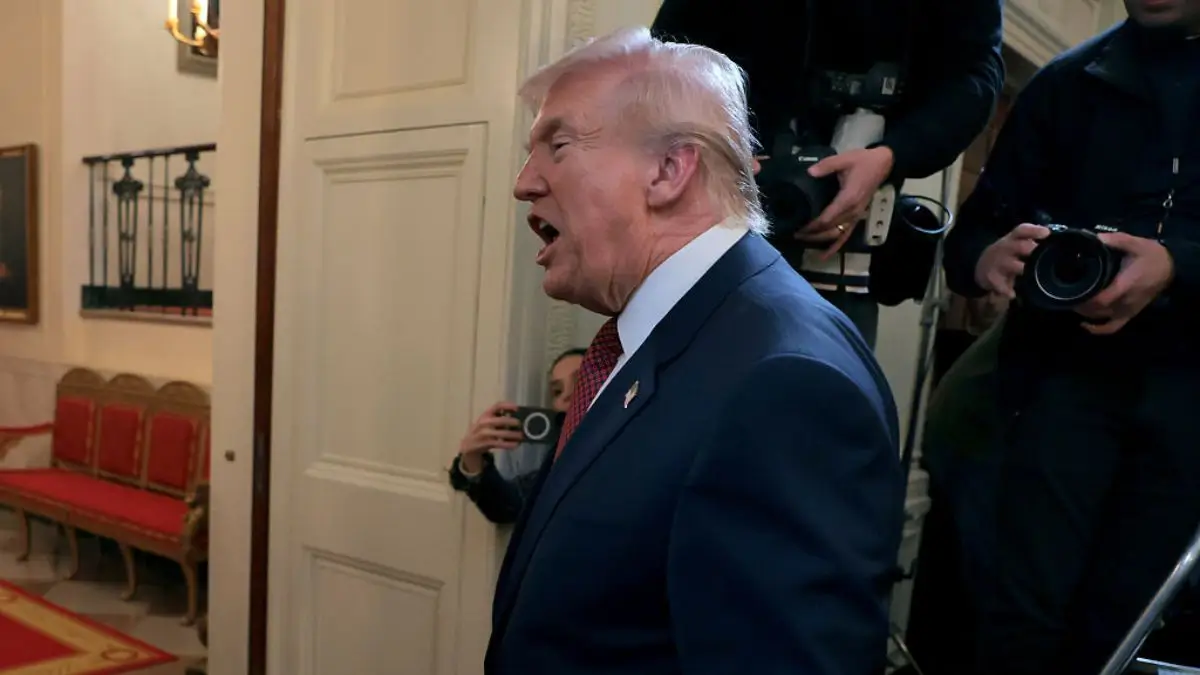
Immigration enforcement, he said, is not welcomed in blue states. “Sometimes we have to force ourselves upon them because they’re so bad, and I don’t even think they realize what’s happening to their cities.”
In a room full of people at a Black History Month event, the president said the quiet part out loud — as if “force ourselves upon them” was just another tool of presidential power.
The Freudian slip set off a wave of alarm not simply because he floated sending troops into American cities again, but because of how comfortably he framed federal help as something imposed and consent as an obstacle to blast through.
With the latest Epstein files reviving allegations of sexual abuse that the Justice Department claims are unfounded, critics say Trump’s language has taken on a darker edge.
Trump made the comments while railing against what he called “radical left lunatic Democrats,” insisting that cities run by them are spiraling and secretly begging for executive intervention.
“We’re saving thousands and thousands of lives in many cities and frankly, if these radical left lunatic Democrats would come and say ‘please help us, please,’ we’d stop crimes all over the place and we’re doing it in a lot of a lot of cities,” he said, before adding his “force ourselves” comment.
Online, the reaction was brutal.
One user simply reposted the line — “sometimes we have to force ourselves upon them because they’re so bad.” — and followed it with, “…. Yup, he did whatever those files said..”
View on Threads
Another wrote, “This speaks absolute VOLUMES about his slimy character.”
A third reaction went further, casting Trump’s posture as that of someone who believes the rules do not apply to him.
“There is no subtext left here. ‘Sometimes we have to force ourselves upon them because they’re so bad’ is the worldview of an abuser. Power as entitlement, consent as obstacle, refusal as justification. If this still does not register as dangerous to you, you are choosing not to see it.”
Trump didn’t stop there, turning his focus to Atlanta as a showcase for what he described as federal muscle waiting to be deployed.
“You need help in Atlanta… we could take care of Atlanta so fast,” he said, mocking local leaders for not calling him while boasting that his administration would “go in” as “tough guys,” “move people out,” and remove “career criminals” by sending them “back to the country from where they came.” Making promises framed as swift salvation, delivered with unmistakable bravado.
The comments suggested a familiar mix of crime control and immigration enforcement — National Guard troops, federal agents, possibly Immigration and Customs Enforcement — deployed into cities that have not asked for them.
Trump has already sought to use the National Guard and active-duty soldiers in Democratic-led cities, including Washington, D.C.; Los Angeles; Chicago; Portland, Oregon; and Memphis, Tennessee. He has also threatened similar interventions in Baltimore, New York, New Orleans, Oakland, San Francisco and St. Louis.
Those efforts are rooted in Trump’s long-running desire to use the military as a domestic police force, a move that collides with the country’s democratic tradition of keeping soldiers out of routine law enforcement.
In Oregon, Attorney General Dan Rayfield this week marked the end of a long legal fight over Trump’s attempt to deploy federal troops to Portland, after the administration dropped its appeal of a permanent injunction blocking the move. Rayfield called the outcome a “win for Oregon,” saying it showed that “no one is above the law” and that the state would not serve as a proving ground for unchecked federal power.
A federal judge agreed, finding “no credible evidence” that the unrest justified military intervention, and Gov. Tina Kotek later confirmed the remaining Guard troops had been ordered home, calling Trump’s effort a “gross abuse of power” and a failed test of constitutional limits.
According to Democracy Docket, Trump has relied on two statutes to do it. Under Title 10, the president can federalize National Guard troops during invasion, rebellion, or when laws cannot otherwise be executed — authority Trump has used to pull Guard units from states like California, Oregon, Illinois and Texas, sometimes sending them across state lines.
Under Title 32, governors activate Guard troops for federally funded missions while retaining command, a workaround that has allowed soldiers to assist law enforcement in some cases.
Hovering over everything is the Posse Comitatus Act, a nearly 150-year-old law that bars the use of active-duty military for civilian policing. Courts have found that Trump pushed past that line. A federal judge has since ruled that his administration violated the law by using troops to directly support arrests, establish perimeters and roadblocks, and even detain civilians.


