For better or for worse, Tyler Perry stands by his work and the stories he tells about Black women in his movies. Despite years of criticism over how he portrays their pain, trauma, and relationships, the Emmy-winning filmmaker has remained unapologetic about his creative choices.
In many of his films, the Black female characters he creates deal with domestic abuse at the hands of their spouse (“Madea’s Family Reunion”). In many of his stories, the women are barely scraping by like the lead character in his new film “Straw.”
Taraji P. Henson stars as a struggling mother living in poverty with a sick child, who was accused of robbing a bank after she brings a gun in a desperate attempt to force employees to cash her check.
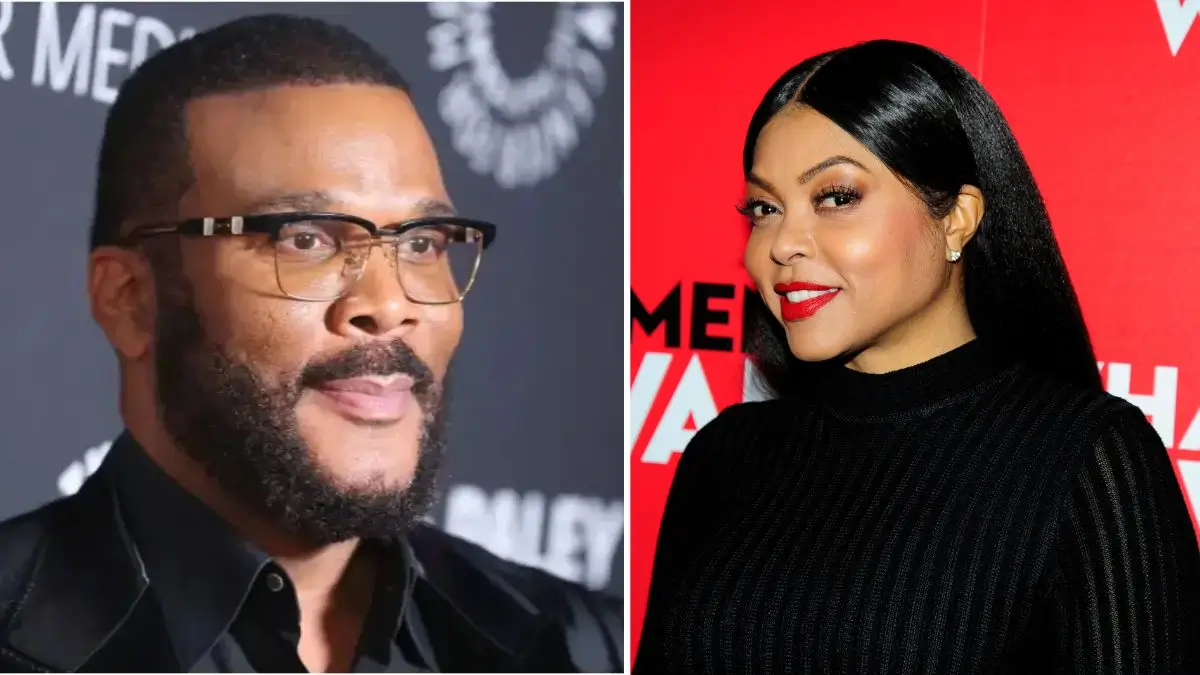
(Photo by Paul Bruinooge/Patrick McMullan via Getty Images)
Immediately Perry got complaints from the public for continuing this theme of a hard life for his Black female leads. The “Diary of a Mad Black Woman” writer and director responded before to these protests about his work. When asked again how he would respond to people opposing his films and shows, he stood firm—defending his work and the stories he chooses to tell.
“I say nothing to those people who think that my films focus on the struggle of Black women because they’re right. It does,” he admitted while speaking with True Love Magazine in a video shared on Instagram on June 8.
“Let me tell you something if I get an opportunity to put a Black woman on screen for people to see them in love, in happy, in joy, in pain, in struggle what I’m doing is a service to all people so that people will know that Black women are not just strong in one thing. They are all things. They go through all of these different things.”
Perry said he will never miss an opportunity to show “all sides” of Black women by “paying homage to my mother, to my aunt, to my sisters, and friends and cousins and the things that they went through.”
Both Perry and his mother Maxine suffered abuse at the hands of his stepfather Emmitt Perry. In 2020, he revealed that he felt “relieved” to find out he wasn’t biologically related to Perry Sr., the alcoholic construction worker he had believed was his father for years. At 41, a DNA test with his brother confirmed the truth, unraveling a belief he had carried his entire life.
Two years ago, Perry, 55, put out a documentary called “Maxine’s Baby: The Tyler Perry Story” where he revealed that despite having no relationship with Emmitt now, he still supports him financially.
While Perry may have many people who dispute his projects, it’s proven that he still has a lot of supporters as well. Just one day after “Straw” premiered on Netflix, the movie became #1 on the streaming services’ top 10 movie list.
Tyler Perry put every black struggle within the first 20 mins of #Straw
— kitaboots ♉️🇭🇹🇯🇲 (@kitaboots) June 6, 2025
~ single black mom
~ low income housing
~ eviction
~ low paying job
~ WIC/Food Stamps/First of the Month
~ expired car registration
~ Child Protective Services
~ shitty boss
~ armed robbery by yns
She previously worked with Perry’s other #1 movies, 2009’s “I Can Do Bad All By Myself” and 2018’s “Acrimony,” where she respectively played a drug who lost her mom and sister to become a foster parent and a woman scorned who stalks and nearly kills her ex-husband and his new wife when he becomes successful after she spent her whole life supporting him.
Therefore working with Perry again was a no-brainer.
“STRAW is finally out on @Netflix and it’s a ride. Raw, real, and rooted in truth. I poured my whole heart into this role— every scream, every moment — and so did this incredible cast,” Henson wrote about the film on Instagram.
The Neighborhood Talk reposted Perry’s response to the backlash about the film and fans further supported him in the comments.
One person said, “I am a black woman who has suffered. If no one else, thank you for telling my story, Mr Perry.”
Another wrote, “We suffering in real life he just brings light to our situations.”
A third said, “He’s spoken on this before. If you don’t like his storylines, it’s simple: don’t watch.”
i just watched #straw and now granted—it is good and taraji’s performance was 10/10—but tyler perry’s obsession with seeing black women struggle in his films needs to be unpacked
— . (@maybetylerornot) June 7, 2025
A fourth offering a slightly different perspective said, “That’s fair butttt it’s just as important to give young Black girls empowering representation in your films… something they can truly look up to.”
However critics were not so nice writing, “Tyler Perry and another black women struggle movie, aren’t y’all sick of this narrative?”
Another wrote, “I just watched #straw and now granted—it is good and Taraji’s performance was 10/10—but Tyler Perry’s obsession with seeing black women struggle in his films needs to be unpacked.”
Both Perry and Henson have celebrated with written messages on Instagram to their followers. Talk show host Sherri Shepherd, who plays a role opposite Henson, expressed her gratitude for the film’s success despite the criticism online.
“I woke up this morning to the news that “Straw,” my movie with Taraji P. Henson and Teyana Taylor, is #1. And it looks like God is in the global business too because I saw in the UK it’s #1. I’m so incredibly grateful,” Shepherd said in a video.
“I’m so excited. You know as a comic, who – I make my living making people laugh, to do drama and step out of my comfort zone, like I’m thankful that Tyler Perry gave me a starring role and believed in me enough to cast me in the movie and trusted me enough to be able to play my character.”
“Straw” is available only on Netflix.


