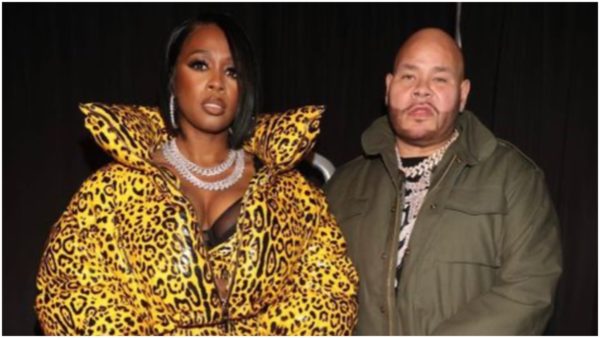
Remy Ma and Fat Joe’s pockets are staying all the way up after their recent court victory.
For the past two years, the New York rappers have been caught up in a lawsuit claiming they stiffed Eric A. Elliot, the co-producer of their 2016 hit “All The Way Up,” out of proper compensation and ownership rights. But, just days into the new year, a federal judge sided with the rappers citing that not only was compensation paid, but that any ownership rights were forfeited at the time of payment.
“Elliott’s retrospective frustration at the amount of money notwithstanding, there is no dispute that Elliott signed the contract, assigning his rights to the song, while simultaneously receiving the $5,000 check from Fat Joe in exchange,” ruled U.S. District Judge Naomi Reice Buchwald on Jan. 8.
Elliot, rap alias Fly Havana, claims he and rapper Infrared put the record together in 2015. Though still unfinished, Elliot alleges he gave the record to Infrared, who then introduced him to Fat Joe. To Elliot’s knowledge the record had not made it any further, at least not until the following year when he heard it blasted on every radio station as the street anthem throughout the spring and summer months.
In an attempt to receive compensation and credit for his contributions to the record, Elliot claimed he contacted the Terror Squad leader, who agreed to meet at a Miami IHOP. He alleges it was there that Fat Joe had him sign a document before writing a check for $5,000 with the guarantee of more money to follow as the record continued to grow bigger — but more money never came.
Despite Elliot’s disapproval of the $5,000 he received two years ago, Judge Buchwald made it clear in no way would he be entitled to future funds. “Try as he might, Elliott cannot avoid the clear and plain language of the contract that no additional compensation will be due to Elliott,” the judge wrote. “Any alleged statements regarding future or additional compensation are explicitly contradictory to these specific and unambiguous provisions of the contract.”
The record, which also features rapper French Montana, peaked at number 27 on the Billboard “Hot 100” chart and even got the attention of Jay-Z who made an appearance on the remix. However, when it comes to people taking credit for the hit record, the plot quickly thickens. In 2017, producing duo Cool and Dre spoke with Billboard about how the record came to fruition.
“We had the beat sitting for a little bit and then we had a session with Joe. Joe had been coming to the studio and he was like, ‘Play me some new vibes.’ We played him the joint, and Joe was like, ‘That’s it right there,’ ” Cool recalled. “We just thought it was a hot joint. Joe definitely heard something that we didn’t hear in the beginning process. Then, once we heard he hooked up with Infared and they put the hook on it, me and Dre were still kinda like, ‘I don’t know, man.’ ”
Dre added, “He [Joe] knows when he hears a hit. When he heard the hook he was very animated about it. He was like, ‘Yo, this is gonna be bigger than Lean Back.’ ” The producing duo would go on to receive Grammy nominations for the record [2017 Song of the Year] alongside Fat Joe, Remy Ma, French Montana and Infrared being nominated for Best Rap Performance.
More Stories from Our Partners:
‘You Gotta Listen to the OG’: Nick Cannon Credits This Famous Friend for Helping Him End Eminem Beef


