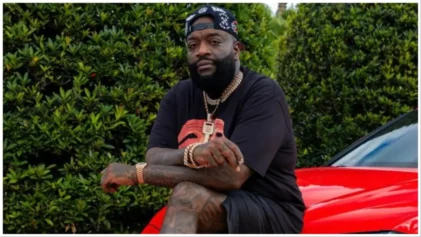
When he’s not on tour or writing a book, rapper Rick Ross can be found riding around on a massive industrial size tractor cutting the grass of his 280-acre estate in the Atlanta suburb of Fayetteville, Georgia.
The seemingly daunting task could be more described as a relaxation session for the “Lemon Pepper” rapper who told Rolling Stone during a recent interview that “it’s something I look forward to.” He added, “I have my window tinted. No one knows it’s Ricky Rozay, the biggest boss. AC’s down to 68 degrees, and I’m cutting. I’m looking for anything on the lawn that’s standing out or looking obnoxious.”

However, Ross’ having the means to purchase such an extravagant estate and personally cutting the massive lawn himself appears to be a full-circle moment for the Miami-raised emcee, whose earlier jobs found him cutting grass for residents in his Carol City neighborhood.
“In my Black community, you made paper if you had a successful landscaping company,” the Grammy Award-nominated artist told the outlet. “I knocked on your mom’s door and told her if she had $5 I’d cut the grass in the front — just not the back, because I was afraid of snakes.”
Although he isn’t required to do his own housekeeping, the “Money Dance” rapper doesn’t appear to have strayed away from his childhood values. “If I had to cut every yard on the block to put some money in my pocket, I’m with it,” he added. “ I’m still that same dude. That’s why I’m still doing it.”
In June, the “Hustlin’” rapper told Forbes it cost nearly seven figures a year to keep up with the large property that was once owned by boxing legend Evander Holyfield. Ross purchased the place in 2014 for $5.8 million. Holyfield reportedly spent $20 million building the estate.
“Locals would see me walk out of a restaurant and scream, ‘You know Holyfield spent $1 million a year to cut the grass.’ So I decided that I was gonna cut my own grass. And that’s what I did,” he explained.
Ross customized the tractor with tinted windows and it even comes with air conditioning, allowing him to peacefully complete what he told the publication is roughly a five-hour job.