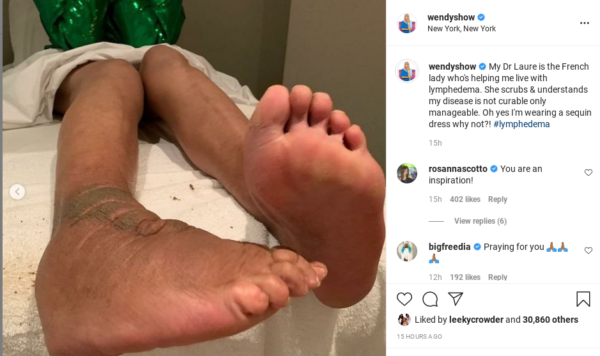
Wendy Williams openly discussed her battle with lymphedema on May 19 by uploading an image of her swollen feet as her doctor helped “manage” the chronic disorder. Lymphedema is a condition that results in swelling of the arms and legs. According to the Centers for Disease Control and Prevention (CDC), the inflammation is due to the build-up of lymph fluid in the body.
Williams, diagnosed with lymphedema in 2019, shared the post to bring awareness to the “incurable” condition. She wrote, “My Dr. Laure is the French lady who’s helping me live with lymphedema. She scrubs & understands my disease is not curable only manageable. Oh yes I’m wearing a sequin dress why not?! #lymphedema.”
Although it is unclear which form of lymphedema Williams was diagnosed with, the causes of the disorder may vary. Primary lymphedema occurs from hereditary or genetic deformities, which causes malformation to the lymphatic system. This form of lymphedema can appear from birth, during puberty or pregnancy, and or later in one’s life. Secondary lymphedema, the commonly known one, occurs because of damage and trauma to the lymphatic system, a network of vessels, tissues, and organs that work together to move lymph back to one’s bloodstream.
The items that can damage the lymphatic system include cancer-related surgery, radiation therapy, traumatic injury, or parasitic infection. Lymphedema can be managed through exercise, wearing a compression sleeve or stocking on the affected area, massage therapy, pneumatic pump, and surgery, if recommended.
Many people praised the daytime television host for being so open about her journey, while others sent their well wishes.
“Keep fighting the good fight . ❤️.”
“My heart goes out to you..I pray that someday they can find a cure…You are such a Strong and are extremely special…sending many hugs…”
“You’re doing a great thing raising awareness 🙌🏼🙏🏼.”
“It’s wonderful how you bring awareness to this, Wendy. ❤️ I’ve seen so many times people worry about the stimga attached to whatever illness and or disease they have. You become a stronger person mentally from it. God Bless you for that. 🙏🙌.”
“Prayers to Wendy 🙏🏽🙏🏽🙏🏽.”
This isn’t the first time the 56-year-old has been vocal about her health struggles. Williams, who also has Graves’ disease, announced she was taking a break from her show last May after suffering a flareup of the auto-immune disease symptoms, including fatigue. The announcement read, “Recently, Wendy has been dealing with symptoms from her Graves’ disease which is causing fatigue. In consultation with her doctor and as a precautionary measure, she will be taking some time off as she continues to receive treatment. We look forward to welcoming Wendy back soon and continuing the ‘Wendy@Home’ shows. More updates on a return date will follow.”
Williams later returned to filming in-studio episodes in September.