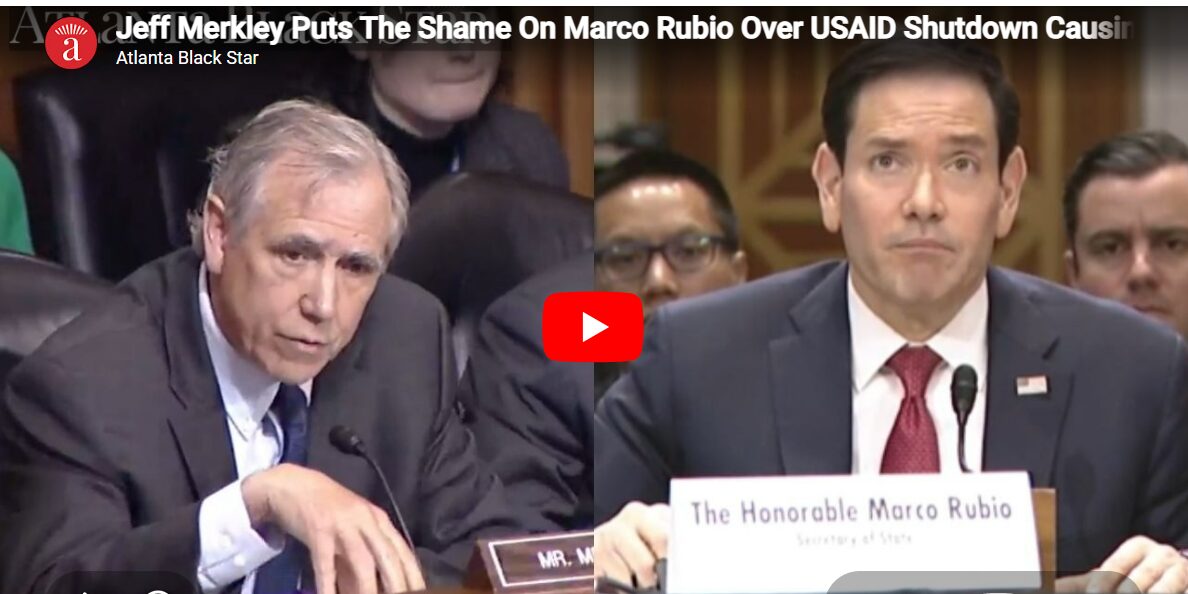
At a Senate Foreign Relations Committee hearing on June 2, Sen. Jeff Merkley (D-OR) didn’t ease into it. The Oregon Democrat opened with a number and forced Secretary of State Marco Rubio to sit quietly while he put a human scale on what the sudden gutting of U.S. foreign aid under President Donald Trump has actually cost the world.
“The folks who study this at the Schools of Public Health — the Harvard Chan School, the Boston University School of Public Health — estimate that over 500,000 children have died from that sudden shutdown,” Merkley said.
Then he made sure no one in that room could look away from what that number actually means.
“If you were to walk across this country, you’d see one dead child equivalent every roughly 30 feet. That’s the level of carnage.”
‘Who?’: Trump Erupts, Drops a Savage Prison Threat After Getting Humiliated On World Stage— And the Enemy He’s Blaming Has Folks Absolutely Floored
Merkley acknowledged Rubio’s standing disagreement with the estimate but didn’t let him off the hook.
“I know you disagree with that,” he said, “but many experts who are in this field — that is their estimate. And I hope you’ll ponder that as we strive to rebuild our programs related to malaria, tuberculosis, AIDS, HIV, nutrition, and certainly infectious diseases like Ebola.”
Rubio did not directly address the child death toll in his response, pivoting instead to Taiwan policy and arms sales when given the floor.
When pressed on whether a pending $14 billion arms sale to Taiwan had been stalled as a negotiating chip with China, Rubio reached for a familiar Republican shield that’s heavily favored by Trump, blame former President Barack Obama.
He pointed to a December arms sale he described as the largest single transaction in history, then argued that critics had short memories. “There was a six-year period of time under the Obama administration where there were no sales to Taiwan,” Rubio said, casting the current review as measured restraint rather than capitulation.
Merkley then turned to the Uyghur Forced Labour Prevention Act, pressing Rubio on whether the administration could build a coalition with Mexico, Canada, and Europe to close the transshipment loophole that allows goods made with forced labor to simply reroute through other countries before entering global markets.
Rubio acknowledged the challenge, conceding the effort had so far fallen short.
“To date, we have not been successful at convincing them,” Rubio admitted, citing fear of Chinese retribution as a key obstacle.
But it was Merkley’s opening that will linger — a quiet, deliberate act of moral accounting that Rubio never quite found the words to answer.
Watch the full clip here.