A single word from a politician can hijack attention faster than a policy rollout — especially when that politician is Donald Trump.
Trump has a gift for turning stray remarks, improvised word salads, and sudden verbal detours into headlines nobody saw coming. One minute he’s making a point, the next he’s inventing a phrase, wandering into a tangent, or leaving the public debating whether they just witnessed a mic-drop moment or a brain freeze.
Add in the sleepy-looking pauses critics love to pounce on, and the jokes often give way to a more serious question some keep raising: are these just Trump being Trump, or small moments feeding deeper concerns about his health and awareness?
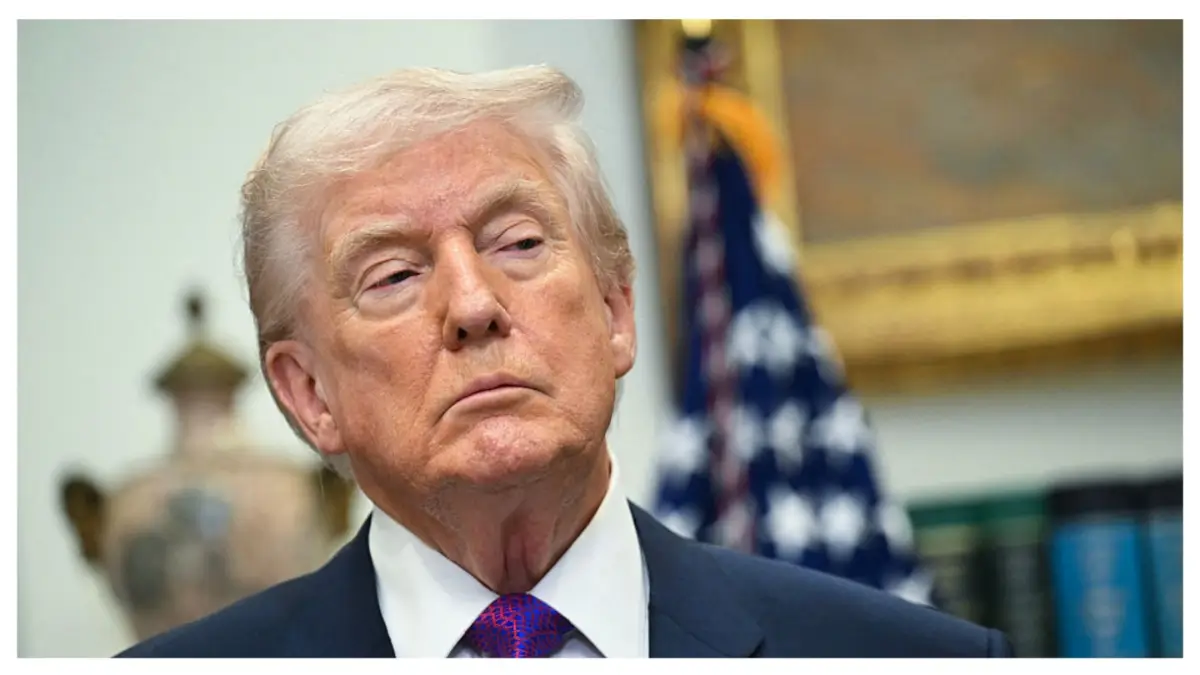
For years, Trump has been serving up word stumbles that land less like slips and more like recurring episodes — the kind that practically arrive prepackaged as viral clips.
He once famously turned the simple word “big” into the now-immortal “bigly” during the 2016 election, and two years later, anonymous became “annon-on-on-mous” after wrestling with the word at a Montana rally in 2018. Now the 79-year-old appeared to blank on the word Alzheimer’s — a slip some excused because of his age, while others saw a red flag. Either way, he often gives the English language a plot twist nobody saw coming.
Since then, the president’s verbal detours have fueled endless chatter that even the easiest words sometimes seem to put up a fight.
The latest conversation began outside the White House as Trump fielded reporters’ questions before leaving for a roundtable event in Las Vegas on April 16.
When asked by a reporter how long the United States can sustain its supposed blockade in the Strait of Hormuz, Trump buckled
“The what?” he yelled at first, seemingly asking the reporter to repeat their question without saying so.
Trump brings a vegan restaurant owner on stage then proceeds to mispronounce the word “vegan” (five times) and tell her he doesn’t think he'll like her food. pic.twitter.com/h3CRjiD9NL
— American Bridge 21st Century (@American_Bridge) May 1, 2024
Trump then shifted gears and tried to respond with confidence, praising the military and describing the operation as steady and routine. “We’re doing very well with the blockade, it’s very routine for us, the Navy is incredible. And I think the blockade is doing very well. No ship is even thinking about entering, no ship is going past our Navy,” — though some listeners insisted the word sounded more like “chip” than “ship.”
The comments spread rapidly, with users replaying the clip and comparing notes as if they were trying to solve a riddle. On Thread, one viewer wrote, “Is Donald Trump saying ‘chip’ instead of ‘ship?’ I hear ‘chip.’”
Two replied, “Definitely said chip. Slurring his words with the dementia, and “He said chip, because he suffers from brain rot. He thought chip is the official word.”
That small difference in sound quickly turned into a big online debate over one troubling detail the White House has never directly put to bed.
“Seems like he has hearing problems too. What? What?” wondered a third person, while a fourth noted, “‘THE WHAT?’ gives it away.”
Most agreed, “I heard chip too,” sharing memes of Lays chips bags, which are alleged to be another one of Trump’s favorite snacks. Another joked, “Must be lunch time its all chip.” One person laughed at the entire scene, writing, “Hahahah unreal.”
View on Threads
As the chatter grew, attention drifted to a familiar subject that has followed Trump throughout his public career: his teeth. Could his teeth be the reason he mispronounces words or why his speech sounds slightly muffled or uneven?
In late 2017, when he said, “God bless the United Shtesh,” during a speech, critics suggested it was because he had dentures that were not in his mouth correctly.
During another speech about national parks, he repeatedly pronounced Yosemite as “Yo-Semite” in 2020. In a policy discussion, he referred to the “oranges” of an investigation when he clearly meant its origins in a 2019 meeting with now-former NATO Secretary General Jens Stoltenberg. He once struggled to say “vegan food,” but called it “vaegan food,” and kept on like nothing was wrong with what he was saying.
Some observers believe loose fittings or adjustments not only affect how certain words come out but might be the reason why he spits when he talks to people. Either way, the topic has become part of the public conversation around his speaking style.
A separate set of reactions to Trump’s comments about “ships” questioned Trump’s description and claim that vessels were staying away from the waterway.
One commenter wrote, “Bs makes the grass grow???” A second posted, “Lol, there is no sustainable block!” The shift in tone showed how quickly a conversation about language can turn into a broader argument about credibility.
Meanwhile, Trump and members of his Cabinet continued to emphasize that their strategy in the Strait is working. Officials have argued that the military presence has discouraged many vessels from entering contested waters, even if some traffic still moves through. According to Reuters, data shows the number of crossings has dropped sharply compared with earlier levels, suggesting pressure is having an effect — though not a complete halt.
Ultimately, the episode played out like a tune the public has heard before — adding fuel to a growing chorus of critics who say these slips are getting harder to brush aside.
Between the White House downplaying the 79-year-old’s health amid alarming concerns about his swollen feet, red spots on his face, his patchy skin, and not to mention the frequent bruises on his hands. Each appearance only adds more fuel to the fire of allegations that he’s getting worse.


