JD Vance stood just a few feet from President Donald Trump, with reporters packed into the Oval Office and cameras locked in, capturing a moment that felt like it could stick. The question came, and for a split second, the hesitation showed — because this wasn’t just another answer. It was one he had already been set up to struggle through.
For days leading up to it, Trump had been sending mixed signals about his vice president’s stance on the escalating conflict with Iran, at times casting Vance as less enthusiastic about the war effort before pivoting to insist he was fully aligned.
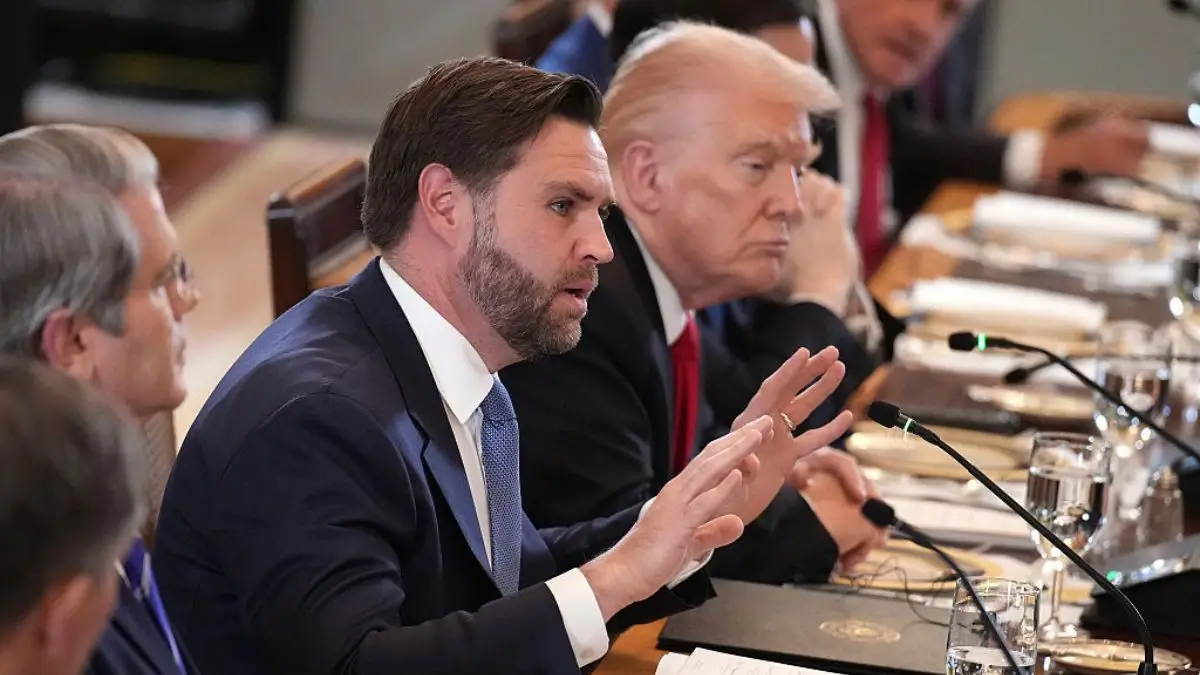
It reflected a broader dynamic that has defined Trump’s handling of allies: create just enough ambiguity to force a public display of loyalty, then leave little room for how that loyalty can be expressed.
And Vance was left to resolve it in real time, in public, with no clean way to do it.
The result has been a series of carefully calibrated answers that, to critics and even some allies, come off less like conviction and more like survival.
Complicating matters further, National Counterterrorism Center director Joe Kent met privately with Vance just hours before resigning in protest of the Iran war — a bombshell that sent shockwaves through the White House and raised new questions as the Oval Office moment played out.
When asked directly whether he was fully on board with the war, Vance sidestepped a clear yes. “I know what you’re trying to do. You’re trying to drive a wedge. All of us should pray for success,” he said, framing the question itself as suspect rather than offering a definitive endorsement.
Pressed further, he leaned on a broader justification for the administration’s actions. “What the president said consistently going back to 2015 — and I agreed with him — Iran should not have a nuclear weapon,” Vance said Monday.
View on Threads
The response aligned him with Trump’s policy without directly addressing the tension between his past skepticism and his current position. It also followed days of mixed signals from Trump himself, who publicly described Vance as “philosophically a little bit different” and “maybe less enthusiastic about going, but he was quite enthusiastic.”
That framing has only intensified scrutiny. Vance built his political identity in part on warning against prolonged foreign conflicts, once saying “our interests, I think very much, is in not going to war with Iran.”
Now, as vice president, he is defending a conflict that has already left at least 13 U.S. troops dead and 200 wounded, according to military officials.
When asked about the apparent shift, Vance pointed to leadership rather than policy. “I think one big difference is that we have a smart president whereas in the past we’ve had dumb presidents,” he said, drawing a contrast meant to reconcile his past views with the present moment.
Online, that explanation drew immediate backlash, with critics questioning both the substance and the delivery.
“Imagine being a Yale graduate and having to lie and say DJT is smart,” one person wrote.
View on Threads
Another added, “Right JD…you mean the president that you called Hitler?? That’s the smart president you mean?” highlighting Vance’s past conflicting statements on Trump.
Others saw the exchange as less about policy and more about political positioning. “Good work getting him on the record supporting this unpopular war,” one reaction read. Another cut deeper: “My god, he’s embarrassing.”
Some observers argued the dynamic itself was predictable. “If JD doesn’t know it’s a trap by now, then then it’s too late for him,” one post said, pointing to Trump’s tendency to publicly test allies.
Another said simply of Vance’s coded response, “That is lawyer talk for No.”
Behind the awkward optics is a more consequential political calculation. Vance, 41, is widely viewed as a potential heir to Trump’s movement and a possible 2028 presidential contender. But that path depends heavily on maintaining Trump’s support while also holding credibility with a base that has grown increasingly skeptical of foreign intervention.
Curt Mills, executive director of The American Conservative, framed the stakes bluntly, calling the Iran conflict “probably one of the greatest campaign betrayals in American history” and warning that its fallout could land squarely on Vance. “This is a problem for him, and I believe he knows that,” Mills said.
View on Threads
The balancing act has shaped Vance’s public presence during the conflict. While he has defended the administration’s decisions, he has avoided becoming the face of the war, leaving that role largely to other officials. His limited appearances and cautious messaging have not gone unnoticed among conservative commentators, some of whom argue he risks looking passive while still being tied to the outcome.
At the same time, Vance has resisted revisiting his earlier statements in detail. “I hate to disappoint you, but I’m not going to show you here and in front of God and everybody else, tell you exactly what I said in that classified room, partially because I don’t want to go to prison, and partially because I think it’s important for the president of the United States to be able to talk to his advisers without those advisers running their mouth to the American media,” he said when asked about his prior concerns.
Administration officials have pushed back on the idea of any internal divide, insisting Vance is fully aligned with Trump’s decisions. But Trump’s own comments — alternating between highlighting differences and emphasizing unity — have kept the question alive.


