President Donald Trump, as he often does, veered off script during a White House Black History Month reception, praising a string of former Black athletes and celebrities before drawing mockery for appearing confused about one of his own ambassadorial appointments.
What was intended to be a celebration of Black history and achievement quickly turned into a viral moment. Clips circulated widely across social media, not just because of Trump’s comments about a former football star-turned political candidate, but because of the broader pattern embedded in his remarks: name-dropping prominent Black celebrities, referencing historic military heroes in passing, and emphasizing his personal proximity to well-known Black figures.
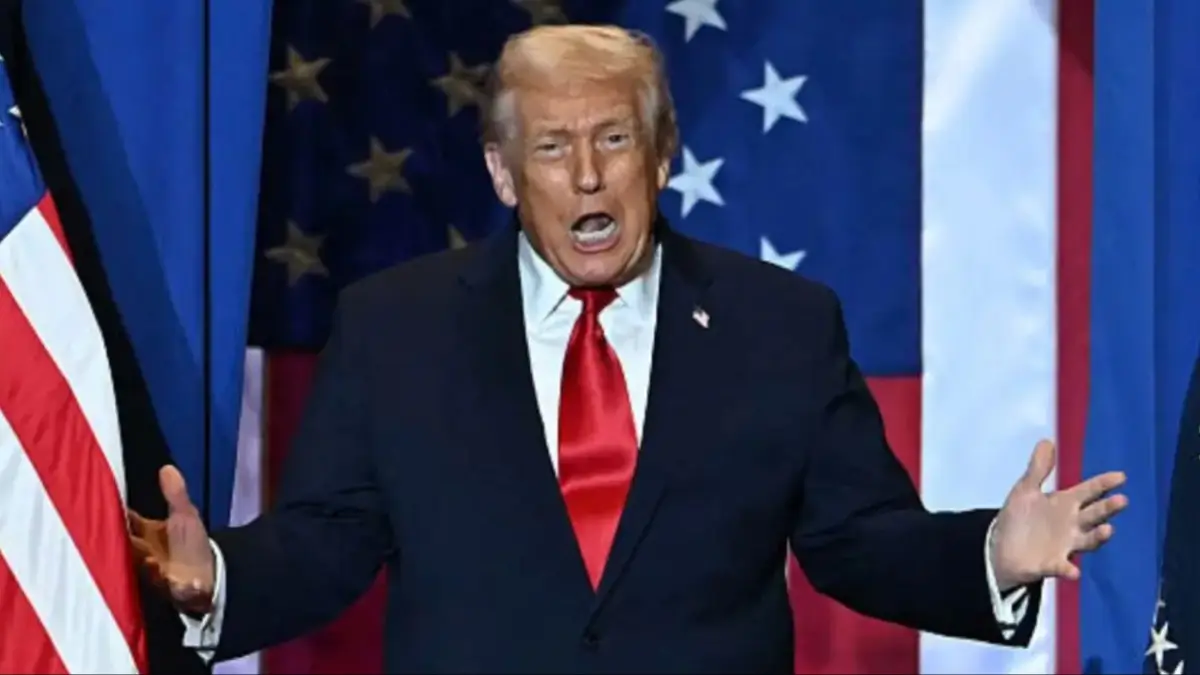
While acknowledging supporters in the room, Trump ticked through a list of loyal allies.
“Mike Tyson. Boy I tell ya, Mike has been loyal to me,” the president began. “Whenever they come out and they say ‘Trump’s a racist,’ Mike Tyson goes, ‘He’s not a racist!’”
But it was Trump’s next example — and the one that would quickly become the focus of online criticism — that drew the most attention.
“And Herschel Walker,” Trump continued, “Speaking about loyal, how good of a football player was Herschel? Now he’s ambassador to the Bahamas. I don’t know. The Bahamas, Bermuda, whatever.”
Walker, the former University of Georgia running back and 1982 Heisman Trophy winner who ran for United States Senate in 2022 as a Republican in the Peach State, currently serves as U.S. ambassador to the Baham as.
The offhand “Bahamas, Bermuda, whatever” remark quickly ignited backlash, with social media users arguing that a sitting president should not appear unsure about a diplomatic post he helped elevate.
Within minutes, the clip spread across social media, with some critics arguing the aside undercut the seriousness of a diplomatic post.
“Nothing says rigorous foreign policy vetting like ‘Bahamas. Bermuda. Whatever,’” one Threads user said sarcastically.
“Sad part is Herschel Walker has no idea where he is either, but wherever he is, he’s the make believe sheriff,” one X user wrote.
Another added, “Just goes to show how he doesn’t know anything about these appointments and only uses these people as a token.”
A third response was more measured but equally snarky: “He was right the first time — it’s the Bahamas — but he should know that without question, obviously,” they wrote.
Trump continued his roll call of football legends, invoking Hall of Famers from past eras.
“There can’t be a better football player than Jim Brown” he said. “By the way, Lawrence Taylor, great friend. The greatest defensive player probably in the history of football.”
Beyond athletes, Trump also referenced rapper Nicki Minaj, who has publicly supported him this term, even calling herself his “number one supporter.”
“How bout Nicki Minaj, do we love Nicki?” Trump went on.” She’s so beautiful. Her skin’s so beautiful. Her nails are so long. I said ‘Nicki, are they real?’ And she gets it!”
For critics, the Black History Month reception reflected a now-familiar rhythm: racial controversy, public backlash, denial, then a pivot to spectacle. Just weeks after sharing and deleting a video widely condemned as racist, Trump stood before a room gathered to honor Black history and cycled through a roster of loyal athletes, supportive entertainers, and historic figures, folding each into a broader defense of himself.
Supporters framed Trump’s remarks as celebratory and unscripted. Civil rights advocates and political observers saw something more calculated: a pattern in which moments of racial tension are followed by highly visible displays of Black proximity, producing images of inclusion that blunt criticism while the underlying conduct that sparked outrage remains largely unaddressed.


