
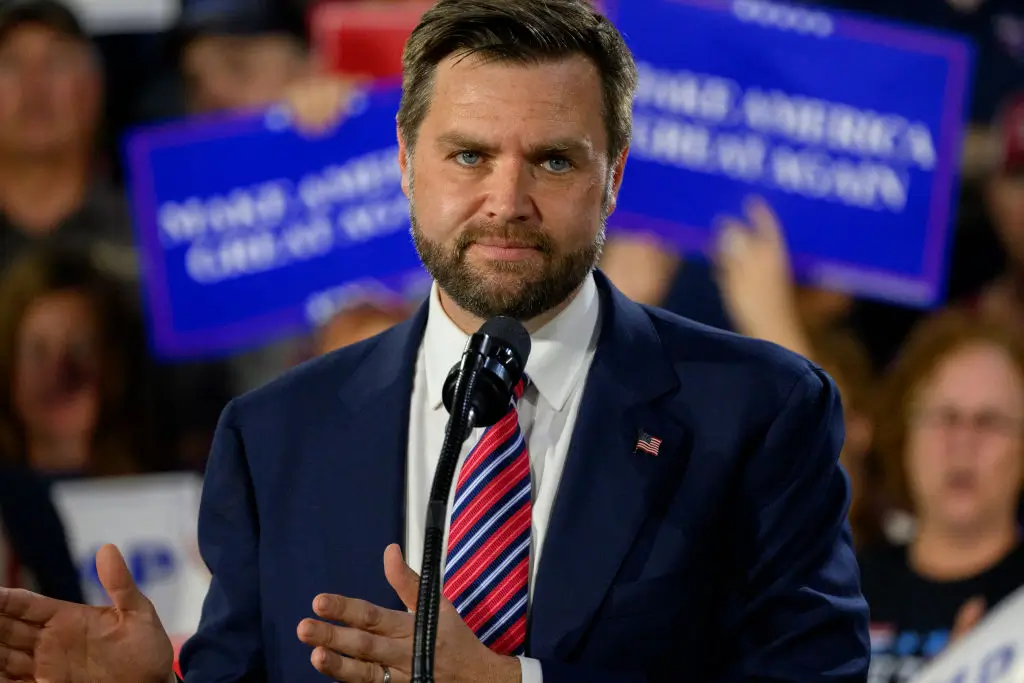
Vice President JD Vance sparked a firestorm Monday after trying to deny that Charlie Kirk once disparaged prominent Black women by questioning their intelligence, only for online users to circulate video evidence proving otherwise.
“Charlie Kirk never said Black women do not have the brain processing power to be taken seriously. He never uttered those words,” Vance argued.
But almost immediately, a split-screen post spread across social media showing Vance’s denial alongside Kirk’s actual words: “Joy Reid, Michelle Obama, Ketanji Brown Jackson—you do not have the brain processing power to be taken seriously.”
The clip, from a July 13, 2023, episode of “The Charlie Kirk Show,” resurfaced after his assassination on Sept. 10, as critics sought to highlight Kirk’s record of bigoted statements.
In the broadcast, Kirk took aim at Black women — TV news host Joy Reid, former first lady Michelle Obama, former Texas Democratic Rep. Sheila Jackson Lee, and Supreme Court Justice Ketanji Brown Jackson. He argued their acknowledgment of affirmative action amounted to proof they lacked merit and didn’t deserve to be in positions of power.
“If we would have said three weeks ago […] that Joy Reid and Michelle Obama and Sheila Jackson Lee and Ketanji Brown Jackson were affirmative-action picks, we would have been called racist,” said Kirk, a college dropout. “But now they’re coming out and they’re saying it for us! They’re coming out and they’re saying, ‘I’m only here because of affirmative action.’”
He continued: “Yeah, we know. You do not have the brain processing power to otherwise be taken really seriously. You had to go steal a white person’s slot to go be taken somewhat seriously.”
(It’s not clear what white person’s slot Michelle Obama stole as the wife of Barack Obama, and Jackson Lee was the voters’ choice in her majority-black 18th Congressional District from 1995 until she died in July 2024.)
Kirk then played a clip of Jackson Lee acknowledging she had benefited from affirmative action and doubled down: “We know. We know. It’s very obvious to us you are not smart enough to be able to get it on your own. ‘I could not make it on my own, so I needed to take opportunities from someone more deserving.’”
The resurfaced comments went viral in the days after Kirk’s murder, with one Sept. 11, 2025, post on X drawing 8.2 million views and more than 55,000 likes. Fact-checkers, including Snopes, have confirmed the video is authentic.
Much of Kirk’s appeal was rooted in grievance politics, particularly the notion that white men were being pushed aside for people less deserving. He frequently cast diversity and civil rights gains as threats to traditional power, framing Black advancement — and especially the presence of Black women in professional spaces — as evidence that opportunities were being taken away from white men. This zero-sum narrative was central to his talking points and helped cement his following on the right.
Kirk’s status as a college dropout also boosted his appeal among supporters, who saw him as proof that higher education was both unnecessary and stacked against conservatives. By leaning into that outsider identity, he positioned himself as a truth-teller who didn’t need elite credentials to challenge institutions he claimed were hostile to white men.
In many ways, Trump became the embodiment of Kirk’s theory — an outsider who turned resentment of institutions into political capital, casting himself as the voice of those who felt left behind.
That may help explain why supporters of Vance continue to emphasize Kirk’s narrative in a more favorable light.
One user on X wrote: “He didn’t say Black women, he was talking about [who he mentioned] specifically.”
But critics pushed back, arguing that singling out specific Black women leaders was no defense, and claiming Vance was purposely minimizing Kirk’s bigotry by dismissing the broader context. “So he was addressing 3 people by name, not an entire demographic as a whole. Got it, he said nothing wrong,” one post responded sarcastically.
Another added: “So the Right Wing defense of Kirk here is that he did not make a blanket statement about ALL black women, only the three he specifically named. Okay…then by that logic why are so many MAGA personally insulted when folks describe only Trump as a bigot, or fascist?”
One critic summed up the episode bluntly: “The level of intellectual dishonesty here is remarkable. Middle school detention logic. Vance is a profound embarrassment to the United States.”
The controversy has revived scrutiny of Kirk’s history of inflammatory statements. Kirk also made statements like, “If I see a Black pilot, I’m going to be like, ‘Boy, I hope he’s qualified,’” and described gay and transgender people as “groomers” who were “destructive.”
He once said the Second Amendment was “worth” the cost of gun deaths, dismissed empathy as a “made-up, new age term,” and argued that Martin Luther King Jr. was “awful” and that the Civil Rights Act was a mistake. Yet, Kirk apologists are now casting him as a martyr, calling for statues in his honor and for renaming streets after him — elevating him to the same pedestal as King himself.
In the wake of Kirk’s assassination, President Trump lowered flags to half-staff and called Kirk a “martyr for truth.” Trump and other Republicans have blamed the “radical left” for the killing without evidence.


