The mother of a Black man in Charlotte who died in police custody in 2022 while mentally distressed and complaining of double vision and trouble breathing is suing the city and four of its police officers for excessive force, claiming their mistreatment of him caused her son’s death.
The way police handled Jovontay Williams, a former All-America college football player, after responding to a 911 call by a woman reporting gunshots outside her home in the early morning of June 13, 2022, has been known since 2023, when the Charlotte-Mecklenburg Police Department released bodycam video footage of the incident.
After officers noticed empty shell casings outside the woman’s residence, Williams, 32, was found on the back porch of a nearby home. Police quickly determined that he was unarmed and undergoing a mental health crisis, “acting erratically, exhibiting stress and delirium,” CMPD officials later said in a statement.
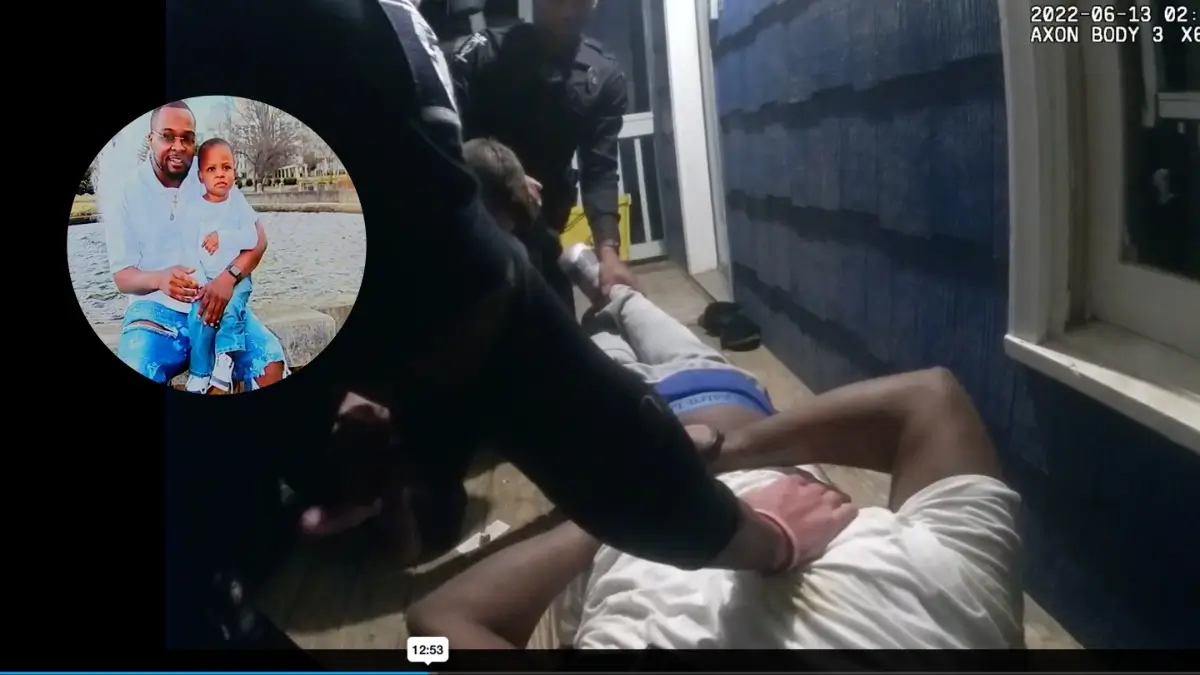
At 2:01 a.m., when they failed to coax Williams off the porch, officers elected to use a “soft, empty hands” approach, following CMPD’s response to resistance policy.
The bodycam video footage showed officers approach and grab Williams, lower him to the ground and cuff his hands behind his back, putting him face-down in a prone position on the porch for about 20 seconds. Then they turned him on his side while holding his body and feet down, and at 2:13 a.m., called for medics to come to the scene.
It was a long wait. EMTs didn’t arrive for another 19 minutes.
During that time, Williams told officers he was lightheaded, seeing double and was “going to die.”
“I can’t breathe,” Williams told police, according to the lawsuit.
“Yes, you can,” an officer replied
“You cops are dead wrong,” Williams responded, and then perhaps prophetically, “If I die, it is on you … Help me.”
As Williams periodically screamed and groaned, and asked police to “let me up,” one officer encouraged him to take deep breaths, then said to another, “He’s stiffening up like a board,” the lawsuit says.
“The fact that we have these statements by Jovontay Williams post-George Floyd is ludicrous,” Michael Littlejohn Jr., the family’s attorney, told the Charlotte Observer.
According to CMPD policies, maneuvering a person onto their side into a “recovery position” is meant to prevent positional asphyxia, the Observer reported. Police Chief Johnny Jennings said at the time that his officers followed department policies.
“I think our officers acted appropriately and admirably,” Jennings told WBTV in 2023. “They were dealing with a criminal situation that they quickly identified as a medical situation and then based on that they did what they were supposed to do.”
According to an excerpt from the autopsy report cited in the lawsuit that was completed by the North Carolina Chief Medical Examiner, who reviewed the footage, Williams raised his head multiple times asking to get up while being restrained on his side by the officers, “stating that he felt light-headed and was seeing double.”
When the fire department arrived at 2:23 a.m., Williams continued yelling and moaning, and had become “unresponsive and lethargic” by the time EMS medics approached him at 2:35 a.m., when they requested removal of the handcuffs to transfer him to an ambulance, the autopsy report said.
Neither police nor firefighters had checked his pulse nor taken steps to ensure Williams was breathing properly, the lawsuit claims.
The medic team found him with fixed pupils, a Glasgow Coma Scale of 3 (indicating severe brain injury) and in severe respiratory distress, the lawsuit says. Williams was transported to a hospital, where he was intubated due to labored breathing. He died several hours later.
An autopsy report issued by a forensic pathologist later retained by the family found that Williams died from “restraint asphyxia/position asphyxia by the police while under the police restraint and custody.”
He did not die from a neurological or psychiatric syndrome, the lawsuit contends, noting that, “There were no anatomic findings, toxicological levels, or documented behaviors to support a differential diagnosis of excited delirium,” as police had earlier reported. “Mr. Williams exhibited lucidity, followed verbal commands, and repeatedly articulated medical distress.”
Williams did not engage in physical aggression or display any signs of “superhuman strength” or “imperviousness to pain,” behaviors commonly associated with law enforcement organizations’ definition of excited delirium, a disputed syndrome not recognized by the American Medical Association or the American Psychiatric Association.
On the contrary, the lawsuit argues, bodycam footage and EMS documentation reflect “a steady decline in responsiveness” by Williams.
According to CMPD’s policy and national training standards, “subjects in medical distress — whether intoxicated, confused or emotionally disturbed — must be closely monitored, promptly repositioned and provided with urgent medical intervention,” the lawsuit says. CMPD officers ignored these responsibilities even after Williams “verbalized distress and ceased resisting.”
As he visibly deteriorated, the complaint says, officers failed to remove handcuffs, initiate aid, or reposition Williams in a way to avoid compressional or positional asphyxia.
Williams posed no active threat, and officers had no objectively reasonable basis to believe continued pressure or restraint was necessary once he was cuffed, the lawsuit says. Less lethal alternatives — monitoring, rolling him over, removing pressure — were available, feasible, and ignored. The prolonged restraint was “grossly disproportionate and directly caused death.”
“My son is gone and it’s a tragedy,” said Christa Ann Williams, now representing her son’s estate in the lawsuit, told WBTV in 2023. “It was no reason to hold him down that long.”
Williams had a 3-year-old son at the time of his death. He played football at Johnson C. Smith University from 2012 to 2014, where he was an All-America linebacker. He had no history of known medical issues prior to the incident, the lawsuit says.
Christa Williams said she hoped that his death would lead to policy changes among police, fire and emergency medical responders.
While the lawsuit argues that the officers failed to comply with the police department’s policies on use of force and responding to a mental health crisis, it notes that CMPD overhauled the latter policy in 2023.
The department’s mental health policy now requires officers to roll a restrained subject onto his side “as soon as it is safe” and mandates continuous airway monitoring, immediate removal of restraints and commencement of CPR upon any loss of consciousness or breathing. It also requires the immediate dispatch of emergency medical services personnel to the scene.
The lawsuit alleges that the city of Charlotte and four named police officers — Timothy Abramo, Zavon Joseph, Brenton Thomas, and Jacob Grigg — violated federal and state laws against use of excessive force and committed assault and battery against Williams, whose emergent medical crisis they ignored with deliberate indifference, causing him to suffer physical pain, mental terror and death.
It demands a jury trial to determine unspecified compensatory and punitive damages and to cover legal costs.
The allegations in the lawsuit present a stark contrast to previous official reviews of the incident, noted WCNC. Both CMPD’s internal affairs division and the North Carolina State Bureau of Investigation found no wrongdoing by the officers in 2023. The Mecklenburg County District Attorney’s Office decided criminal charges were not appropriate.
CMPD told reporters it could not comment on the pending litigation.
The city and the other defendants have 21 days, or until July 4, to file a response to the complaint.


