The attorneys for three officers in Washington state who are accused of killing a Black man after shocking, choking, and hogtying him in police custody are insisting that the victim died because of drugs, not excessive force.
Manuel Ellis, 33, died in police custody on March 3, 2020, in Tacoma, Washington, after an encounter with police in which he was beaten and had a spit mask placed over his head. The police reportedly stopped him because he allegedly harassed a woman on the street, but multiple witnesses disputed that account and said police approached him unprovoked.
As Ellis was being detained, a nearby home’s doorbell security camera caught him repeatedly telling the officers he couldn’t breathe. His death occurred three months before George Floyd’s, which sparked global demonstrations to end violent policing practices.
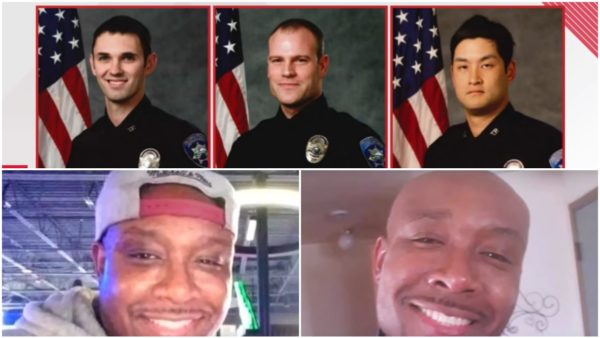
The officers who are standing trial for Ellis’ death are Officers Christopher Burbank, 38, Matthew Collins, 40, and Timothy Rankine, 34. Burbank and Collins were charged with second-degree murder and first-degree manslaughter. Rankine only faces a manslaughter charge in connection with Ellis’ death.
Their lawyers have been in court for nine weeks, working to distance the officers from any indication that they were responsible for Ellis’ death. Instead, they’re painting the cause of his death as a drug-induced demise. Burbank’s lawyer, Wayne Fricke, argued that Ellis’ addiction to methamphetamine spurred on violent and paranoid behavior that warranted the officers’ actions.
Authorities also put forth the claim that excited delirium might have contributed to Ellis’ death. It’s defined as a syndrome that’s typically associated with drug use and is often linked to in-custody deaths, according to the Western Journal of Emergency Medicine. However, the American Medical Association or the American Psychiatric Association doesn’t recognize the syndrome.
“This is a situation where he created his own death,” Fricke said during closing arguments. “It was his behavior that forced the officers to use force against him because he created a situation that required them to act.”
However, audio and video clips that special prosecutor Patty Eakes played during the trial reveal that the officers’ actions directly contradicted their witness testimony.
Collins said that Ellis lifted him off the ground and threw him in the street like a child, even though witnesses at the scene never recalled that happening, and it’s not seen on the videos.
Burbank also testified that Ellis was “assaultive” and used “wild strikes” during the entire encounter, but videos show Collins had Ellis on his back and had placed him in a chokehold. His hands were also in “a surrender-type position” in the air, according to Eakes.
The officers’ lawyers argue the videos and the testimonies of witnesses are flawed.
“No one wanted him to die, but ultimately he died, and that’s sad,” Fricke said. “We don’t compound that tragedy by convicting innocent people of these charges.”
Closing arguments are expected to wrap up on Wednesday to make way for jury deliberations.
Ellis’ family was already awarded $4 million by the Pierce County Council after the medical examiner’s office ruled his death a homicide. The medical examiner noted that physical restraint and the spit mask were major contributors to Ellis’ death. Methamphetamine intoxication and heart disease were noted as lesser contributing factors.


