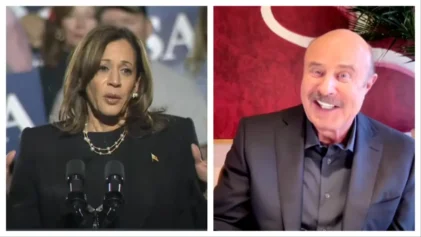
Dr. Phil has folks on social media dragging him to hell after he said providing cash reparations for slavery would be an “absolute disaster” during an episode of his talk show on April 18.
The talk show host made the statement after economist and Duke University Professor William A. Darity Jr. said that $14 trillion should be distributed evenly to the 40 million Black descendants of slavery in America, or $350,000 per person.
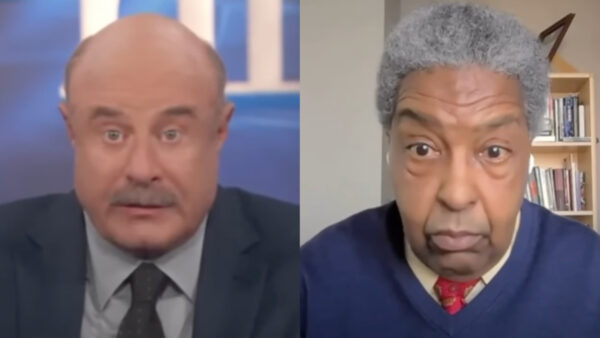
The payments would be an attempt to help eliminate the wealth disparity between Black and white Americans, which he said is about $840,000. Darity co-authored the book “From Here to Equality: Reparations for Black Americans in the Twenty-First Century.”
Darity noted that the government could pay the funds in a way similar to how federal payments were distributed during the COVID-19 pandemic.
“It would be paid by the federal government in the same way in which the federal government has met the expenses that were, uh, that were paid out for the purposes of trying to deal with the great recession and also, most recently, with the economic downturn associated with the great pandemic,” he said.
Civil rights activist Bob Woodson also appeared on “Dr. Phil” and disagreed with Darity.
“When you go into slavery, it’s much more complex than all white people were the oppressors, and Black people were the victims,” Woodson said. “If you dissect it, you will find there were about 3,700 free Blacks who owned 12,000 slaves — Black slaves. The question is, do the descendants of those free Blacks who owned Black slaves, do they pay?”
“Blacks really benefited more the first 100 years after slavery than we have in the last 50 years,” he added.
Darity responded that the federal government paid reparations to white families after slavery but reneged on their promise of 40 acres and a mule to each Black family.
“There is a substantial history of the United States government providing financial assets to white citizens when it did not provide similar assets to Black citizens,” said Darity. “The U.S. government gave one-and-a-half million white families in the United States 160-acre land grants in the western territories under the Homestead Act of 1860. That was a transfer that has resulted in a situation in which 45 million living white Americans are continuing to be beneficiaries of those land patents.”
Dr. Phil replied that giving any group of people $350,000 without guidance would be disastrous and brought up the people who took advantage of the federal government’s PPP loans as an example.
“I can tell you from a psychological perspective that if you take $350,000 or $840,000, and you write a check to any group of people, Black, white, poor, homeless, whatever, you give any group of people that much money and say, ”there you go, best of luck,’ you come back in six months, they’re going to be broke,” he said. “Whatever reparations are done, that would be an absolute disaster, as opposed to guidance and help in creating generational wealth, as opposed to income.”
Darity explained that no one is claiming that some people might not mismanage their money but asserted that it wasn’t the point, prompting Dr. Phil to retort, “I just said it. I just said, ‘you give that money to anybody, they’re going to mismanage it. They’re going to blow it.’ Look at the fraud that just occurred with all of the money that was given in support of COVID.”
Some viewers did not appreciate Dr. Phil’s reparations assessment and took to social media to drag the talk show host.
“Dr. Phil is a f*cking idiot. Cash Reparations are owed & I don’t give a f*ck what anyone “thinks” about it,” wrote one Twitter user. “The law is the law, crimes against humanity never expire, wage theft is illegal. Black Americans are owed what was taken from us. F*ck all this talk. #CutTheCheck.”
“Let’s be clear,” responded another user. “Why would we be asking the opinion of a white man about reparations? When did slave owners like for slaves to be free? Someone answer. The point is Dr. Phil doesn’t have to like it, we’re owed a debt, let us mess it up or not mess it up. It’s ours!”
Another user reminded Dr. Phil about his production company’s $7 million in PPP loans. His youngest son Jordan McGraw paid $10 million in cash for a Beverly Hills mansion around the same time, but sources claimed there is no connection.
“Why do some people feel they need to police Black folks? If we get reparations and decide to burn it all in a furnace, that’s our dam [sic] business,” replied another.
“Dr. Phil got some nerve after [Oprah] put him on,” added one.