The San Francisco chapter of the NAACP released a statement rejecting a reparations plan to pay eligible Black residents $5 million.
The rejection, on March 14, comes several months after the San Francisco African American Reparations Advisory Committee recommended providing Black residents of the city descended from slavery with a one-time $5 million payment. The plan would also eliminate all debt and guarantee eligible individuals the area’s median income for 250 years. The payments would be meant to serve as amends for the systematic repression Black Americans have suffered.
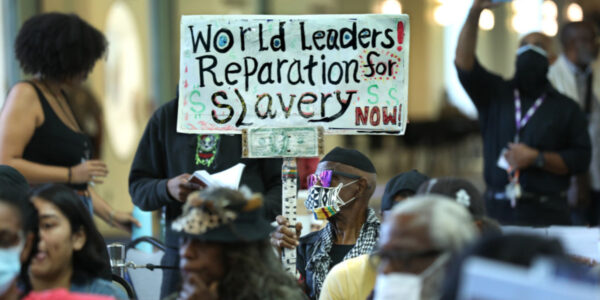
In a response to the plan, the San Francisco chapter rejected the $5 million payments and instead recommended the Board of Supervisors redirect the funds for education, jobs, housing, health care and a cultural center.
“The Rev. Amos Brown today said that the Board of Supervisors, which is holding a hearing today at 3 p.m. on the city’s Reparations Plan and Dream Keeper Initiative, should redirect its focus on providing five key elements as part of reparations: education, jobs, housing, healthcare and a cultural center for Blacks in San Francisco,” read the statement. “We strongly believe that creating and funding programs that can improve the lives of those who have been impacted by racism and discrimination is the best path forward toward equality and justice.”
People were not impressed by the NAACP’s rejection of the recommendation and had strong reactions on social media.
“This ain’t it,” replied one. One person wrote, “Blacks? Who are these Blacks they’re speaking of? The NAACP does not represent nor speak for Native Black Americans/American Negroes!”
Another person responded with a gif that said, “STFU.”
Conservatives were more upset about the $5 million recommendation for reparations. Ex-congressional candidate Christine Quinn responded with a Twitter post condemning the reparations plan and called it a “political ploy.”
“San Fransisco is considering $5 Million dollar payouts to blacks for reparations? For what? California didn’t have any slave owners or slaves in the entire state! I busted my ass to build a business I want $10 Million dollars for working! Another political ploy! I say NO WAY!”
After the backlash, the NAACP updated their recommendation on social media and claimed that Black Americans should be paid some reparations in cash form, but that $5 million may not be enough. The post was captioned, “Updated Clarification on Reparations. #SanFrancisco #California.”
“We are clarifying the NAACP San Francisco Branch’s statement presented on
Tuesday, March 14, 2023,” read the statement. “The City & County of San Francisco claims to be a progressive and liberal metropolitan city, but it is diametrically opposite. While the reparation recommendations for Black Americans were unanimously ‘accepted’ by the San Francisco Board of Supervisors, they did not vote last night because the recommendations
would not have passed. Although we feel there should be some form of cash payments in installments to each Black American, according to the agreed upon qualifications, we know the facts; they are as follow.”
The statement went on to say that Board of Supervisor President Aaron Peskin and Budget Chairperson Supervisor Connie Chan privately stated that no cash payments would ever be paid to eligible residents. The statement also claimed that other board members agreed, and the recommendation only provided Black Americans with false hope.
“Again, there should be some form of cash payout in installments, but $5M is an arbitrary number. Presently, there is no explanation of a method for how the $5M will be allocated. We recommend a practical plan including a rationale of the specified dollar amount. More than $5M may be needed!”
The statement also noted that the NAACP San Francisco Branch was the first organization to present a reparation package to the San Francisco Board of Supervisors back in 2020.
The updated statement also did not go over well with social media users. One person replied that all credibility had been lost. “We don’t need clarification; you’ve already lost whatever little credibility you had.”
Another person replied that people, not organizations, should be given the funds.
“Reparations needs to start at direct cash redress to affected people — not putting money into organizations. The harm was inflicted on people. Repay the people. Requiring the injured class to become consumers of institutions is unjust & not REPAIR. That’s called a business subsidy.”
One person replied, “Chiiiillllle… the original and update need to be filed:” The post included a gif of a person taking out the trash.
The San Francisco African American Reparations Advisory Committee plans to issue its final report in June. The city’s board will discuss reparations proposals in September.


