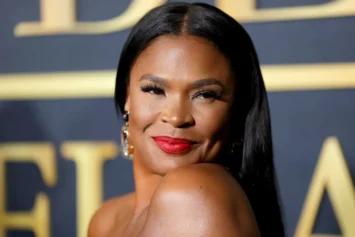
Can you imagine Nia Long as one of the detectives in the “Charlie’s Angels” films? Well, studio executives certainly were unable to do so.
Long recently revealed that she auditioned for the role of Alex Munday but was ultimately turned down. The actress recalled in an interview with Yahoo Entertainment that she was informed by her agent that the film’s producers “did not want me because they said I looked too sophisticated and too old next to Drew Barrymore.” The role ultimately went to Lucy Liu, whom Long praised for her performance in the comedy-action film series.

Still, news of the dismissal struck a nerve with Long’s fans and Barrymore, who brought up the subject again on “The Drew Barrymore Show” on Jan. 26. The “Wedding Singer” star said that she was mortified to learn why Long was rejected.
Long said the rejection was par for the course as an actress; however, the rationale behind their decision to pass on her left a lasting impression. She told Barrymore, “The feedback was, ‘My eyebrows were too sophisticated and I looked too old next to Drew.’ And that was the feedback and I was like, ‘What?’ It just was an odd way of saying you didn’t get the job.”
Barrymore, obviously mortified by Long’s account of how things played out after the audition, acknowledged that she was one of the film’s producers but had nothing to do with the decision. “It’s bewildering to me that someone would say those things,” added the talk show host. “First of all, Nan [Nancy Juvonen, head of Flower Films production company] and I would never talk about eyebrows. That’s not what women would do.”
Barrymore added, “Nan and I would never speak like that, and as far as age, that’s the stupidest thing because you’re actually the same exact number and age as Lucy Liu, so how is that possible?”
The “Missing” star assured her industry peer that she never felt Barrymore had cost her the gig. Instead, Long thinks Hollywood’s struggle to diversify was ultimately at play. “Now that I’m older and wiser and we’ve been in this business for a long time, I think what was happening during that time is there were all these conversations about diversity, but people weren’t really pulling the trigger,” she explained.
Long continued, “I think this is just a result of the fear of really putting a Black woman into a film that never cast anyone Black.” Her fans agreed that race and Long’s undeniable beauty had to have been determining factors as well.
“Translation they wanted to say she is black and we don’t want a black woman for the part,” wrote one supporter.
“They really thought she is too fine and will take the center role instead of the supporting cast approach. We know the truth,” wrote another.
“They could’ve just said they didn’t want any beautiful brown skin women with curves to show up and show out the other costars…I don’t know what hater drugs the producers were on, because Nia long is gorgeous!!!” commented a third person.