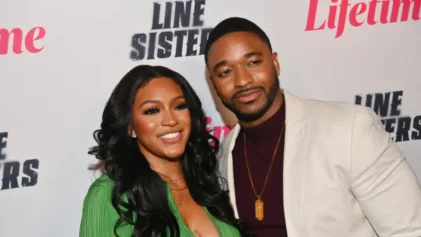
July is Fibroid Awareness month and Porsha Williams is on a mission to break the stigma of women discussing their personal experiences. The former star of “The Real Housewives of Atlanta” discussed her personal journey on the Bravo series in April 2020. She shared more about her struggle with fertility in her memoir, “The Pursuit of Porsha: How I Grew Into My Power and Purpose.”
When ABS spoke to Williams in November 2021, she admitted she learned about her fibroids while pregnant with her daughter, Pilar Jhena’ McKinley.
She said, “It’s actually pretty sad that I didn’t find out that I had fibroids until I was pregnant. So, you know, I’m really big about wanting to make sure that women get checked … for fibroids, because, unfortunately, doctors don’t ask you about it. Doctors don’t check.” The reality star continued, “And…I ended up having to suffer through a miscarriage because they didn’t know they were there. And then I got pregnant.”
In doing her own research, she learned that “depending on the size of them, they can outgrow your fetus.”
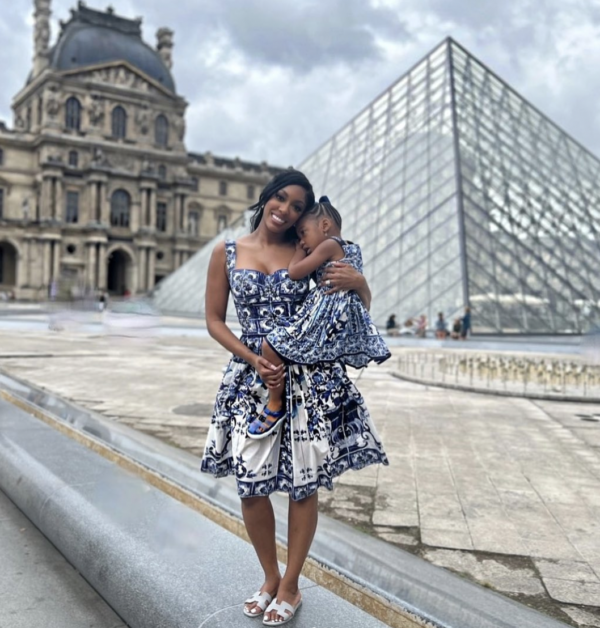
After six years of struggling with fertility, Williams became pregnant with her rainbow baby — a term that affectionally describes a baby born after a miscarriage. She was hospitalized during the pregnancy due to her large fibroids. Years later, she ultimately had a myomectomy “to rid me of them so I could give birth to my daughter.”
“And now, fortunately, they have grown back,” the actress explained at the time. “And one of them is so large. Like, it literally makes me look like I’m like three or four months pregnant.”
She gave birth to Pilar on March 22, 2019, whom she shares with her ex-fiancé, Dennis McKinley. Now, the mom of one wants other women to share their stories and to get checked for fibroids.
“I do plans on talking about this in the future publicly because I’ve suffered so much from these fibroids. And I just feel like if this conversation is being had by young women, they can find out earlier and not have to go through what I went through,” she noted.
ABS spoke to the former “Real Housewives of Atlanta” a day before she had what she described as “a life-changing procedure” performed by leading fibroid specialist Dr. John C. Lipman. She had undergone uterine fibroid embolization, which is a minimally invasive treatment. It uses tiny particles to “stop bleeding or to block the flow of blood to a tumor or abnormal area of tissue,” as stated on the National Cancer Institute’s website.
Later, she revealed plans to create a workshop or seminar with Dr. Lipman to let other women know the procedure “reserves your fertility.” She added, “I hope to have more kids in the future. So I’m just ecstatic that I met him.”
Dr. Lipman founded the Atlanta Fibroid Center, where Williams revealed more about her fibroid journey at a women’s health event in June. The two met years ago after Lipman donated $250,000 from his Apple stock to the building that houses Hosea Helps, the foundation named after Williams’ grandfather Hosea Williams. Dr. Lipman performed the same procedure on William’s former cast member Cynthia Bailey, who also shared her experience on “RHOA.”
According to the center’s website, uterine fibroids are tumors that grow in and on the uterus. Although there is no exact known cause, 40 to 70 percent of women experience fibroids, and the risk is higher for African-American women, who are 80 percent more will likely to develop them by the age of 50. Research shows that African-American women are two to three times more likely to experience fibroid growth than white women. It has also been connected to family genetics, obesity, and other health factors.