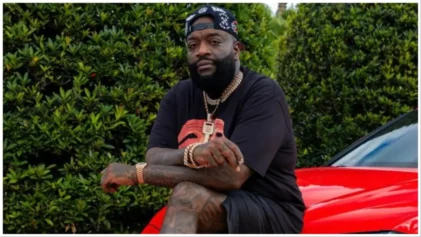
Looking at the hip-hop mogul Rick Ross in 2022, one would be hard-pressed to believe that he wasn’t an exceptional student. He runs several businesses, acquired numerous endorsement deals, and as a rap star, often hits the top of the charts. But the Maybach Music founder struggled in school and used his natural humor to divert attention from how poor a student he was.
According to an interview the former prison guard did with AfroTech to promote his book “The Perfect Day To Boss Up: A Hustler’s Guide To Building Your Empire,” he shared how being a class clown covered up a mountain of insecurities.
“I was a jackass,” the “I’m Not a Star” rapper said.
“Without a doubt, I was a comedian, I had a good sense of humor. I was the funny dude and all that,” he remarked. “And I don’t think it was just because I naturally wanted to be, but [because] I didn’t know the answers to the questions and all the stuff [the teachers were] writing on the wall.”
He confessed, “That might’ve been my way to cover that up because I never understood, I never learned my multiplication still to this day.”
The artist grew up in the diverse Carol City, Florida, a municipality where more than half of the population is either a newly arrived immigrant or undocumented resident, the average household income is a little over $50,000 a year, and approximately 65 percent of the residents either dropped out of high school or did not attend at all. Still, he pushed through school, learning challenges and all. He saw communications as a tool to accomplish his goals.
“Imagine when they began going into pre-algebra a=e, that sh-t was like a whole ’nother language to me,” he continued.
“I just wanted to walk out of the god damn…’What are you talking about? A=E? What is this?’ I knew right then, while I was sitting in the math class, I wanted to learn how to be a great speaker, because when I’m speaking to somebody I don’t want them to know my shortcomings in my other areas. So, that’s what made me become a writer and I think that’s why I’m an author now.”
With all of the grim statistics, the majority of the residents in Carol City were white-collar workers and almost 10 percent of the population were entrepreneurs. That ecosystem inspired him to be the hustler that he is.
“Me walking back and forth to school every day in Carol City, I noticed the people who had the nicest homes were people who worked for themselves, whether they had a landscaping company or they had a roofing company, or a plumbing company, I knew I wanted to have something that I worked for myself,” he revealed.
Ross did graduate from high school and even attended Albany State, a historically Black college in Georgia, on a football scholarship. Football proved not to be for him, and while sitting in class his learning challenges started to kick in, and he determined that he was designed to be a “bawse.”
He recalled, “I got a scholarship to Albany State University and once I got there, the same thing came back and said, ‘Rozay, you’re not going to work for nobody. You wasting your time,’ And I walked away from it right then.”
The multi-platinum artist has put on artists like Wale, Meek Mill, and Gunplay. He is the co-author of best-selling novels, has six No. 1 albums, is the franchise owner of 25 Wingstop locations, a few Checkers and Rally’s restaurants, and has a partnership with spirits brands Luc Belaire and Bumbu. Because of his signature beard, he has invested in his own men’s hair and beard grooming line. Currently, with so many other deals, he is in partnership with Master P’s Rap Snacks and Swizz Beatz’ Verzuz.
Now … he is the one laughing, all the way to the bank.
Why Building Wealth Is About More Than Money and How Black America Can Close the Wealth Gap