Beyoncé, Rihanna, and more celebrities are showing their support for the protests in Nigeria, all calling for the end of the Special Anti-Robbery Squad police unit by speaking out against the country’s government and its treatment of its citizens.
Beyoncé shared a post on Instagram advocating for the protesters. “I am heartbroken to see the senseless brutality taking place in Nigeria. There has to be an end to SARS,” Beyoncé wrote. “We have been working on partnerships with youth organizations to support those protesting for change. We are collaborating with coalitions to provide emergency healthcare, food and shelter. To our Nigerian sisters and brothers, we stand with you.”
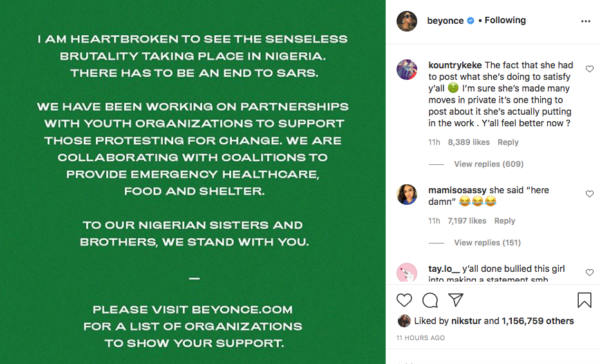
On the star’s official website, there are links to donate to the Feminist Coalition and Connected Development. Beyoncé’s visual album “Black Is King” was partly filmed in Nigeria, which led to scrutiny online about her initial silence about the #EndSARS protests.
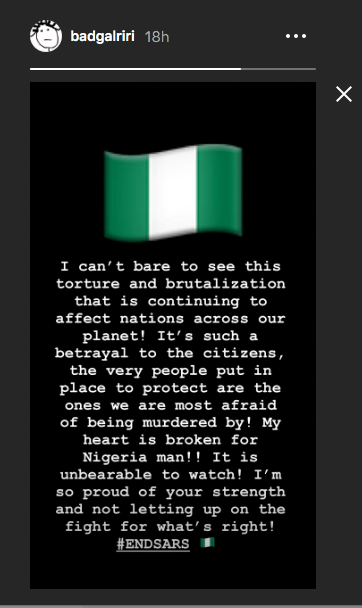
Rihanna also took to social media in support of the #EndSARS movement, writing on Instagram, “I can’t bare to see this torture and brutalization that is continuing to affect nations across our planet! It’s such a betrayal to the citizens, the very people put in place to protect are the ones we are most afraid of being murdered by! My heart is broken for Nigeria man!! It is unbearable to watch! I’m so proud of your strength and not letting up on the fight for what’s right! #ENDSARS”
Nicki Minaj and Justine Skye and Chance the Rapper also showed solidarity with the Nigerian citizens on their respective social media accounts.
SARS, whose origin is variously described as dating from 1984 or 1992, has been connected to various acts of violence and illegality, including kidnapping, blackmail, armed robbery, and extrajudicial killings. Protesters have now crowded the streets following the emergence of a video online allegedly showing a young man being shot by a SARS officer.
On Oct. 11, the Nigerian government declared the dissolution of the police unit. By Tuesday, Oct. 20, however, the continuing protests for police reforms led to a confrontation in the Lekki district of the nation’s largest city, Lagos, in which some dozen people were shot to death by men in Nigerian military uniform. Human rights group Amnesty International reports that at least 56 people have been killed since the protests began weeks ago.


