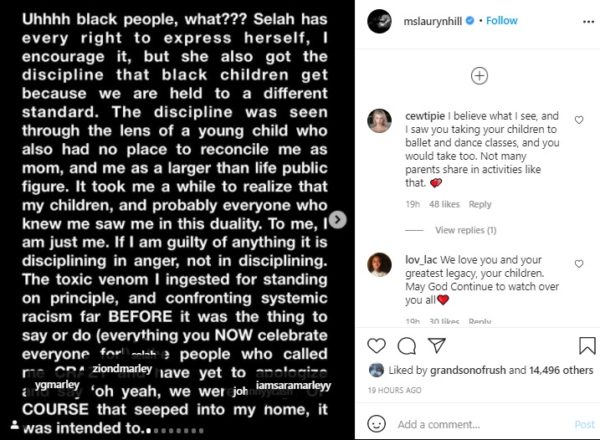
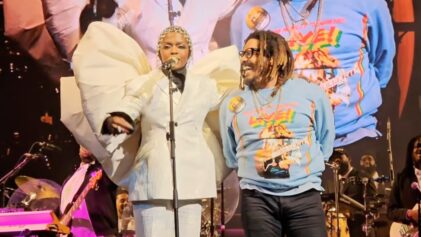
Lauryn Hill defended herself against those who’ve come down on her after the singer’s 21-year-old daughter Selah Marley said that she was often beaten by her mother as a child, something that still traumatizes her.
The way Lauryn sees it, the physical punishment was necessary for her kids because the world treats them much differently from children of other races.
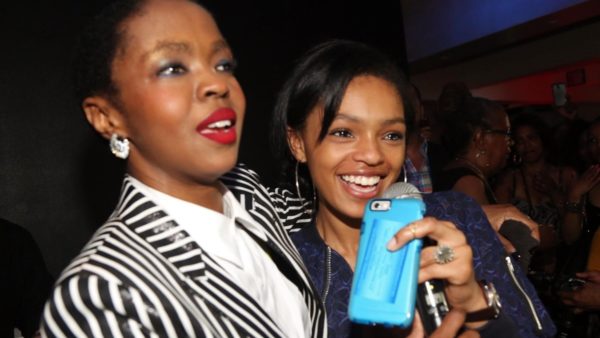
“Uhhhh Black people, what???,” wrote Lauryn on Thursday, Aug. 13, in an eight-page Instagram message. “Selah has every right to express herself, I encourage it, but she also got the discipline that Black children get because we are held to a different standard.”
“The discipline was seen through the lens of a young child who also had no place to reconcile me as mom, and me as a larger than life public figure,” she added. “If I am guilty of anything it is disciplining in anger, not in disciplining.”
Lauryn then wrote about the challenges she faced being a celebrity who spoke out about racial equality and admitted that the constant pressures affected her home life.
“The toxix venom I ingested for standing on principle, and confronting systemic racism far BEFORE it was the thing to say or do … the people who called me CRAZY and have yet to apologize and say ‘Oh yeah, we were wrong.’ Of COURSE that seeped into my home,” the New Jersey native explained.
Selah made her claims about her mother in a two-hour Instagram Live session on Monday, Aug. 10.
“She was just very angry. So, so, so, so, so, so angry,” said Selah about Lauryn, according to the Source. “She was literally not easy to talk to. And then the threats, the constant threats. That belt, man. That’s that slave s–t … That was some slavery s–t. All Black parents were on that s–t.”
Lauryn was heavily criticized afterward.
“Parents with toxic aggressive ways … need to stop and read the room concerning how they treat their children,” one person wrote on YouTube.
“She Took Her Hate and Bitterness Out On The The Children, Because Of The Father,” another person chimed in.
In that same video, Selah said that her father, Rohan Marley, Bob Marley’s son, wasn’t around like he should’ve been during her childhood, and his absence caused her to have problems with men in her romantic relationships.
Selah also claimed that her parents often argued when she was a child, and it still affects her today. Lauryn and Rohan have five children together and had an on-and-off relationship.
Rohan responded to his daughter’s claims on Tuesday, Aug. 11, in a statement released by his publicist.
“I love her very much and do apologize for any contributions I may have added by arguing in front of her as a child,” he said. “I’ve grown as a man, a spiritual being and a father. I will be there for her no matter how many hours, days, months or years it will take. I will be the best dad that I can be.”
Elsewhere in Lauryn’s message, the former Fugees member said that she spent much of her time as a parent protecting her children from the people who wanted to exploit her riches and fame, while also telling her critics not to have selective outrage.
“Selah is on a road to healing and contextualizing her childhood, and is allowed her process, but if you come for me, come for your own mama, and those absent fathers — come for them too, your grandparents, your great great grand parents … Caribbean parents, African parents and everyone else damaged and judged for being Black and forced to conform and assimilate to western standards of ‘order’ shaped through the filter and lens of anti-blackness,” wrote Lauryn.