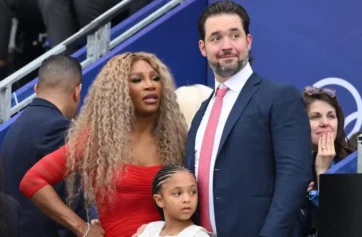
It appears that a host of a Romanian TV show will keep his job after he called Serena Williams a monkey on B1 TV in the European nation.
“Serena Williams looks exactly like one of those monkeys at the zoo with the red asses,” said host Radu Banciu. “If monkeys wore trousers, they’d look exactly like Serena Williams does on the court.”

Afterward, the National Council for Combating Discrimination, which is a part of the Romanian government, issued a press release and said Banciu was fined $1,875.
“The governing board shows that slavery of people of color was based, among other things, on their comparison with monkeys,” the press release read. “As a result, such statements express a form of extreme racism.”
Banciu’s words could remind people of that racist cartoon that was drawn by Mark Knight of Australia’s Herald Sun after Williams played in the 2018 US Open.
Knight drew the tennis star as a baby with big lips after she lost to Naomi Osaka in the finals, which made international news at the time.
And in 2007, at the Sony Ericsson Open, a heckler had to be removed after he yelled racist remarks at Williams.
“The guy said, ‘Hit the net like any Negro would,'” Williams recalled. “I was shocked. I couldn’t believe it. I had to do a double take. I think I hit a double fault on that point.”
But even before she joined pro tennis, Williams said that she and her sister Venus Williams faced racism on the court as young girls.
“I do remember one time I was playing, and these kids came up behind me while we were practicing — I was probably like 7 — they were calling me Blacky,” she said in 2016. “Me and Venus, they were like, ‘Blacky and Blacky.’ I remember thinking, ‘I don’t really care,’and that’s pretty crazy to think that at that age.”
In that same interview, Williams also explained how she was able to shake off those kinds of remarks, and she chalked it up to being raised properly.
“We were always told to love ourselves,” she explained. “My dad always said you have to know your history, and if you know your past, you can have a great future.”