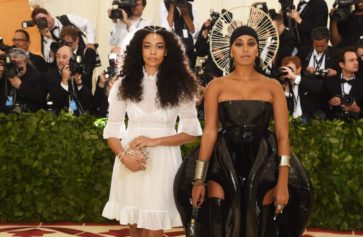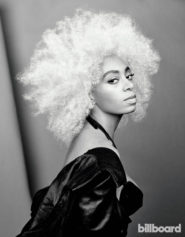
Solange (Mikael Jansson/Interview magazine)
Singer Solange’s newest album “A Seat at the Table” earned wide acclaim from fans and critics when it was released last year and the singer is now revealing how it came together. In an interview that steps outside the norm, none other than Solange’s superstar sister Beyoncé spoke to her about her career and image.
Bey called up her younger sibling for a story in Interview magazine, published Tuesday, Jan. 10, and the pair discussed what led Solange to have such control over her Grammy-nominated album.
“As far back as I can remember, our mother always taught us to be in control of our voice and our bodies and our work, and she showed us that through her example,” Solange said. “If she conjured up an idea, there was not one element of that idea that she was not going to have her hand in. She was not going to hand that over to someone.
“I do have — and I’m unafraid to say it — a very distinctive, clear vision of how I want to present myself and my body and my voice and my perspective,” Solange continued of her hit LP. “And who better to really tell that story than yourself? For this record specifically, it really started with wanting to unravel some truths and some untruths. There were things that had been weighing heavy on me for quite some time.”
Several guest stars make appearances on the album, including the Knowles sisters’ mother and father and rapper Lil Wayne. But Beyoncé was interested in exploring why Master P was featured on “A Seat at the Table.”
“I wanted a voice throughout the record that represented empowerment and independence,” Solange said. “The voice of someone who never gave in, even when it was easy to lose sight of everything that he built, someone invested in Black people, invested in our community and our storytelling, in empowering his people.”
Solange has a similar investment in Black people. Amid the excitement over her album that explores what it’s like to live in white spaces, the singer told Bey it was most gratifying to hear from Black women.
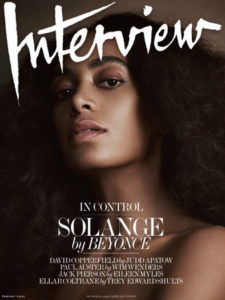
Solange covers “Interview” magazine (Mikael Jansson/Interview magazine)
“The biggest reward that I could ever get is seeing women, especially Black women, talk about what this album has done, the solace it has given them,” she said.
One song that has done that is “Don’t Touch My Hair,” which describes why white people shouldn’t run their fingers through Black women’s tresses. Solange explained she purposely sang with a tone that showed empowerment.
“It was very intentional that I sang as a woman who was very in control, a woman who could have this conversation without yelling and screaming,” the singer-songwriter said. “Because I still often feel that when Black women try to have these conversations, we are not portrayed as in control, emotionally intact women, capable of having the hard conversations without losing that control.”
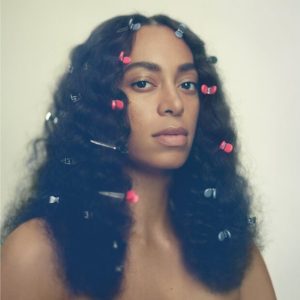
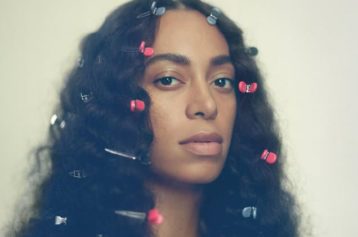
“A Seat At The Table” (Saint Heron)
As for that famous cover art that was imitated by Tracee Ellis Ross and was the focus of a cultural appropriation controversy last year, Solange said she wanted the image to exhibit the album’s personal content.
“I wanted to create an image … like, ‘Come and get close. It’s not going to be pretty. It’s not going to be perfect. It’s going to get a little gritty, and it might get a little intense, but it’s a conversation we need to have,'” she said, noting she was inspired by Leonardo da Vinci’s “Mona Lisa.”
“I wanted to put these waves in my hair and to really set the waves, you have to put these clips in. And when Neal [Farinah], the hair stylist, put the clips in, I remember thinking, ‘Woah, this is the transition, in the same way that I’m speaking about on ‘Cranes.’ It was really important to capture that transition, to show the vulnerability and the imperfection of the transition — those clips signify just that.”