
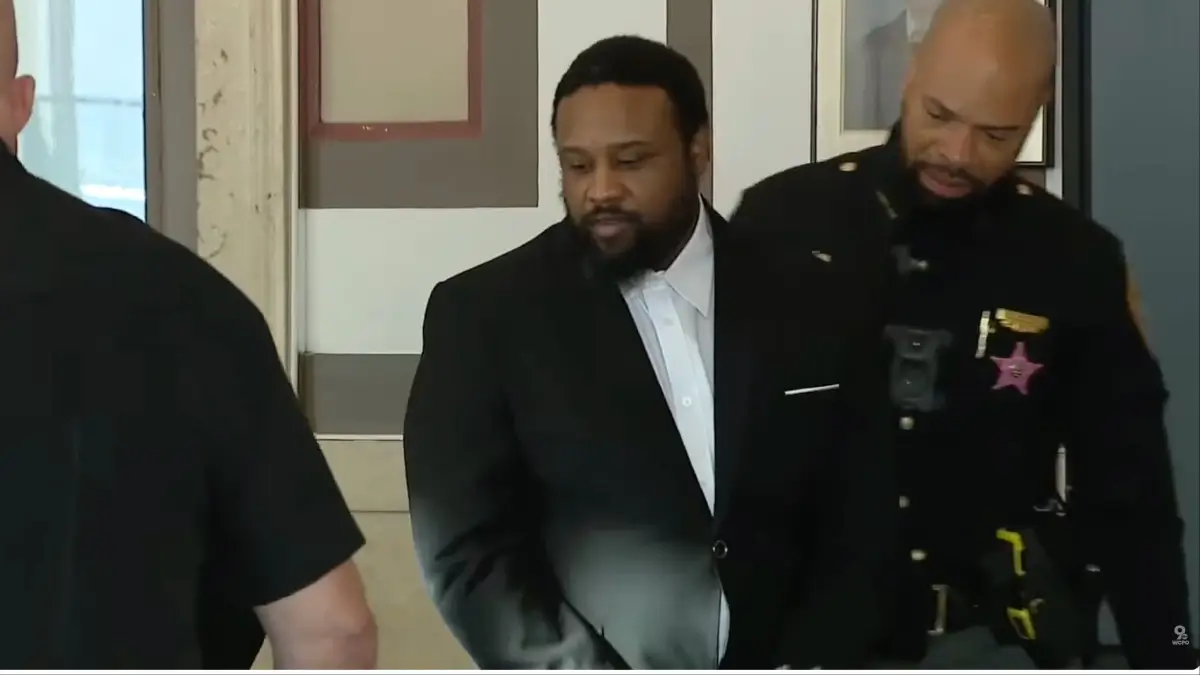
An Ohio jury found Rodney Hinton Jr. guilty of all charges after he killed a sheriff’s deputy after watching a video of police fatally shooting his son.
The verdict came after a nearly two-week trial and three days of jury deliberations.
Jurors convicted Hinton of murder, two counts of reckless homicide, and two counts of felonious assault.
Prosecutors accused Hinton of intentionally striking Hamilton County Deputy Larry Henderson with his vehicle on May 2, 2025, as the deputy directed traffic near the University of Cincinnati’s graduation ceremonies.
Earlier that day, Hinton had watched footage of a Cincinnati police officer fatally shooting his 18-year-old son, Ryan, the day before.
Hinton pleaded not guilty by reason of insanity.
Hinton’s aunt testified that she worried about his mental health. She said several relatives joined Hinton at the Cincinnati police building on Linn Street to watch the footage. Afterward, they did not want him driving home.
Hinton went to a relative’s home and slept for at least an hour. After he woke up, someone took him back to the police building to retrieve his vehicle.
“I think we should follow Rod home,” his aunt recalled saying.
But the trip quickly became confusing. Hinton left the parking lot, made several turns, and returned, she testified. He told relatives he thought he had forgotten something.
When he left again, his aunt and another relative followed him toward Clifton, where graduation traffic crowded the streets.
While they sat in traffic, Hinton changed lanes. His aunt assumed he had noticed them following him and wanted to get away.
“He just takes off,” she testified, describing his speed as “really, really fast.”
Hinton’s attorney described a mental health crisis that started years before the crash. Childhood abuse, depression, and psychosis left him vulnerable, attorney Clyde Bennett II told jurors. He argued that Hinton watching an officer fatally shoot his son pushed him further from reality.
Bennett also argued that Hinton did not understand the wrongfulness of his actions that day. He described his client as an unmedicated man suffering from psychosis and overwhelming grief.
Prosecutors disputed that account.
“He knew it was wrong. He just didn’t care,” Assistant Prosecutor Heidi Rosales said during opening statements.
Rosales acknowledged that Hinton received diagnoses of bipolar disorder and schizoaffective disorder after the crash. But she argued that a mental illness diagnosis does not establish legal insanity.
Prosecutors called two mental health experts to the stand. Both testified that Hinton didn’t show signs of an acute psychotic break immediately after he hit Henderson.
“There are things that indicate he did understand the wrongfulness of his conduct,” forensic psychologist Jennifer O’Donnell testified for the prosecution.
During the trial, Hamilton County Common Pleas Court Judge Jody Luebbers ruled that the jury could consider the lesser charge of reckless homicide, which carries a maximum three-year sentence.
She also agreed to rule out the death penalty in the case after multiple experts testified to Hinton’s mental illness during pretrial hearings.
Hinton decided not to take the witness stand. Jurors were also not shown a recorded police interrogation of Hinton.
Hinton faces 15 years to life in prison on the murder charges, though with the possibility of parole. His sentencing hearing will take place on Nov. 16 at 9 a.m.


