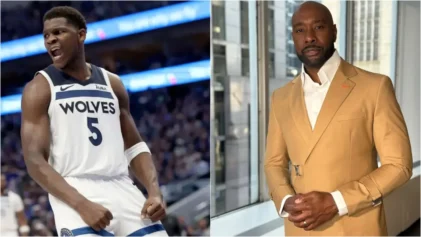
Morris Chestnut has many roles in his acting catalog.
Most may know him as Ricky in “Boyz In the Hood,” Lance Sullivan in “The Best Man ” franchise, John Watson in “Watson,” or, more recently, Corey Cash in Hulu’s “Reasonable Doubt.”
From romantic dramas to comedies, Chestnut became a familiar face in Hollywood by showing his range while building a loyal fan base.

However, some fans may not remember one of his earliest television appearances on a show that recently got a reboot.
Long before many of his most recognizable roles, Chestnut made a brief appearance in an episode of “A Different World” for a scene that never made it to air.
The actor appeared on the Oct. 13 episode of the “R&B Money” podcast, where he reflected on his early acting days and auditioning for a role as a food server on the hit sitcom.
“A Different World” series ran for six seasons from 1987 to 1993 and followed students at a fictional HBCU, with Chestnut’s character greeting students as they arrived to grab a bite to eat.
“So I did that in the audition. I smiled and said hi, and so that was it,” he said.
Chestnut was over the moon when his agent called a few days later with the news that he’d landed the role — along with a pretty sweet weekly paycheck.
Chestnut recalled being offered $1,500 per week for the role, admitting that the paycheck immediately caught his attention.
“They said, ‘If you do the job, it’s going to pay $1,500 per week” — and all I heard was 1,500. I said, ‘How much?’ He said, ‘I said $1,500 per week. You get this, you get that.'” he said.
After calculating what he would earn, he started wondering how much the show’s leads, Dwayne Wayne and Whitley Gilbert, made.
“So I start doing my math and I’m like, ‘Wait a minute, so if I’m saying hi for $1,500, what is Dwayne Wayne getting? What is Whitley Gilbert getting?’” Chestnut explained.
Although his scene ultimately didn’t make the final cut, Chestnut was still paid for his work and continued auditioning for the beloved sitcom, creating some memorable moments alongside fellow actors who would go on to become A-listers.
“I remember there were a couple times when I did go back to “A Different World” and I’ll never forget, when I went to this audition Martin [Lawrence] wasn’t Martin yet but he was there at the audition and he was in outside — everyone’s got their papers outside — and of course he’s holding court with all the comedy and everything.”
He concluded, “There were [a few] roles on ‘A Different World’ that I didn’t get. There were a lot of roles that I didn’t get.”
With more than three decades of captivating audiences across film, television, and streaming, Chestnut has cemented his status as one of Hollywood’s leading men.
His estimated $6 million net worth reflects years of on-screen success and real estate investments. Shout-out to “A Different World” for giving him an early boost as he began turning his acting talent into a lucrative career.
Chestnut’s reveal on his “A Different World” auditions and cut scenes comes as the popular sitcom enjoys renewed attention with a well-received Netflix reboot.
The revival follows the original cast members’ children as they return to Hillman, carrying on their parents’ legacies while carving out their own paths at the iconic fictional HBCU.
Morris Chestnut shared how an audition for A Different World changed his career path. After learning the role would pay $1,500 a week, he decided acting was worth pursuing full time. Although the script was later rewritten and he lost the role, the experience motivated him https://t.co/tU4CaWUgib
— Global Celeb Updates (@gcelebupdates_) October 14, 2026