President Donald Trump is no stranger to awkward moments at the White House, but his latest Oval Office gathering came with a distraction he probably never saw coming.
What was supposed to be another carefully staged announcement quickly took an unexpected turn as viewers began focusing on something unfolding directly behind his back.
While the 80-year-old president nap, a woman standing just inches behind him stole the spotlight with her unusually wide-eyed stare, restless movements and repeated gestures toward his chair.
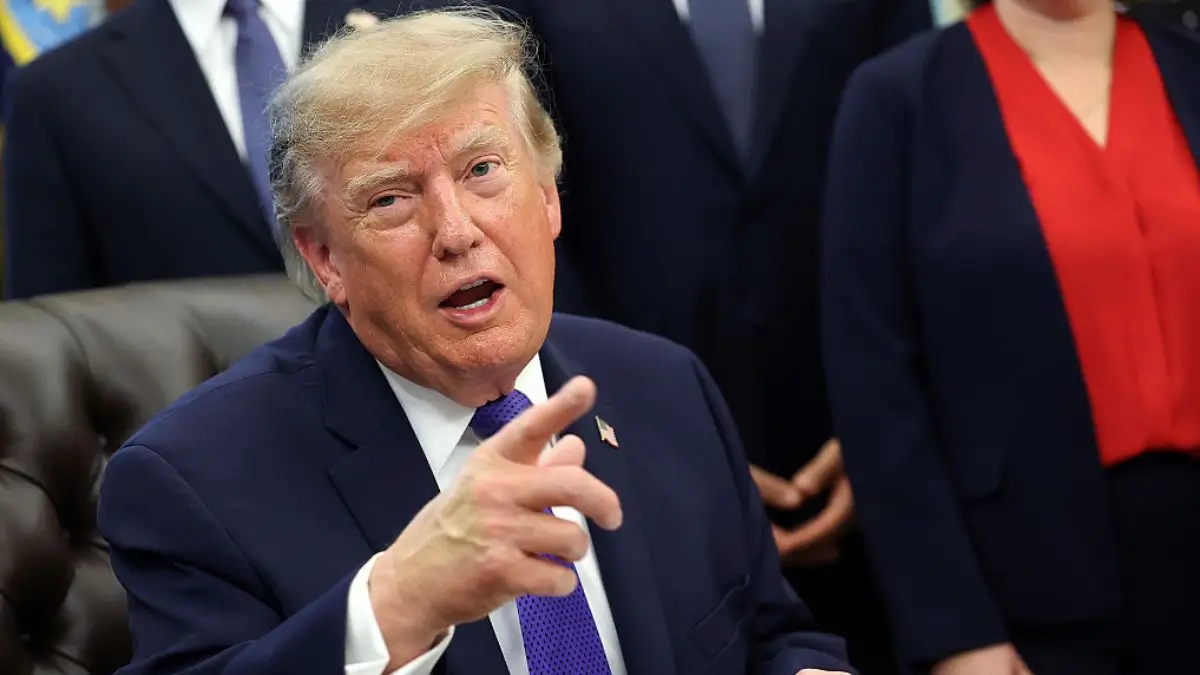
But the moment grew even more awkward when Trump suddenly turned around and put her on the spot.
The woman was Susan Dell, who is married to Dell Technologies billionaire Michael Dell.
The couple joined Trump on Oct. 7 to promote his signature investment accounts for children.
Their $6.25 billion commitment was supposed to be the headline. Instead, Susan’s facial expressions and body language threatened to steal the spotlight.
Standing behind the president, Susan appeared tense. She shifted her posture, blinked repeatedly, fidgeted with her hands, and touched Trump’s chair.
Her eyes remained noticeably wide as she stood among the guests. Then Trump unexpectedly put her on the spot.
After Michael finished speaking, the president turned toward Susan and asked, “Susan, do you have anything to say?”
She began delivering remarks about helping children dream big and build brighter futures. Her speech was occasionally hesitant. Her expression remained tense as she addressed the room.
Trump initially stared ahead sternly. He eventually turned to watch her. By the time she finished, his demeanor had changed.
“Wow, good job,” Trump said, his eyes widening. Then he turned toward her husband and asked, “Michael, is she thinking about running for office?”
Michael answered, “No.”
“I’ll endorse her immediately,” Trump declared, offering his “complete and total” endorsement.
The unexpected exchange added another awkward chapter to a meeting already generating plenty of online chatter.
On Threads, one viewer looked past Trump’s “sickly” look to zoom in on the woman behind him. Two people asked, “Who is that stuck woman in red? Wow. Ick” and “What was that tapping about?”
Over on Hollywood Unlocked’s Instagram page, commenters turned the appearance into an unofficial Halloween preview.
An X user delivered a particularly brutal assessment, wondering, “Is this in honor of Halloween this month?” Another said, “Look at her face! Who’s taking advice from her?!” Another replied, “The female robot is back.”
But Susan was hardly a stranger to this kind of online scrutiny.
In December 2025, the Dells visited the White House to announce their multibillion-dollar commitment to Trump Accounts. Viewers quickly shifted their attention from the money to Susan’s expressions. Video showed her blinking slowly and leaning sideways. She also appeared to fidget while standing behind the president.
Months later, another White House appearance had viewers questioning the behavior of people surrounding Trump.
The March 2026 viral image showed the president leaning forward while speaking to reporters. But attention soon shifted to a woman standing near the White House entrance.
Viewers compared her stiff posture and expression to a character from “The Stepford Wives.” The woman was later identified as Trump aide Natalie Harp.
In July, Trump’s rollout of the children’s investment accounts created another distraction. Youngsters grew restless during a lengthy Oval Office appearance. Some sat on the floor. One boy even appeared to fall asleep.
As that controversy faded, footage of Susan’s earlier appearance resurfaced. Her facial expressions again became a topic of discussion.
The scrutiny has also fueled speculation about cosmetic surgery.
Last year, the Irish Star consulted cosmetic specialists about Susan’s changing appearance. They suggested that procedures such as a facelift, eyelid surgery, Botox or fillers could explain the differences viewers noticed.
One surgeon also raised the possibility of excessive facial fillers. However, neither specialist examined Susan. There is no confirmation that she underwent cosmetic surgery or received any of those treatments.
The experts also noted that lighting, makeup and camera angles can dramatically change someone’s appearance.
For the Dells, the latest White House visit was supposed to celebrate billions of dollars in opportunities for children. Instead, Trump’s impromptu endorsement and the internet’s fixation on Susan overshadowed the announcement.
The president may have briefly closed his eyes, but social media users certainly kept theirs open — especially when it came to Susan Dell’s expressions.
Creepy body language of an American billionaire’s wife in front of the cameras.. Susan Dell stands next to her husband with tense features, continuously placing and tapping her finger on Trump’s chair throughout the press conference https://t.co/LXoIRxd6bV
— John F. Kennedy Jr Q (@Real_JFK_Jr_) October 8, 2026


