Without a clear understanding of the law, Ohio cops arrested a 32-year-old Black man waiting for the bus on the sole basis he was wearing a yellow safety vest, accusing him of violating the city’s solicitation law.
But the solicitation law in Barberton prohibits people from conducting residential door-to-door solicitation without registering their credentials with the city.
It does not apply to people waiting for a bus minding their own business wearing a yellow safety vest.
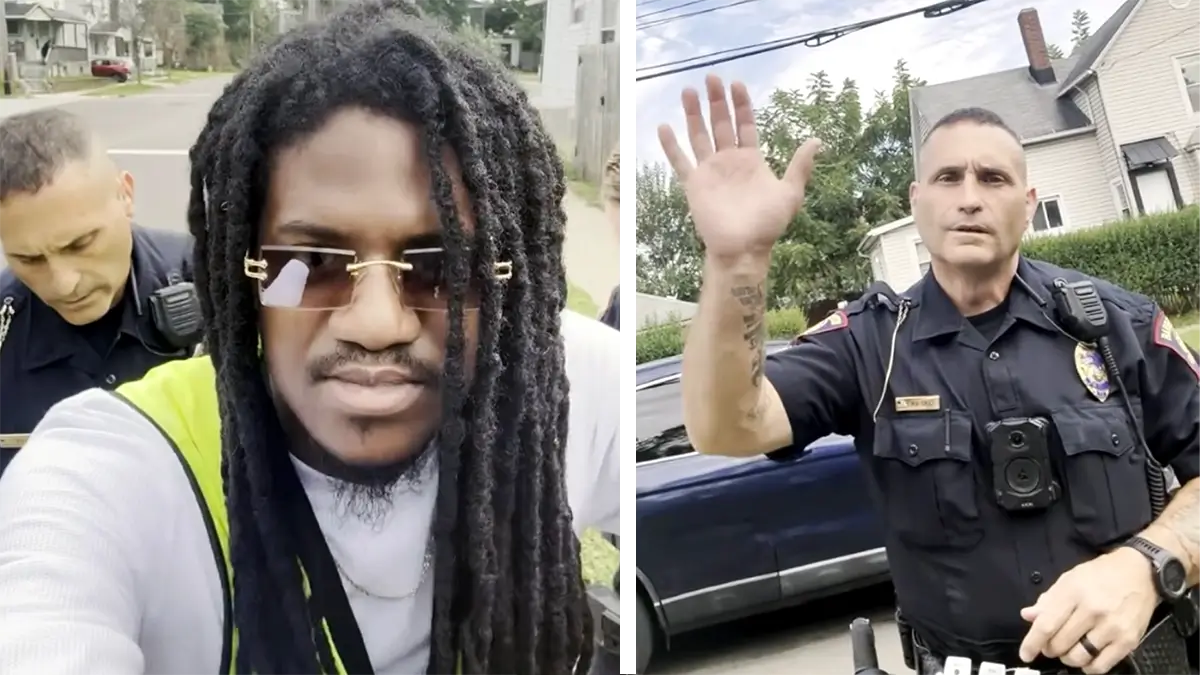
That explains why the cop arrested Vincent White on a single charge of failure to disclose personal information and not for violating the city’s solicitation law, according to online court records.
But that charge is unlikely to stand either since the cops had no reasonable suspicion he was committing a crime — a requirement stemming from the 1968 landmark U.S. Supreme Court ruling Terry v. Ohio — which is based on an arrest that took place in a locale less than an hour from Barberton.
“It’s not reasonable to assume that a person simply by virtue of what they’re wearing is soliciting if you don’t actually see them come and go from somebody’s residence,” said James White, a former cop, prosecutor and defense attorney who runs the YouTube channel Southern Drawl Law.
“When residence is an essential element of a crime and you’ve not observed them or had any report of them actually approaching a residence, you have nothing except a hunch and a hunch is not reasonable “reasonable, articulable suspicion,” suspicion.”
But court records show the charge remains pending, with his next hearing scheduled for Oct. 28.
“It’s pretty pathetic that you’re a sergeant, ostensibly a supervisor in a municipality in Ohio where this case law comes from … and you still don’t have a handle on it,” White said in his video posted Sept. 27.
Barberton Police Sgt. Michael Casey, who has been working for the department since 2014, making more than $106,000 in 2024, confronted Vincent White on Sept. 10.
“Sir, I didn’t do anything wrong, I’m standing on the corner waiting for the bus,” White says after he starts recording.
“Sir, you’re wearing a gas and power thing identifying yourself,” Casey says.
“I’m investigating whether or not you’re soliciting in a town that has …”
“I’m not soliciting,” White responds.
“Then I’ll identify you and you’ll be on your way,” Casey says.
But White refused to identify himself which is his right based on the above-mentioned case law.
“Why are you identifying me? I’m waiting on the bus,” White says.
“OK. You are not free to go,” the cop says.
“Are you on a power trip right now?” White asks.
“No, I’m not,” the cop responds.
“Feels like a power trip,” White says.
And it certainly looked like a power trip after the cop patted White down for weapons, removed his identification from his wallet and placed him in the back of his patrol car.
“My lawyer is going to love this,” White says.
“Your lawyer is going to be frustrated with you,” the cop responds, revealing his ignorance of the law.
“You must be bored today, Black guy waiting on the bus, let me stop him,” White says from the back of the patrol car.
“You want to shoot me or something, do it,” he continues, prompting Casey to accuse him of being “dramatic.”
“I’m in the back of a cop car for no reason,” White responds.
“For doing something suspicious in the city of Barberton,” Casey responds without ever articulating what that “something” was that made White suspicious in his eyes.
Online court records do not show how long White remained in custody, but he posted the video to his YouTube channel the same day as his arrest, and others have since shared it on other platforms.
“Reasonable articulable suspicion of a crime….. they got none,” wrote one commenter on the YouTube video. “Illegal detainment. Unlawful stop. Unlawful demand for ID. Deprivation of rights under the color of law. A federal crime.”
“Just another criminal dressed in a police costume. Should file a lawsuit. This garbage has to stop,” the commenter continued.
Another commenter who described himself as a “retired cop” said “this scumbag violated your rights, talk to an attorney!”
“Looks like armed kidnapping and holding you against your will to me,” wrote a third commenter.
White, the attorney who runs Southern Drawl Law, said even if the cop had reasonable suspicion White was committing the crime of solicitation, the cop still had no right to frisk him for weapons.
“Solicitation is not a violent offense,” he said.
“There’s no reason for a person who says they just got off work, who’s wearing a high visibility vest who you might think is soliciting based on wearing that vest, but nothing about that person’s demeanor or anything like that would lead you to believe that they’re armed and dangerous.”
Atlanta Black Star attempted to reach Vincent White at a phone number associated with him but had not received a response by publication.


