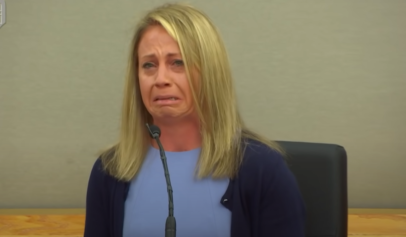
Seven years to the day after a Dallas jury convicted her of murder, Amber Guyger got the news Botham Jean’s family spent two years trying to stop.
The former Dallas police officer, who fought all the way to the U.S. Supreme Court to get that conviction thrown out, has been approved for parole with roughly three years left on her sentence. For Jean’s loved ones, the timing could hardly have been crueler.
Just two days earlier, he would have turned 35. His family had begged the state to make her serve every last day. The reasons the parole board gave for letting her go anyway have people asking who the system was really built to protect.

For anyone catching up, it still sounds impossible. On Sept. 6, 2018, Guyger came home in uniform after a long shift and walked into the wrong apartment at the South Side Flats in Dallas. She lived on the third floor. Jean, a 26-year-old accountant from St. Lucia, lived directly above her on the fourth, according to FOX 4.
She found his door partly open, believed he was a burglar and shot him. He had been sitting in his own home eating a bowl of ice cream.
On Oct. 1, 2019, jurors rejected her claim that it was an honest mistake and found her guilty of murder. She became the first Dallas officer convicted of murder since 1973, and the next day she was sentenced to 10 years.
Now the Texas Board of Pardons and Paroles, whose members are appointed by Gov. Greg Abbott, has approved her release over the family’s objections. And the reasons it listed had nothing to do with the man she killed.
They were all about Guyger. The board said her record showed no documented pattern of violent or assaultive arrests, that she had maintained a “satisfactory institutional adjustment” behind bars and that she’d completed treatment programs meant to help her land and keep a job once she’s out.
Her next review wasn’t due until Oct. 10, and the board said the prison system will decide when she walks free. No date has been announced.
Lee Merritt, a civil rights attorney who previously represented the family, says he is “deeply disappointed” by the outcome.
“A 10-year sentence was already a fraction of what was lost. Releasing Ms. Guyger after seven years makes that loss feel even smaller in the eyes of the system. It is not,” Merritt said in a statement sent to Atlanta Black Star.
Minister Dominique Alexander, founder of the Next Generation Action Network, put it more plainly. “Amber Guyger has been granted the opportunity to return home. Botham Jean will never have that opportunity,” he said in a statement.
On social media, the anger came fast, particularly under one X post.
“The fact that she only got a decade to begin with is wild,” one person wrote.
Another kept it short: “1 ‘justice’ system for Black people and 1 system for white.”
“And if the roles were reversed in that story, he’d be doing life or got the death penalty,” a third added.
One reply centered the victim. “Mr. Jean was at home minding his own business and did nothing to incite the deadly force inflicted upon him. He should still be alive today.”
And one summed it up: “Plain as day man- ain’t nothing change but the year. Rest in Power Botham Jean.”
This was supposed to be settled two years ago. Guyger first became eligible on Sept. 29, 2024, which would have been Jean’s 33rd birthday. More than 6,000 people, including his family and the Dallas County district attorney, signed a petition against her release, and the board turned her down that October.
“She needs to serve her entire 10-year term, which is well below a sentence that one receives for murder,” his mother, Allison Jean, told CBS News Texas at the time.
Weeks later, a federal jury ordered Guyger to pay the family $98.65 million in a civil trial she didn’t attend. Under the conditions, any future money Guyger tries to make from book or movie deals with go to the family.
In March 2026, Jean’s family filed a civil lawsuit against the City of Dallas asking for nearly $100 million in damages. That case is still pending.
A Texas appeals court upheld Guyger’s conviction in 2021, and the Supreme Court declined to take up her case in November 2022. Jean’s sister, Allisa Findley, had blasted her appeal as disrespectful, saying the sentence felt like a slap on the wrist.
Many still remember her sentencing, when Jean’s younger brother, Brandt, hugged Guyger and told her he forgave her, the Black judge presiding over the case embraced her too. Some saw grace. Others saw a kind of mercy Black defendants rarely get.
Seven years later, the state just extended her a little more. Jean’s family says they’ll keep saying his name.