Jurors told the court Monday they could not reach a verdict, prompting a federal judge to declare a mistrial in the case against District of Columbia Council member Trayon White Sr., whom prosecutors accuse of accepting $35,000 in cash bribes from a city contractor in exchange for helping secure multimillion-dollar contracts to provide violence prevention services to Washington-area youth.
White, 42, a Black Democratic lawmaker who has represented Ward 8 in southeastern Washington since 2016, faced up to 15 years in prison and removal from office if jurors found him guilty.
U.S. Attorney Jeanine Pirro said in a statement on Monday that she will retry the case before another jury.
White chaired the D.C. Council’s Committee on Recreation, Library and Youth Affairs, which oversees the District’s Department of Youth Rehabilitation Services (DYRS). The FBI arrested him in August 2024 after an informant, government contractor Allieu Kamara, engaged White in a “quid pro quo” deal to help Kamara’s homeless and mental health services companies win government contracts by having White influence decision-makers in the contracting process.
The jury saw hidden camera video footage of four separate meetings between White and Kamara in Kamara’s Cadillac Escalade during the summer of 2024 during where Kamara handed over envelopes containing thousands of dollars in cash as part of an alleged deal to pay White a kickback of 3 percent of the total award amount of the government contracts he helped Kamara secure.
Kamara became an FBI informant after he pleaded guilty in 2024 to taking a $230,000 bribe and to bank-fraud conspiracy.
The September 2024 indictment of White said he had first taken a $20,000 bribe from Kamara in 2020 to help him resolve a $4 million contract dispute with the district after Kamara lost a government contract because he submitted falsified background checks for workers employed by his company. (White denies taking the bribe and prosecutors never charged him for such a crime).
Kamara said he first met White about 15 years ago and had donated $75,000 to his campaigns over the years. The two men traveled to the Dominican Republic together as friends in 2019, according to the trial evidence, The Washington Post reported.
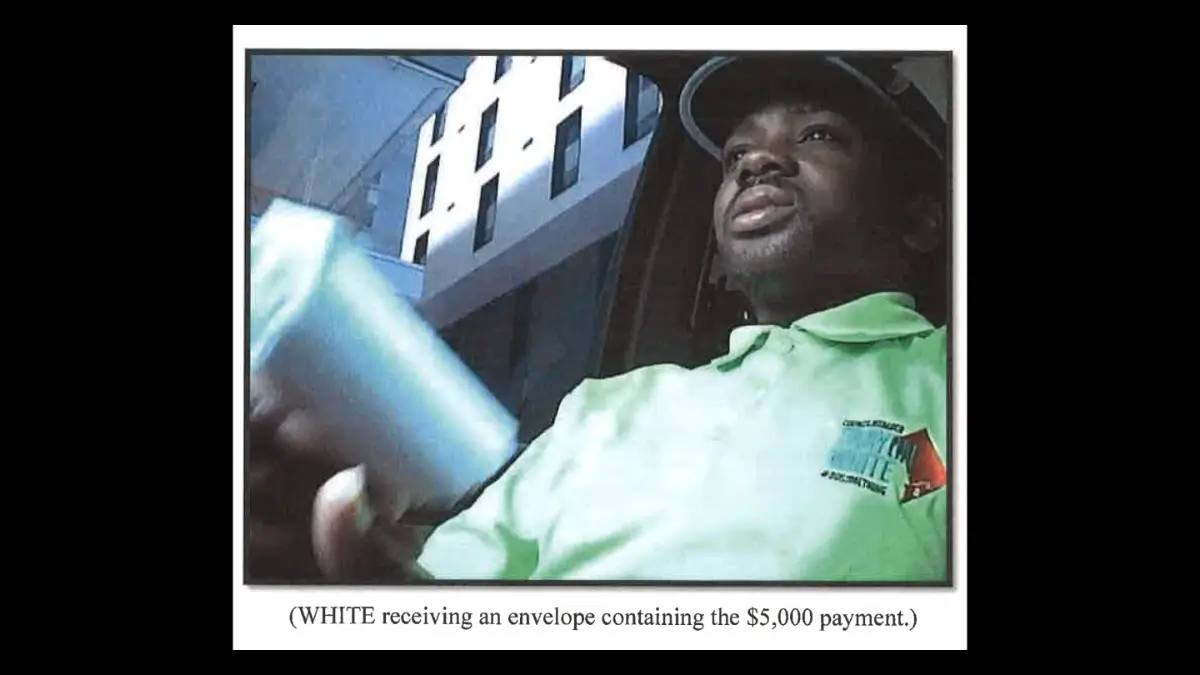
During their first meeting in Kamara’s car in June 2024 as part of the alleged bribery scheme, White accepted an envelope containing $15,000 cash, while saying, “What you need me to do, man? I don’t, I don’t wanna feel like you gotta gimme something to get something. We better than that.”
But White then put the envelope containing the money in his jacket pocket.
The two then discussed the specific tasks Kamara wanted White to perform, including meeting with a mayor’s office official to find out whether the city would renew Kamara’s existing contracts. White said he would and suggested there were more opportunities for White and Kamara to work together to secure contracts “in the mental health space. … Like there so much sh-t we be doing.”
In July, in another videotaped meeting in Kamara’s wired car, White updated Kamara on his efforts to pressure government officials to extend grants for violence prevention services to two of his companies. Then Kamara shared a ledger showing his pending grants and offered a kickback of 3 percent of each grant’s value, which amounted to $141,000 for White, which he accepted, the indictment said.
White expected to receive $156,000 from the deal, which involved $5 million in government contracts.
Kamara then handed White an envelope with $5,000, and said, “That’s for making sure you reach out to [two D.C. officials involved in grantmaking].”
“I’m on top of all that,” White replied. “You know me, I’m already moving. Once you and I lock eyes and get to an understanding, I gets to work.”
That comment meant, Justice Department prosecutor John Crabb, Jr. said in his opening arguments, that White was willing to defraud the D.C. government, violate his official duties as an elected official and “sell his office as a D.C. Council member,” reported Courthouse News Service (CNS).
But Warren Kohlman, White’s defense attorney, portrayed Kamara as the primary offender, citing his background of engaging in government contract fraud, including through the Covid-19 Paycheck Protection Program, and calling him “corrupt to the bone.”
The FBI had used the informant Kamara, who was desperate to avoid prison time stemming from his 2024 plea deal, to induce White into committing a crime, Kohlman argued, but White did not do so, he said.
“If there’s no quid pro quo, there’s nothing wrong, and it’s certainly not bribery,” Kohlman told the jury.
In his motion to dismiss the case prior to trial, White’s attorneys argued that the U.S. government had provided “no evidence that White took a single step that would violate the bribery statute. The most that the Government will be able to prove is that White attended a single meeting with two government employees who were involved with one of the [informant’s] contracts. … At no time during the meeting did White attempt to pressure the employees on what decision they should make as to the confidential informant’s contract.”
The motion further argued that Supreme Court precedent found that “even when a public official has received something of value from a constituent, lobbyist or private citizen,” an elected official can set up and attend a meeting with a public official who has authority over a matter affecting that person and “can relate back information learned at the meeting” and “can express an opinion as to what he thinks is the proper outcome of a matter that is pending before a government agency and demonstrate his support for the constituent, lobbyist or private citizen.”
While Kamara “followed a script provided by the government that was designed to steer White into making commitments to speak with government employees about [Kamara’s] contract, and that was his mindset, … White’s mindset was otherwise,” his attorneys contended.
The dialogue between the two shows “White never committed to doing anything on behalf of the confidential informant, and aside from a single meeting, he did nothing.”
His attorneys did not dispute that White took the $35,000 in cash from Kamara. But they said he never intended to pressure D.C. officials to renew Kamara’s contracts. He only looked into the status of the contracts, Kohlman said.
Three D.C. officials White told Kamara he was in touch with regarding the contract renewals testified during the trial that the council member never pressed contractor issues with them, the Post reported. They were Deputy Mayor Lindsey Appiah; Kwelli Sneed, who led the Office of Neighborhood Safety and Engagement (ONSE), a D.C. agency in charge of violence interruption programs; and Anwar Walker, a former contracting specialist.
Prosecutors countered that White broke the law when he agreed to take cash to advocate for Kamara’s contracts, regardless of whether his advocacy worked. They pointed to White’s remarks in the video in which he tells Kamara that he told Sneed, who was then an interim director of ONSE, that he would not vote for her confirmation to her position full-time unless she supported his initiatives.
According to the indictment, White said he told Sneed, “The only way I’m gonna support you, if you support me.” He further assured Kamara that though he was only 1 of 13 council members voting on her confirmation, “They can still get it passed without me. But I’m a huge voice when it comes to violence prevention and the Council.”
White then proceeded to tell Kamara “We are in a good place” regarding one of his government grants, and to “make sure we cross the finish line … I think that I got to massage it a little bit more and I got an inside person that I am working with.”
Kamara then handed White an envelope containing $10,000 in cash that White had previously requested, prosecutors said.
During their three days of deliberations, jurors seemed to struggle with whether White’s words and actions broke the law.
Last Thursday the jury foreman sent notes to the judge asking, “Do we need to see a contractual benefit to one of Kamara’s businesses getting a contract extension in order for it to be bribery?” and “Is it bribery if the defendant received money to perform an official act, but had no intention of fulfilling the agreement?”
“No,” answered U.S. District Judge Rudolph Contreras to the latter question.
The jury ultimately told the judge that they could not agree on whether White was guilty or not guilty because their positions were “cemented.”
Contreras then declared the case had ended in a mistrial.
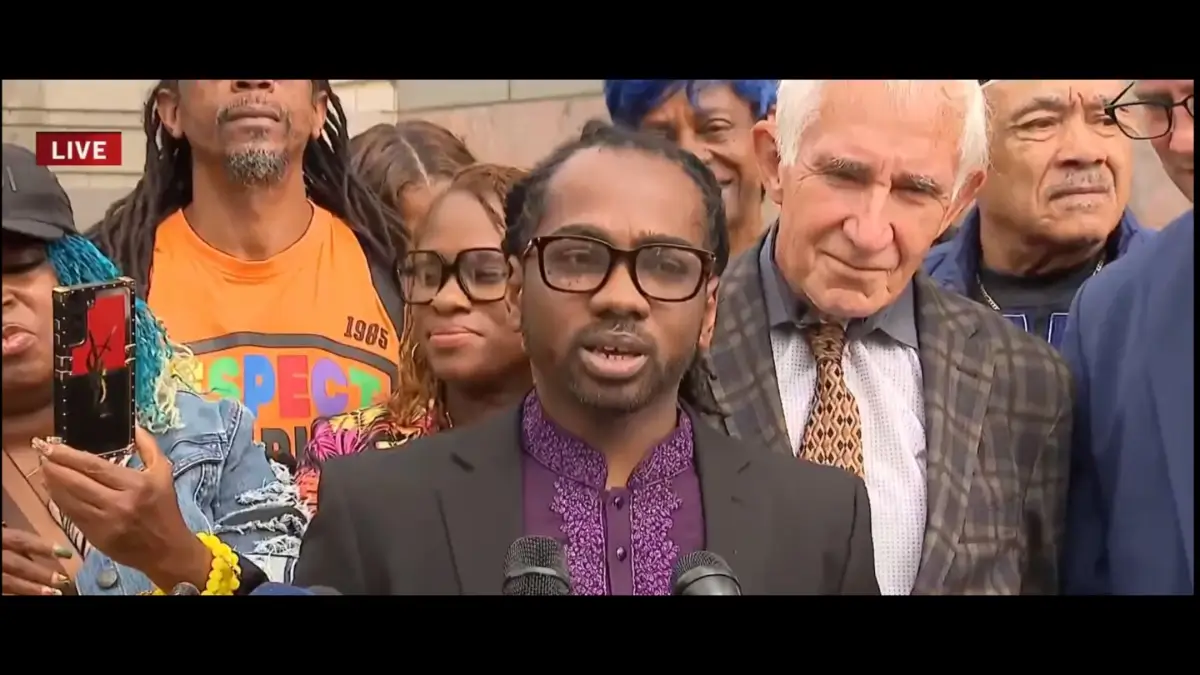
In remarks to his supporters gathered outside the courthouse, White thanked God, his defense team and all those “who played a part in this victory,” the Post reported.
“It’s been over two years of me being patient and hoping to get to this moment,” White said.
News4 Washington, an NBC affiliate, asked White outside the courthouse: If the $35,000 cash he accepted wasn’t a bribe, what was it?
“Let’s stick to the topic, man. Come on,” replied White. “You’re smarter than that. I can’t speak to that,” he replied.
“That is the topic,” News4 said.
White said he would get back to work to ensure equity and inclusion.
“There was no there there. And the jury, under careful deliberations – in fact, the jury deliberated longer than the trial lasted,” White said. “The prosecutor didn’t submit sufficient enough evidence to convict me of a crime. There was no crime in the first place.”
Pirro immediately signaled her intention to go after White again.
“We have video showing piles of cash being given to a D.C. councilmember as part of a $156,000 bribe,” Pirro said Monday in a statement. “Rest assured that we will retry this case and every corruption case to a verdict.”
The mistrial outcome leaves White able to continue representing his constituents in Southeast Washington for now.
The D.C. council has the authority to expel White, as it voted 12-0 to do so last year following his federal bribery indictment.
He won the seat back in a special election months later, though he lost his positions on council committees and leadership positions, CNS reported.
On Monday D.C. Council Chairman Phil Mendelson, a Democrat, told the Post in a brief telephone interview that he expected that the council would allow the legal process to unfold without taking any action.
“I don’t think the council will move at this time with expulsion,” he said. Asked for a reason, he said, “That’s the best you’re going to get out of me.”
“The fact that the court had a mistrial does not absolve the councilman of possible guilt,” said Craig Holman, a government affairs lobbyist for the nonprofit group Public Citizen, who has advocated for the council to adopt a more stringent ethics code. “I would still encourage the council to at least admonish the councilman, so it doesn’t look like they’re giving a nod of approval.”


