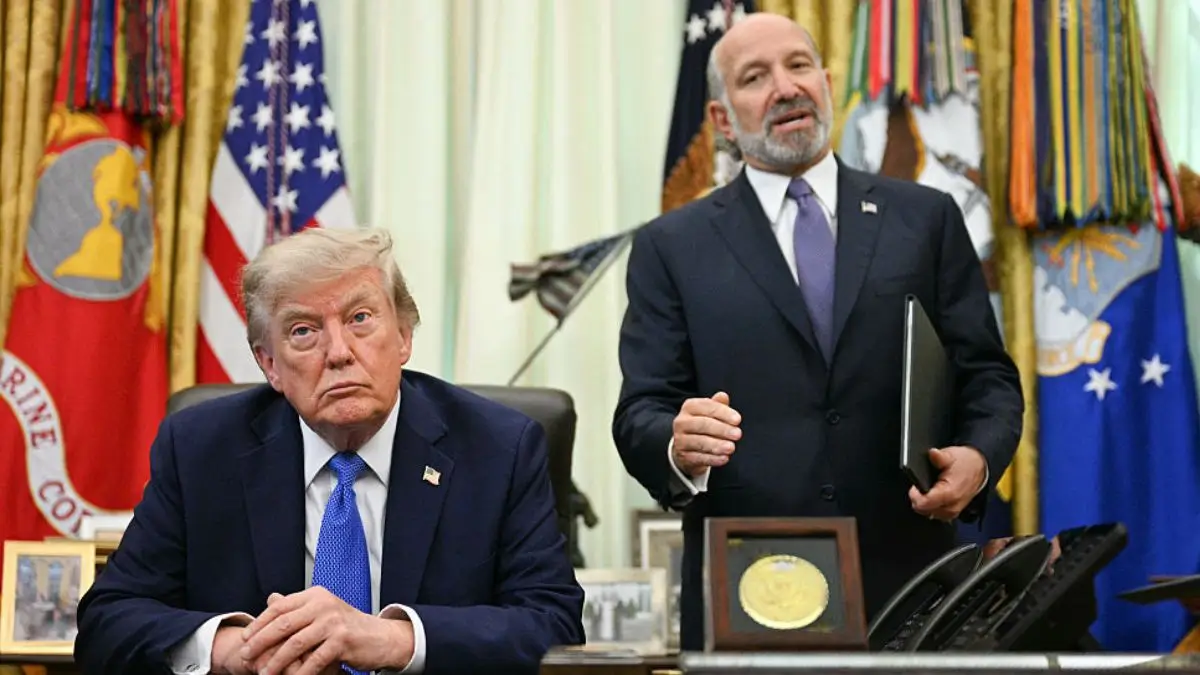
A photograph of Commerce Secretary Howard Lutnick standing behind President Donald Trump has taken on a life of its own. Lutnick appears to make a choking gesture and grimace while Trump’s back is turned.
The photo captured Lutnick on Sept. 28 as he animatedly discussed the White House announcement of a new steel mill in Iowa.
On its own, the image could pass for an awkward moment caught on camera. The strange moment takes on a sharper edge when paired with an account of what happens when the president faces his own Cabinet, according to a new report.
The Politico report describes a White House where senior officials routinely avoid challenging the president. One administration official described a Cabinet full of people who have learned to go along with Trump on everything, rather than tell him when they think he is wrong.
That account, combined with the steady stream of departures from the West Wing this year, paints a picture of an administration where loyalty to Trump can matter as much as — or more than — the normal boundaries of a Cabinet job.
Some of the reaction to Lutnick’s gesture was severe. One person described it as “Evil.”
Another offered a more restrained response, calling it an “Interesting picture.”
But others saw the image as a glimpse of what they believe happens when Trump is not looking.
“I suspect that anyone who dares to contradict the idiot in chief gets lots of late-night harassing phone calls. Big baby doesn’t take No for an answer,” one said.
Another added: “They are cowards. Vile enablers who must pay for their inactions. Their day of judgment awaits them. Mercy will not be shown.”
A senior administration official told Politico that Cabinet members have increasingly learned that their job security is based on avoiding direct confrontation with the president.
“There’s a huge emphasis to basically steer where he’s gonna go. It turns most of the Cabinet into yes people,” the anonymous official told Politico.
The official added: “Everybody wants to keep their job, and those who haven’t had a pre-existing relationship with the president don’t have the ability to tell him the truth.”
The report also describes a president who does not necessarily trust the people around him. Aides said Trump sometimes asks questions he already knows the answers to, using the exchanges to determine whether someone is being truthful with him.
“The president likes watching people squirm a little,” said a person close to the White House. “Or to put it differently: Who’s a player and who’s furniture?”
That dynamic has also affected how Cabinet officials respond to major policy decisions. When Trump launched his war on Iran at the end of February, the White House instructed Cabinet officials to remain silent while Trump’s Truth Social account served as the administration’s main public voice on the matter.
Defense Secretary Pete Hegseth did not publicly discuss the war, its objectives or its strategy until the morning of March 2, when he held a Pentagon briefing.
Politico’s reporting also describes a Cabinet in which officials can suddenly inherit responsibilities far outside their assigned portfolios. Lutnick, for example, was unexpectedly tasked by Trump with addressing problems at the Kennedy Center after a federal judge ordered the president to remove his name from the venue.
That assignment had little connection to Lutnick’s official responsibilities at the Commerce Department.
“If you bring a problem up to the president, and it’s not exactly in your lane, and it’s really not in anybody else’s lane, but there’s a problem, you will inherit that problem,” said Homeland Security Secretary Markwayne Mullin. “Because the president will listen to you, get your opinion, and he’ll say, ‘Well, go fix it.’”
A former senior Trump administration official told Politico that Trump tightly controls the White House, forcing officials to constantly seek his approval.
“What you have is a very strong centralized authority figure, and everybody is trying to stay in his good graces and keep him happy from a personality perspective,” one former senior Trump administration official said. “Trump is a very strong monarch, and when you have a strong monarch and weak barons, they’ve got to constantly go to the king for the ability to do anything.”
White House spokesperson Davis Ingle has rejected that characterization.
“President Trump is working tirelessly on behalf of the American people to fulfill his commonsense America First agenda that nearly 80 million people elected him for,” Ingle said.
Questions about Trump’s relationship with his Cabinet come as the West Wing has also seen a notable wave of departures.
Eight White House aides announced their exits over the summer, including Press Secretary Karoline Leavitt, one of Trump’s most visible defenders. Leavitt has since announced plans to work for MAGA Inc., the Trump-aligned super PAC where she previously served as spokesperson. Trump has said she will become “one of my top outside advisors.”
Other departures included Deputy Press Secretary Abigail Jackson, Deputy National Security Adviser Andy Baker, Director of Cabinet Affairs Lea Bardon, Stephen Miller adviser Emily Underwood, Director of Media Affairs Sonny Joy Nelson, Deputy Director of Legislative Affairs Pace McMullan and Sriram Krishnan, who helped shape the administration’s artificial intelligence policy.
James Blair left in April to run the administration’s outside political operation for the midterms, while White House Director of Legislative Affairs James Braid has also announced his departure.
“You’ve begun to see a deterioration of the tight ship that was run in the first year,” one person close to the White House told Semafor, according to the Daily Beast.
Army Secretary Dan Driscoll also submitted his resignation to Trump in August, according to CNN, after months of friction with Hegseth. One source said the resignation was unsurprising. Another said Driscoll “brought up concerns with the administration surrounding Army transformation and readiness and Hegseth’s blocking those efforts specifically by firing the generals who were responsible.”
The departures have left Trump with a narrower circle of trusted advisers as the administration confronts the Iran war, trade tensions with Canada, low approval ratings and the approaching midterm elections.


