Fresh off an explosive viral video documenting his racial profiling inside a high-end department store, the Black entrepreneur at the center of it is now taking his fight for accountability public.
Charles Sowell Kellam, founder and CEO of the sustainable luxury brand Fruitful Rooster, sat down with Atlanta Black Star alongside attorney Sean Woods to detail the aftermath of his confrontation with Nordstrom management.
The interview follows a June 19 viral video capturing a store manager trailing and targeting Kellam during a March 21 visit to Scottsdale Fashion Square.
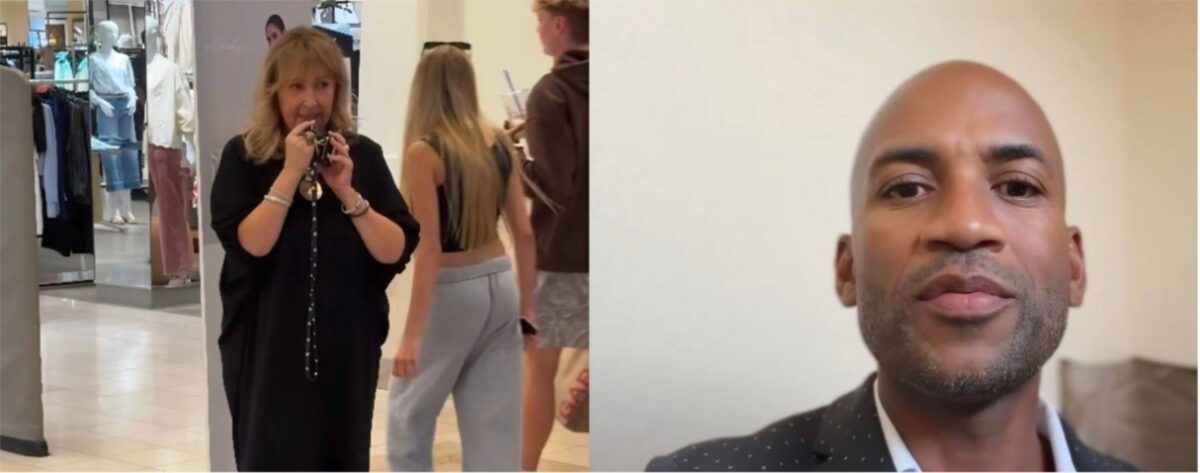
Highlighting his background as a luxury designer and federal contractor, Kellam is using the sit-down to lay bare the full extent of the confrontation and demand direct answers from retail executives.
The March incident began after Kellam sat down at the store’s E-Bar with Ruby, his leashed, trained German Shepherd service animal. He was preparing for an upcoming government contract meeting. Kellam told Atlanta Black Star that the manager approached him, accused him of violating store rules, and told him he was not welcome back.
Initially thinking the interaction was a joke, Kellam quickly realized the confrontation was escalating as the manager stood over him.
“Once I started to really engage into what she was saying, I realized it was a threatening matter,” Kellam recalled. “She’s essentially standing over top of me in kind of aggressive manner. She was accosting me, saying, don’t come back in the store, and next time you come back, you know, bring a leash and all of these things.”
According to Kellam, the confrontation escalated when the manager picked up her phone and walkie-talkie to alert store security.
The commotion quickly drew the attention of surrounding shoppers. For Kellam, the growing public scene only made an already uncomfortable situation worse.
“I’m, like, in the Twilight Zone. Is this really happening?” he said. “And people are watching. It was embarrassing.”
Mall security officers eventually intervened as the confrontation spilled into the concourse, bringing additional personnel to the scene as a crowd of shoppers gathered to photograph and record the ongoing incident.
Reflecting on the encounter, Kellam shared that the public humiliation has left a lasting psychological toll.
“It really sent me into a kind of a dark space, mentally, and it really just had me question a lot of things about myself, about how I’m perceived again,” he said.
Although he revisited the mall once at his therapist’s recommendation to confront the anxiety, Kellam said he remains unable to step inside a Nordstrom store.
“I just feel that electric feeling,” Kellam said, describing a sense of being watched. “That hypervigilant feeling of being, you know, watched or stalked. It was just bad all around.”
Seeking executive accountability, Kellam said he drafted a detailed account of the encounter and submitted it directly to top leadership, including CEO Eric Nordstrom.
While his original social media post noted he received a reply within 24 hours — an initial response Kellam admitted was encouraging — he later accused the company of dismissing the incident as a routine misunderstanding rather than addressing his allegations of racial profiling.
Nordstrom corporate later assigned a corporate team executive to follow up with Kellam regarding his complaint, he said.
Kellam and his attorney, Sean Woods, subsequently joined a 25-minute conference call with Williams, but the discussion produced neither an acknowledgment of wrongdoing nor a formal apology.
Instead, Kellam said corporate representatives characterized the incident as an isolated misunderstanding and challenged his account.
“[They said] It didn’t really happen that way. I think you’re misappropriating the facts,’ Kellam recalled. “That was even more hurtful. It’s like, wait a second, we got witnesses. It’s on camera. We got surveillance. What are you talking about?”
Woods has formally asked Nordstrom to turn over store surveillance footage.
Kellam and his attorney are also pushing back against claims that the manager’s actions followed store guidelines on animals.
Woods noted that Kellam properly leashed Ruby, his highly trained service dog. He said Nordstrom corporate used the dog as a convenient excuse to justify Maddox’s decision to target Kellam.
“If you met Ruby, you would walk away saying, I have never seen a dog better trained than Ruby,” Woods said.
Kellam also said he frequently sees other dogs inside Scottsdale Fashion Square and questioned why the manager singled him out.
“So it’s not a dog issue,” he said. “And if you ever walked into Scottsdale Fashion Square, there are dogs everywhere.”
Woods went further and read the situation for what it was. “Mr. Kellam was targeted,” Woods said. “He was being monitored because of his skin color.”
Kellam said he wants Nordstrom to acknowledge what he believes happened and address the broader issue of how Black shoppers are treated.
“Before you get to an apology, you have to get to an acknowledgment,” Kellam said.
He asked the company to recognize the alleged wrongdoing, examine its diversity practices, and take steps to prevent similar encounters.
“I think we got to start,” Kellam said. “There is some type of acknowledgment, some type of accountability. So we can start the conversation of how do we move forward?”
Kellam originally described the incident as something he wanted to keep private. But after seeing other people describe similar experiences, he said he began viewing the controversy differently.
For him, the viral attention has become an opportunity to push for greater visibility for Black-owned luxury businesses while demanding accountability from companies that serve Black consumers.
“I just didn’t want that negative attention of being a victim,” Kellam said. “I just didn’t want to revisit it.”
But now, he said, telling the story is part of what comes next.
Atlanta Black Star has made numerous requests for comment from Nordstrom but has not received a response.


