Montaria Robinson’s 10-year legal battle seeking justice for her son ended last month when a federal judge dismissed criminal charges against the Georgia officers who killed him on August 5, 2016.
The three officers who killed her son, 26-year-old Jamarion Robinson, fired 91 rounds after they entered the Atlanta apartment where he was staying to serve arrest warrants, claiming he shot at them first.
Montaria Robinson believes the officers, who served on a U.S. Marshals task force, kept firing even after he became incapacitated and no longer posed a threat.
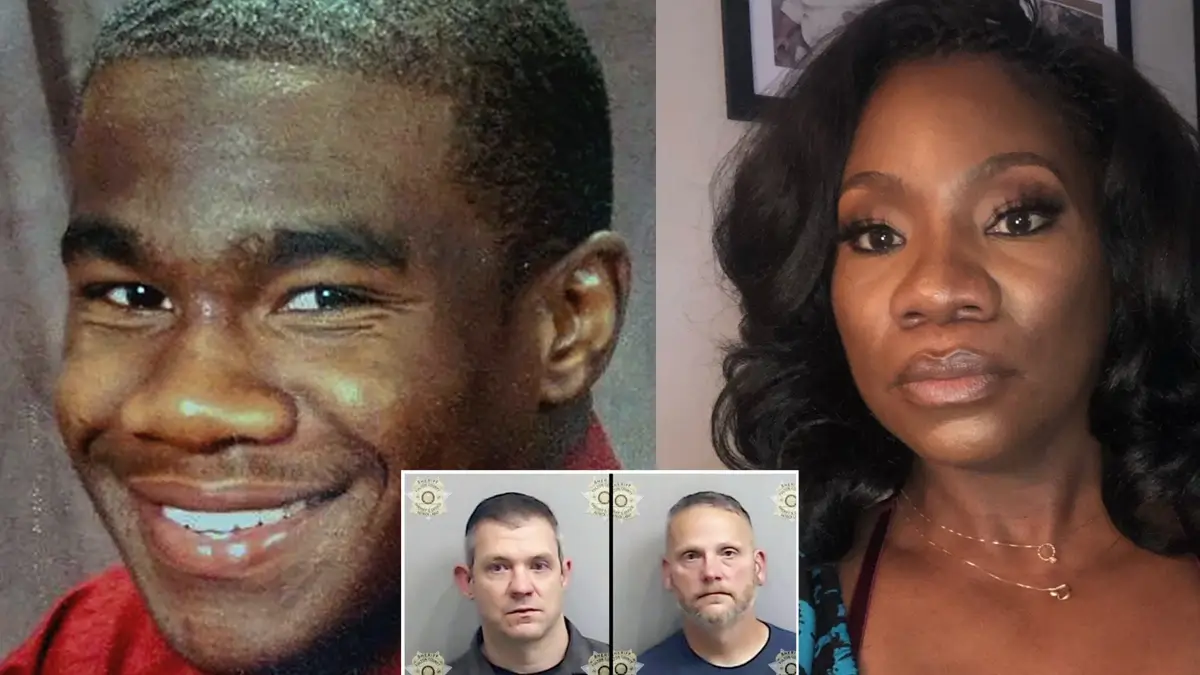
In 2021, a Fulton County grand jury indicted two of the officers, Eric Heinze and Kristopher Hutchens, on charges of aggravated assault with a deadly weapon, burglary in the first degree, felony murder, making a false statement, and violating their oath of office. The third officer, Daniel Doyle, died of cancer in 2020.
On July 30, a federal judge dismissed the charges against Heinze and Hutchens, ruling that Supremacy Clause immunity protected them from state prosecution while they carried out their federal duties.
On Friday at 11 a.m., Montaria Robinson will hold a press conference outside the Fulton County Courthouse in downtown Atlanta.
“It does not bring my son back; it does not erase the gunfire; it does not erase the physical evidence,” she said in a statement to Atlanta Black Star. “It does not erase the unanswered questions; it does not erase the audio and video evidence that captured additional gunfire after a flash-bang was deployed.”
The Shooting
Jamarion Robinson was diagnosed with paranoid schizophrenia eight months earlier and began acting in ways his family says were completely out of character for the former college football player.
A U.S. Marshals fugitive task force, with at least 14 officers from seven agencies, moved in to serve arrest warrants accusing him of attempted arson and aggravated assault on a police officer. Officers entered his girlfriend’s apartment, where he sometimes stayed but did not live permanently.
None of the officers wore body cameras. They say Robinson walked down the stairs, pointed a gun at them, prompting Doyle and Heinze to fire several rounds as Robinson retreated upstairs into a bedroom.
The officers say he then racked the gun and fired two shots, prompting Doyle, Heinze, and Hutchens to shoot again.
They say he lifted the gun a third time, even though his body was already riddled with bullets, and they fired another volley before Hutchens threw a flash-bang grenade at him. Medics pronounced Robinson dead at the scene.
The officers insist they stopped firing after the flash-bang. But a neighbor’s cellphone video captured the sound of additional gunshots inside the apartment after the grenade exploded.
“Over 90 rounds were fired at my son,” Montaria Robinson said at a 2020 press conference. “They threw flash-bang grenades that landed on him, burning him. After that, someone walked up the stairs, stood over my son and shot down into his body. After that, he was handcuffed and dragged down a flight of stairs.”
An autopsy found 76 bullet wounds on Robinson’s body, including 59 entry wounds and 17 exit wounds. It also documented bullet wounds in the palms of both hands, which his family says show he was not holding a gun when at least some of the shots were fired.
The Lawsuit
In 2018, Montaria Robinson filed a civil lawsuit accusing the officers of using excessive force and then conspiring to falsify reports to cover it up.
A judge dismissed the civil case in 2021 on qualified immunity grounds. Robinson appealed, and the Eleventh Circuit Court of Appeals sent part of the case back to the lower court, which dismissed it again.
She appealed a second time, but the Eleventh Circuit ultimately affirmed the dismissal. The court held that citizens cannot sue U.S. Marshals joint task force members for damages under Bivens because those task forces include local, state, and federal officers rather than exclusively federal agents.
“This case presents a new context because the Supreme Court has never recognized a cause of action for excessive force against officers operating as part of a USMS joint federal and state task force apprehending fugitives,” the appellate ruling states.
“Recognizing a cause of action for money damages against a task force member could impact cooperation among law enforcement agencies and the operation of these task forces,” the ruling continues. “Allowing claims for damages against task force members could chill recruitment for the task forces, which could negatively affect their operations in apprehending fugitives at both the state and federal level.”
That decision permanently closed the civil case.
The Criminal case
The criminal case against Heinze and Hutchens remained pending until last month, when the federal court dismissed it under Supremacy Clause immunity.
Montaria Robinson says the dismissals of both the civil and criminal cases show how the government designs laws that shield law enforcement officers from accountability, even when they violate the law.
“The federal court acknowledged that video recorded the sound of additional shots after the flash-bang was deployed,” she said in her statement to Atlanta Black Star. “The court also recognized that the officers denied firing or hearing those shots. But the court concluded that the State had not sufficiently connected those shots to the defendants or established the necessary criminal intent.”
“When officers are the only surviving witnesses inside a home, when there are no body-camera recordings documenting the operation, and when agencies control the evidence and investigation, how is a family supposed to overcome immunity?” she continued.
“How is a prosecutor supposed to prove what happened beyond a reasonable doubt when the system itself failed to create transparency?”
“How many families must be denied their day before a jury because officers were operating under the authority of a federal task force?” she asked. “This case exposes a dangerous accountability gap. When local officers join federal task forces, families should not lose their right to truth. Federal authority must never become a shield against accountability.”
“A badge should not place anyone above the law. A task-force designation should not erase constitutional protection. And immunity should never become impunity,” she said.


