Michael Strahan is done letting the internet tell him how he should have handled one of the most sensitive interviews of his career.
The Hall of Fame pass rusher turned television host is firing back at critics who say he dropped the ball over a recent sit-down.
Some believe he dropped the ball by failing to ask the questions everyone wanted to hear.
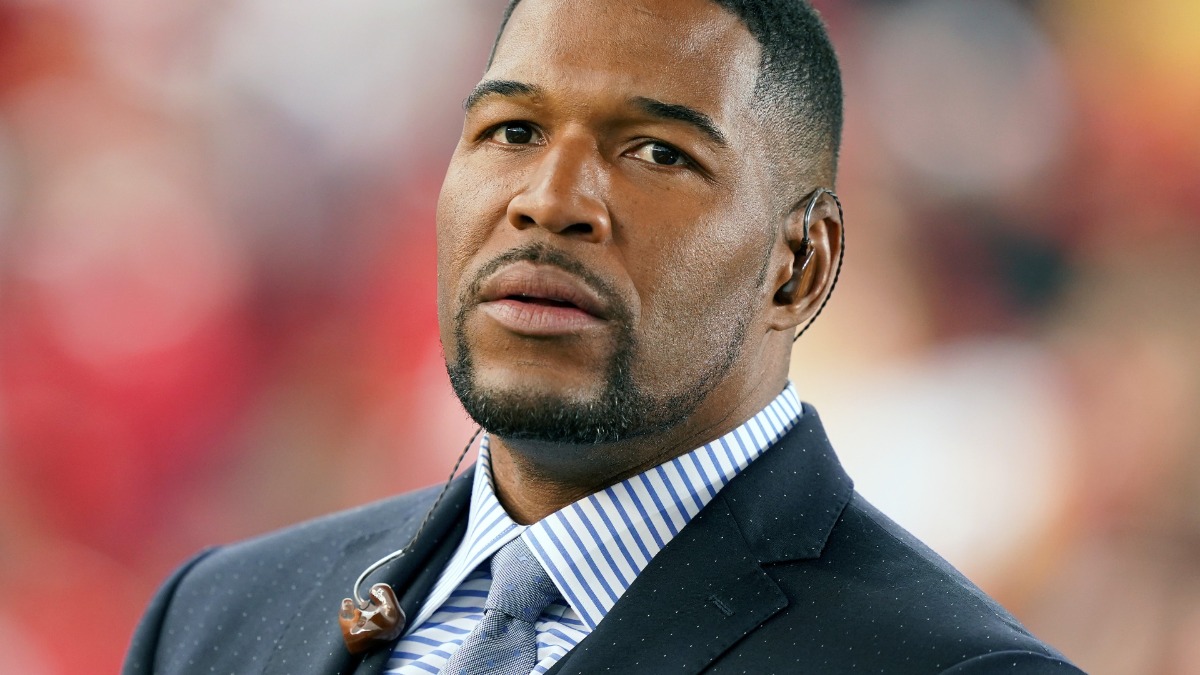
Strahan interviewed former NFL running back Chris Johnson after his ALS diagnosis on the June 29 edition of “Good Morning America.”
The interview sparked backlash after Strahan focused on Johnson’s story instead of CTE and football’s concussion crisis.
Strahan made his position clear during a July 28 appearance on “The Dan Patrick Show.”
He said, “I saw what every[one said], ‘Well you should have asked this, you should have asked that,'” before hitting back with a pungent remark.
“Well, you should have got the interview. How about that?” he added.
Johnson is a former Tennessee Titans standout and 2009 NFL Offensive Player of the Year. During the interview, he revealed he had been diagnosed with amyotrophic lateral sclerosis, the progressive and fatal neurodegenerative disease known as ALS, according to E! Online.
Former NFL player, Chris Johnson, one of the fastest running backs in history reveals ALS diagnosis at just 39 years old in an emotional GMA interview with Michael Strahan.
— geezer (@0xgeezer) July 2, 2026
Chris speaks in the interview using an eye-tracking speech-generating device.
Michael Strahan: You’ve… pic.twitter.com/7wxcVDudS2
The sit-down was raw and personal, with Johnson opening up about how the diagnosis has upended his life and his family’s future.
Viewers felt Strahan let a real opportunity slip, arguing he should have asked whether years of hits on the field played a role in Johnson’s diagnosis.
Harvard and Boston University’s CTE Center have linked long NFL careers to a heightened ALS risk. Weeks earlier, the Concussion & CTE Foundation found NFL players are four times more likely to die from ALS, dementia or Parkinson’s.
"As an interviewer, our job is to deliver information. I'm not trying to get a bigger name for myself by putting somebody else in an uncomfortable position."
— Dan Patrick Show (@dpshow) July 28, 2026
– @michaelstrahan on his Chris Johnson interview pic.twitter.com/qTZ1WuCF0V
“That was Chris’ moment for Chris to share the story which Chris wanted to share,” Strahan explained. “And when I got the call that Chris wanted to share that he has ALS, that was the story. It wasn’t for me to try to grandstand.”
He said he’s not someone who would boost his career by forcing an uncomfortable moment.
“As an interviewer, our job is [to] deliver information. I’m not trying to get a bigger name for myself by putting somebody else in an uncomfortable position. I was there as a service to Chris, for what Chris wanted people to understand and know about his life and where he was now.”
The former New York Giants defensive end noted football wasn’t entirely off the table, it just wasn’t the centerpiece critics wanted.
“I did ask Chris about football, how the NFL has been supportive and all those things,” Strahan said, adding that Johnson’s twin sons currently play the sport themselves. “The headlines were about Chris, [which] is where they needed to be.”
The internet kept arguing.
“Isn’t the interviewer’s job to ask questions that everyone wants answered?” one X user wrote.
“A lot of deflection here by big Mike. It wouldn’t have hurt to ask,” another added.
Daily Mail readers were divided, though.
“This was Chris Johnson’s interview….he wanted to get this out. Strahan was right,” said one supporter.
Another said, “So Johnson was supposed to now be an expert since his diagnosis? The guy was sharing his story not becoming a lab rat.”
Another pushed back, “I saw it,it was a good interview and I learned something. In an interview with someone whose days are numbered, I thought Strahan was careful and led the conversation into a good direction.”
The debate over football and brain disease has grown louder in recent years. More than 400 former NFL players have been diagnosed with CTE after death, including Hall of Famers Junior Seau, Mike Webster, Ken Stabler and Frank Gifford. CTE can only be confirmed posthumously, but researchers have tied repeated head trauma to memory loss, depression and dementia.
Even NFL legend Jim Brown hasn’t been spared. Brown’s daughter is challenging his estate in court, claiming he suffered CTE-related decline before signing legal documents before his death.
Strahan stands by keeping Johnson’s story the focus.
“Overall, I’m very proud of what we did there at ABC in bringing that story,” he said. “I’m very proud and very happy that Chris trusted us to tell it because that was Chris’ story to tell.”
He left critics with one final thought.
“I don’t make any of these things about myself,” Strahan said. “That was the disappointing thing for a few people who were critical of that interview. But if you don’t have critics, that means you’re not doing a good job, too.”