An inmate at a California prison who was shot in the head by a guard, lost part of his skull and nearly died in January has been denied needed brain surgery and kept in an isolated cell for weeks, according to a government claim filed by his attorney last month.
Civil rights attorney Brad Gage held a press conference on April 13 to bring attention to what he described as the dire medical condition of Jose Alfredo Amaya, 33, who has been serving a 26-year sentence since 2015 at High Desert State Prison in Susanville, California, for two violent physical assaults committed when he was 19.
On Jan. 16, a scuffle between inmates erupted in the High Desert prison yard, Gage said, and Amaya was shot in the head by a prison tower guard using a block gun, which typically uses rubber bullets or other less-than-lethal ammunition.
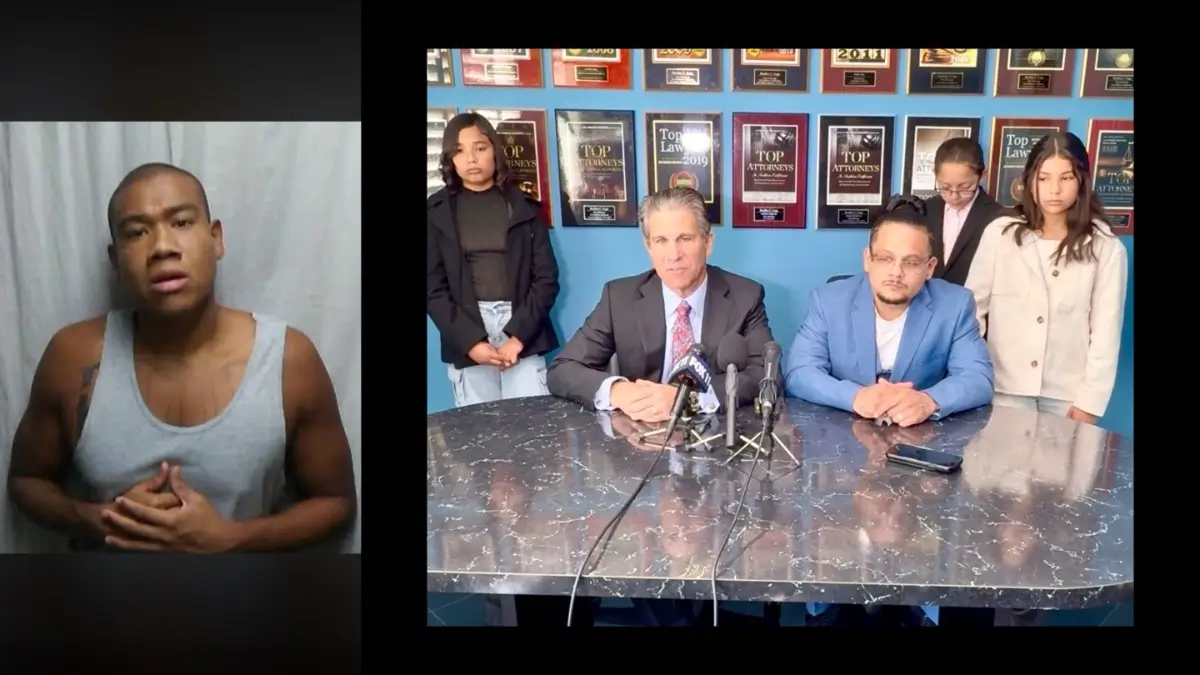
Part of Amaya’s skull was shot off, he lost consciousness and was transported to a local hospital, where he was in a coma and clinging to life, and at one point deemed brain dead, according to the government claim.
His brother, Michael Quiroz, 29, was contacted by prison officials and allowed a compassionate relief visit to say goodbye, during which he was allegedly told by medical personnel that Amaya had no chance for recovery and would be taken off life support. Quiroz protested and “was able to stop the plug from being pulled,” the claim says.
The following day, Amaya “miraculously” woke up in the hospital. His family was denied any further in-person access to him, but subsequently learned that a protective helmet was placed on his head to cover the area of missing skull, Gage told Atlanta Black Star.
Amaya, who has “a dent in his head” and still wears the helmet three months later, has been held for several weeks in isolation in “the hole” at the prison, where he has been denied needed medical care and has received only one visit from a doctor, the claim alleges.
Despite needing “potentially life-saving” brain or cranial surgery, the surgery has not been provided or ordered, “in deliberate indifference to his needs, health, and safety,” the claim says.
Gage, who has won numerous multimillion-dollar verdicts and settlements in civil rights cases involving police misconduct, excessive force and wrongful death, said he has requested but not yet obtained any prison or medical records, including video, related to the Jan. 16 shooting incident or Amaya’s care, and has relied primarily on information supplied by Quiroz.
“I don’t have all the facts,” Gage said. “Whether the shooting was justifiable, whether or not they had a right to use force, they have an obligation to provide medical care and treatment, and that is not being provided, in violation of his constitutional rights . … You don’t get to shoot someone and then say, ‘We’re going to leave them to suffer and grovel and be treated like an animal.’ It’s not part of a civilized society, it’s not humane.”
Quiroz said at the press conference that he has been able to talk to his brother via phone once every two weeks. Gage said that Amaya has been “coherent” and “able to discuss his situation and what’s happening to him” during those calls.
Quiroz also learned that Amaya was going to be transferred to another, undisclosed prison, and said he was worried that a forced extraction from his cell and a long bus trip could be harmful to his health.
After filing the government claim with High Desert State Prison in April, Gage sent a letter requesting a halt to the transfer and compassionate release for Amaya to get medical treatment. The next day, the prison had agreed to delay the transfer, he said, but not to anything else.
In response to a request from Atlanta Black Star for information about the prison shooting incident and Amaya’s current health status, a health communications officer from the California Department of Corrections and Rehabilitation (CDCR) replied in an emailed statement, “CDCR cannot comment on pending litigation.”
In California, a government entity generally has 45 days to respond to a government claim. If no action is taken within this period, the claim is deemed automatically rejected by law. If the claim is rejected in writing, the claimant has 6 months to sue; otherwise, they typically have two years.
According to court records, in January 2014, Amaya, then 19, went to a “smog shop” (where auto emissions are tested) in Riverside County in east metro Los Angeles and stole a beer from a person, then punched another person who told him to return it in the face, threatening to kill the man if he reported the incident.
In May 2014, Amaya returned to the shop and bullied a friend of the victim, then punched him in the face, knocking him unconscious, and continued to beat him, causing multiple injuries.
After a jury trial in October 2015, he was convicted of two counts of assault with force likely to produce great bodily harm and dissuasion of a witness, receiving a sentence of 22 years. He was also sentenced to another four years for possessing marijuana in jail and violating probation related to a previous assault charge.
Amaya is eligible for parole in 2033, according to his CDCR prisoner profile.
“It doesn’t matter what he went to prison for,” Gage said. “He was not given a life sentence, and prisons are not allowed to use cruel and unusual punishment, to impose a death sentence by deliberate indifference to a person’s medical needs. … He has a right to live out his life as a human being with dignity, with having his full skull back in place through surgery.”


