President Donald Trump’s long-running fixation on rewriting how the country remembers its past surfaced again last week when he praised Confederate Gen. Robert E. Lee and suggested the South might have won the Civil War if not for the crippling loss at Gettysburg, a remark that underscored Trump’s tendency to whitewash one of the nation’s darkest chapters.
The remarks, delivered during a disjointed speech in Florida, quickly drew backlash because they fit into a broader pattern of casting Confederate figures in a favorable light while downplaying the central role of slavery in the Civil War.
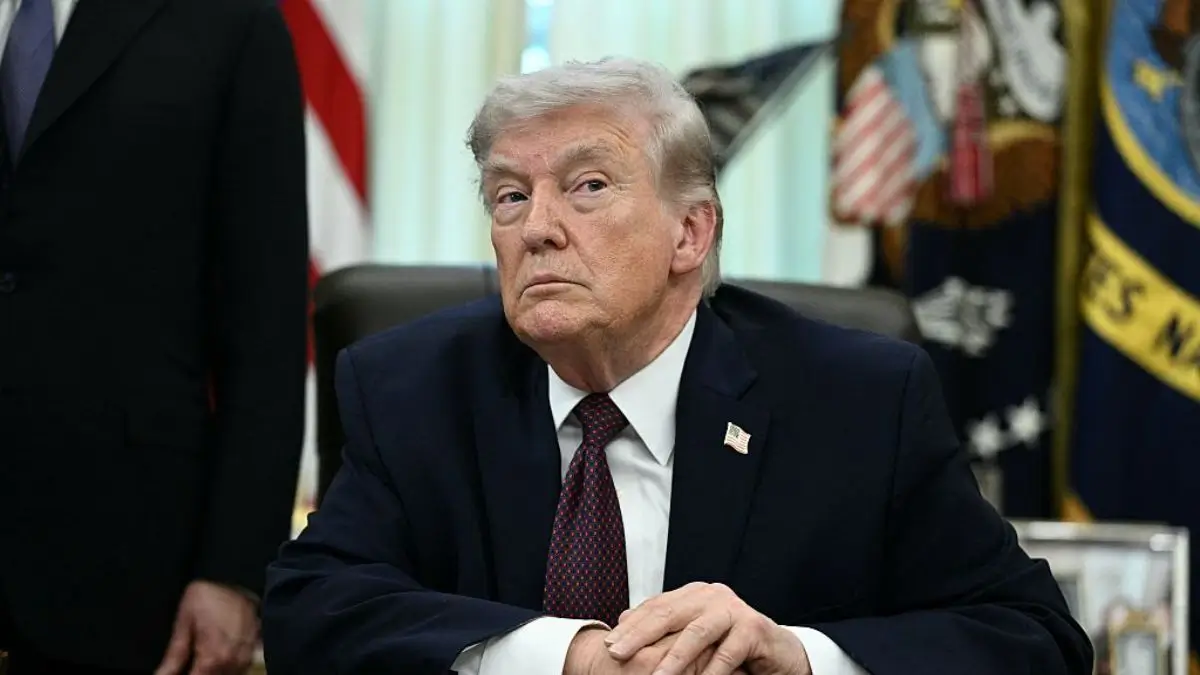
Speaking Friday at the Forum Club of the Palm Beaches in West Palm Beach, Trump veered into a discussion of the Civil War after touching on unrelated subjects ranging from prescription drugs to foreign policy. What followed was a lengthy and winding reflection that praised Lee while speculating about an alternate outcome to the war.
Trump called the Civil War “brutal” and questioned whether it “couldn’t … have been settled,” before praising Lee as “an amazing general” who stretched what was “supposed to last one day” into four years. He added that “with the exception of Gettysburg … if that didn’t happen, it would have actually won.”
“It was supposed to last one day, but because Robert E. Lee was an amazing general, you know, I deal with generals a lot, and I asked who was the best general,” Trump continued. ”A lot of them say Robert E. Lee …”
“To me, the Robert E. Lee era with Ulysses S. Grant and Abraham Lincoln — I mean, to me, that is such an amazing… You can learn so much from it, but it was such an amazing time.”
The comments drew immediate pushback online, where critics framed the speech as part of a larger pattern in Trump’s rhetoric.
One user wrote, “I just want people to understand that when he makes these statements he thinks he sounds like a prolific scholar of American history.”
Another added, “Him praising Robert E. Lee tells you he doesn’t give AF about this country…this dude is the problem.”
Others questioned both the tone and substance of the speech. “Is this supposed to be a comedy routine?” one post read, while another jabbed at the delivery: “Amazing how he can talk endlessly and never really say anything.”
Trump repeatedly suggested the conflict could have been avoided through negotiation, a claim widely rejected by historians who point to slavery as the central and irreconcilable issue.
His comments also elevated Lee alongside the founding fathers.
Now in his second term, Trump has ordered the restoration of Confederate symbols that were removed following nationwide protests over racial injustice. His administration has argued that such moves are about preserving history, not endorsing it, but critics say the distinction often blurs the line.
Recent actions have reinforced that perception. Confederate-linked monuments and names that had been taken down or changed were restored under directives emphasizing a return to what Trump has described as a more “accurate” telling of American history. That includes moves affecting military institutions and cultural sites, where previous efforts to address racial inequities had led to removals.
Several years after removing Confederate tributes under a Pentagon directive aimed at addressing racial injustice, the U.S. Military Academy has restored a portrait of Robert E. Lee to its library, with plans underway to reinstall a bust and display a quote about honor that had also been taken down, according to The Associated Press.
Historians note that Lee remains one of the most polarizing figures from the Civil War era. While he is often recognized for his military skill, his legacy is inseparable from his role in leading Confederate forces that fought to preserve a slaveholding system.
Lee himself described slavery as a “moral and political evil” while still defending the institution and overseeing enslaved people, reflecting the contradictions that continue to shape how he is viewed today.
Trump’s comments also revive tensions that have surfaced before, particularly during moments of national debate over race. In 2017, his defense of Confederate monuments following violence in Charlottesville, Virginia, drew bipartisan criticism and intensified scrutiny over how he framed the issue.


