During a Fox News interview meant to spotlight energy policy and the global oil crisis, President Donald Trump veered into a winding monologue about himself and his decision to rename the Gulf of Mexico, a controversial move he continues to frame as a personal triumph.
What began with a question about oil tankers and supply flows instead became another example of how Trump often treats his interactions with the media as openings to revisit his own greatest hits, even when the moment calls for clarity.
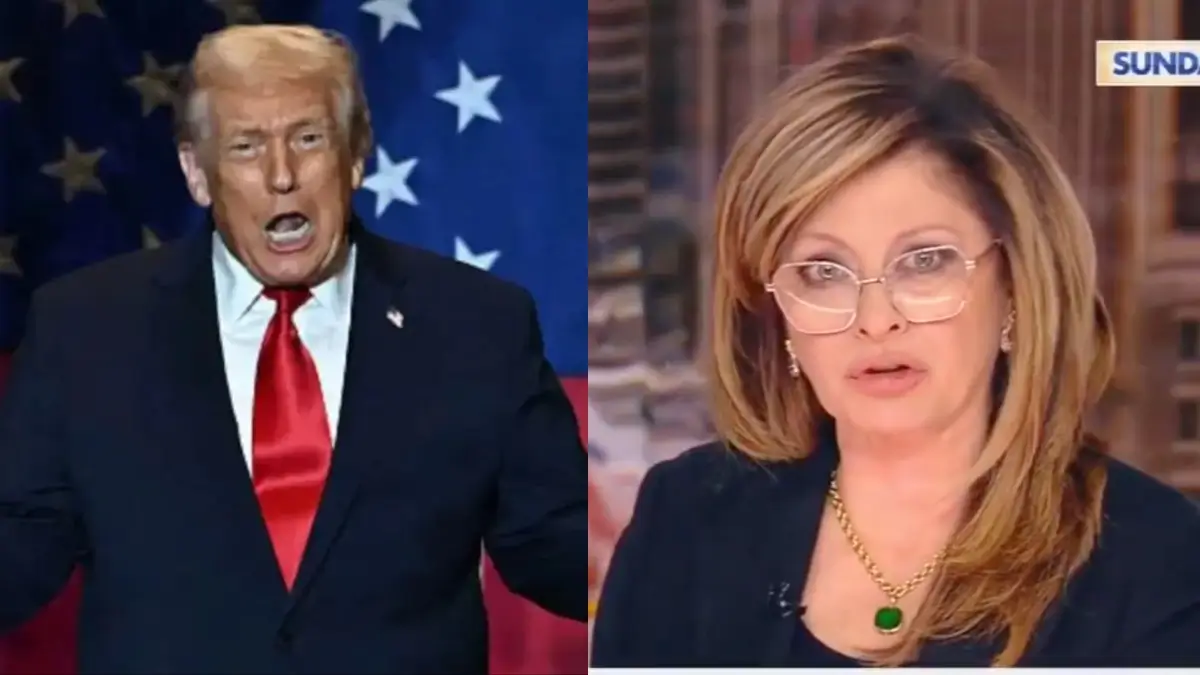
The episode unfolded during an interview on Fox News “Sunday Morning Futures” with host Maria Bartiromo. She opened with a direct question about Trump’s recent claim that large numbers of oil tankers were heading toward the United States to transport oil and gas to other countries.
“Mr. President, you referred to a post that hundreds of super tankers are headed to the Gulf of America to buy oil and gas from the U.S. What can you tell us about that, sir?”
Trump immediately brushed past the question and instead launched into a self-congratulatory explanation of how he renamed the Gulf.
“Well, I can tell you that it used to be called the Gulf of Mexico. That’s what I can tell you. Now it’s called the Gulf of America because of me. One of my little things that I did. You know, one of my little sidelines. And it’s a great honor. People are so happy.”
The rambling monologue continued with Trump claiming the U.S. has “93 percent of the frontage” of the Gulf and recalling how he decided, “I said, ‘I think I’m gonna change it to the Gulf of America,’ what a beautiful name, and I did.”
He added, “I give a lot of credit to Google, cause once I filed the papers, I did it, and Google Maps, once Google Maps changed, you know, did it, it was a done deal. But we had, we had lawsuits, we had law, we won everything. And it’s now the Gulf of America, which I’m very, which I’m very honored by.”
A visibly exasperated Bartiromo tried to steer him back: “But, but do you expect super tankers?” but Trump cut her off before she could finish.
“I was thinking about, I must tell you, I was thinking about calling it the Gulf of Trump, and I decided not to do it. … I think that one maybe wouldn’t have worked out, I’m not so sure, you’ll have to tell me. But I was thinking about it, it’s gonna be called the Gulf of Trump. And then I said, you know, that’s not going to play too well.”
The detour landed at a moment when the underlying issue carries real weight.
Earlier in the day, Trump threatened to blockade all shipping in the strait, but the administration eventually clarified on Sunday night that only ships going to and from Iran were subject to the U.S. blockade put in place on Monday.
Trump had posted that “Massive numbers of completely empty oil tankers” were heading to the United States, a claim that would signal a major shift in global energy flows if true. The comment came as Iranian officials and a U.S. delegation led by Vice President JD Vance met in Islamabad on Saturday, with the Strait of Hormuz largely closed to shipping and crude prices surging.
The marathon negotiations failed to produce a breakthrough that would have ended the war. The next day, Vance said the Iranians refused to give assurances that they would not try to obtain or develop a nuclear weapon.
Analysts have urged caution about reading too much into the tanker claim itself. Jake Dollarhide, CEO of Longbow Asset Management, said the broader dynamic — restricted flows through Hormuz — could boost demand for U.S. oil, but stopped short of confirming Trump’s assertion about tanker movements, according to Reuters.
A disruption in the Persian Gulf wouldn’t suddenly make more U.S. oil available; it would mainly drive up global prices.
According to the Wall Street Journal, the U.S. already produces near capacity, so supply doesn’t jump overnight; instead, existing oil may be redirected to higher-paying foreign markets. Any increase in production would take time, meaning the immediate impact at home is higher gas prices, not more supply.
Robert Pavlik of Dakota Wealth pointed to ongoing negotiations as the real driver that investors are watching.
“We’re all waiting — everybody along with Wall Street — to see what comes about from these discussions,” he said, according to Reuters.
The gap between global turmoil and Trump’s self-focused public remarks drove the reaction online, where viewers saw the exchange either as a deliberate dodge to sidestep accountability or the ramblings of an old man that never came close to answering the question.
“He cant even answer a simple question about oil tankers without turning it into another ego trip,” one person wrote. “Instead of talking policy he just brags about his little sidelines like a kid.”
Another added: “Keep in mind that this ISN’T an SNL skit. He’s inane & insane. The President of the United States is stark raving NUTS! And of course he didn’t answer the question. (Stupidly ‘open’ though it was.)”
Others suggested Trump’s nonsense was predictable.
“Some are asking why didn’t she repeat the question. Because if she did he would’ve thrown a fit, called her a nasty woman and hung up the phone. Why? Because hundreds of super tankers are not headed to the Gulf of Mexico.”
Still others questioned why the claim itself was given airtime.
“Why do we still give him any credibility, everyone knows he is lying even people who voted for him, it has gotten beyond insanity, we have become the biggest joke in the world and we deserve the title. For folks still trying to justify it or rationalize it, need mental support.”
The backdrop to Trump’s remarks adds another layer. His push to rename the Gulf of Mexico—referenced repeatedly in his answer—has already triggered legal and diplomatic friction, including a lawsuit from Mexico over how digital maps display the name. The issue has spilled into media access fights and raised tensions with other countries that border the same body of water.
At the same time, Trump has hinted at extending that approach elsewhere, floating the idea of renaming the Persian Gulf, an idea that has drawn sharp warnings from Iran.


