The White House this Easter felt strangely different, though no one could put a finger on exactly why. For his latest spectacle, President Donald Trump transformed the Rose Garden into what can only be described as a chaotic scene as he welcomed families to celebrate the holiday with him.
Onlookers couldn’t decide whether to laugh, cringe, or wonder if anyone had actually noticed how much the space had been altered. The event meant to feel festive and traditional instead looked strangely different, leaving critics and casual observers alike asking how the iconic garden had become a backdrop for something so surreal—and who, if anyone, had signed off on it.
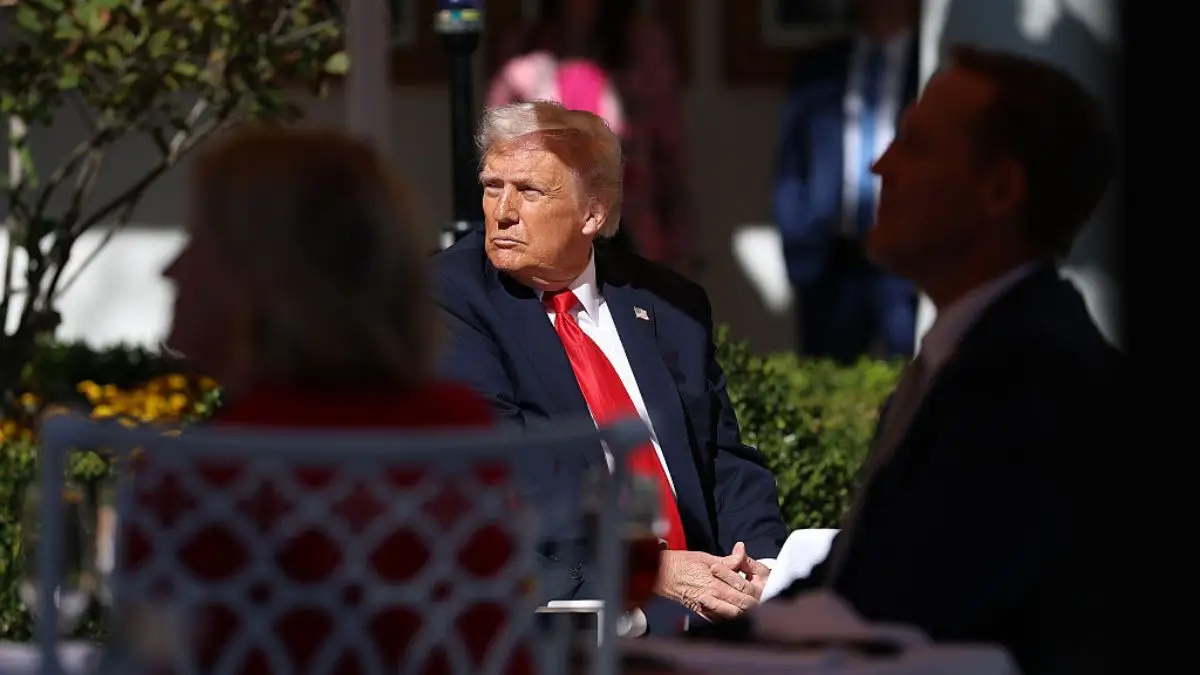
The president made some renovations to the iconic Rose Garden, long known for its lush lawn and delicate blooms, which now looks insanely different than before. Where soft grass once cushioned heels and framed presidential announcements, a bright, stone-covered surface stretched across the grounds.
The president pulled out all the stops for the annual Easter Egg Roll at the White House this week, where a picture-perfect spring day was about candy-colored eggs and giggling children, quickly turned in the complete opposite, as the focus became less about the little ones running on the South Lawn and the chaotic scene at play.
The change came after the garden was paved over the previous year, replacing the traditional landscape with what many described as a patio-like surface.
And to make matters even more noticeable, temporary strips of artificial grass had been placed down for the festivities. The visual quickly sparked conversation across social media and beyond.
Threads users wasted no time weighing in once images of the event began circulating online, asking, “And, like why is the fake grass under the bench where they sit?”
“Did he spray them down like his hair?” another person asked, “What the F was the point of this? And just under the benches? He could have made the patio with grass spots.”
The reactions kept rolling in as more photos surfaced, and despite the revelry of the day, critics noted that the historic garden had been reduced to something that looked staged, patched together, and far removed from the living landscape that once defined it.
Another commenter took the critique even further, saying the patches of grass “look like his trashy, geriatric, golf clubs,” while another said it looked more like “Corporate ‘picnic’ vibes.”
“No! Under the bench only. There were on sale strips at Home Depot,” another person joked. And perhaps the bluntest reaction came from a user who simply wrote, “You just can’t make this s–t up.”
The backlash did not appear overnight.
The Rose Garden has been a fixture of presidential history since the Kennedy administration, when the central lawn was established in 1961 at the request of President John F. Kennedy. Over the decades, the space became more than scenery. It served as the backdrop for treaty signings, press conferences, state ceremonies, and moments of national reflection.
Originally it was impressive pic.twitter.com/uJ4GcSpKSe
— Suzanne (@SJohnsdottire) April 6, 2026
To many Americans, it represents continuity — a living piece of history tied to the dignity of the presidency.
That sense of tradition is part of why the changes made in recent years have stirred such strong reactions. In 2020, for the first time, first lady Melania Trump oversaw a redesign that introduced limestone borders and structural updates to the garden. At the time, historians and preservationists criticized the project, arguing that it altered the character of a historic landscape. Supporters, however, defended the work as necessary maintenance that modernized the space while preserving its function.
Five years later, the transformation went much further.
In 2025, the garden’s grassy lawn was removed and replaced with a white stone surface, a decision the president defended as practical rather than aesthetic. It cost the nation approximately $1 million to do these renovations.
Trump argued that the soft ground had created challenges during events, particularly when guests wearing high heels struggled to walk on damp grass. The new surface, he said, was designed to be safer, easier to maintain, and more consistent with the color of the White House itself.
🚨 JUST IN: President Trump is enjoying his new sound system at the Rose Garden patio and the crowd ERUPTED as he walked by
— Eric Daugherty (@EricLDaugh) April 6, 2026
Trump is reveling in all of his White House additions 🔥
📽️ @MaryMargOlohan pic.twitter.com/xTEIwA6M4C
Still, the optics proved hard to ignore. The idea of paving over one of the most recognizable green spaces of the American political scene — only to cover parts of it with artificial grass during a family-friendly celebration — struck many observers as ironic. For critics, it felt like a temporary fix layered on top of a permanent change.
Whether supporters see the renovation as a practical upgrade or detractors view it as a break from history, one thing is clear: the Rose Garden is no longer just a garden. It has become a symbol of taste, of legacy, and of how each administration leaves its mark on the nation’s most visible home.


