President Donald Trump has spent the past several weeks trying to project control — framing his approach to the widening conflict in Iran as measured, strategic and firmly in his hands, even as the situation threatens to spiral far beyond Washington’s grip.
He has cast himself as the dealmaker in the middle of overlapping crises, insisting he can manage both the war in the Middle East and its global consequences while steering outcomes behind the scenes.
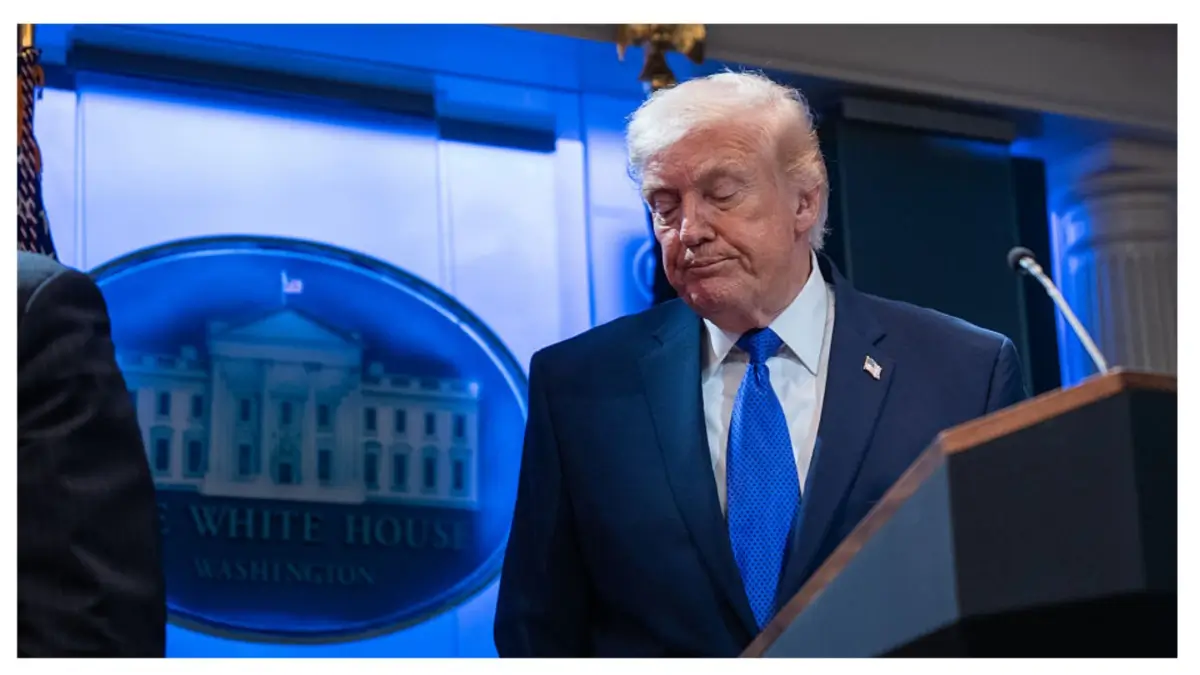
But that image began to crack the moment Trump started explaining how he was handling the crisis — because even as he tried to sound like the steady hand in the middle of it, the details pointed somewhere far more unsettling.
Trump wasn’t leaning on America’s traditional allies or projecting confidence in the usual power centers. He was making clear, once again, that his faith sits elsewhere.
In a recent conversation recounted by MSNBC’s Stephanie Ruhle, Trump blasted NATO partners as ineffective and accused Ukraine of exaggerating its support, while describing Ukrainian President Volodymyr Zelensky as “very difficult to deal with.”
By contrast, his tone shifted when discussing Russian President Vladimir Putin.
Ruhle said Trump made it clear he views Putin as easier to work with and more reliable.
“I would clearly say that he expressed more trust in Putin than he does any of our European allies,” she said.
That framing alone set off alarms. Online, the reaction came quickly and without restraint.
“No surprise, but how f***ing embarrassing. Also deeply concerning,” wrote one viewer.
“This is prime example of why I’m so pissed at people for voting for this. This is not a surprise! It’s disgusting,” another added.
View on Threads
Speaking earlier this month at his Florida golf club, Trump casually revealed that he had been on the phone with Putin — describing the conversation as “very good” and suggesting the Russian leader had been offering input as the war in Iran rattles global markets.
“I had a very good call with President Putin,” Trump said.
However, some observers believed Trump disclosed the call only after it had already surfaced earlier in the day, when MSNBC anchor Rachel Maddow reported on the conversation following Russian media reports.
“Rachel Maddow just reported that Trump had an hour long call with Putin today. We didn’t learn it from Trump but from the Russians,” one person noted on Threads. “Trump also removed sanctions on Russia so they could sell more oil. I guess this is the punishment Putin gets for sharing US intel with Iran.”
Trump insisted he tried to steer the conversation toward ending Russia’s war in Ukraine.
“I said, ‘You could be more helpful by getting the Ukraine-Russia war over with. That will be more helpful.’”
Trump told reporters that Putin said he was “very impressed” with what he saw.
View on Threads
But the broader context told a different story. At the same time Trump has been leaning into that relationship, the geopolitical fallout from the Iran conflict has been delivering a series of advantages to Moscow — economically, strategically and politically.
Oil markets surged as fighting broke out, with fears that shipping through the Strait of Hormuz could be disrupted sending prices sharply higher.
That spike has directly benefited Russia, one of the world’s largest oil exporters.
“Cargoes have been sold around $90 per barrel, so this is a large increase in price and sales volume for Russia,” said Henning Gloystein of Eurasia Group.
Saul Kavonic of MST Marquee noted that rising prices alone are boosting Russian revenues, even before accounting for policy changes.
“Russia stands to gain revenue from higher oil prices, especially as the U.S. has relaxed restrictions on selling Russian crude to India,” he said, according to CNBC.
The United States recently issued a limited sanctions waiver allowing Russian crude already loaded onto ships to be sold through April, though the updated guidance explicitly blocks shipments tied to Cuba, North Korea and occupied regions of Ukraine.
Even with those restrictions, the move has drawn criticism from European leaders who argue it still creates space for Russia to capitalize on the chaos.
Trump has also openly floated the idea of loosening additional oil-related sanctions to bring down global prices.
“We’re also waiving certain oil-related sanctions to reduce prices,” Trump said. “We’re going to take those sanctions off until this straightens out.”
View on Threads
Critics say the combined effect is hard to ignore.
“Right now, the clearest winner from this war in Iran is Russia,” Sen. Chris Coons said. “It’s stunning that President Trump is on the phone with Vladimir Putin and spending more time consulting with him than he is with Congress and the American people.”
Outrage rippled across social media.
“oh so it’s all about impressing Putin,” one observer wrote. Another argued, “Isn’t that blatant treason? Russia is collaborating with Iran to bring us down in a war. WTF?”
Some questioned Trump’s loyalties: “Because Trump is not America first and he’s compromised.”
Others said the real boss is Israeli Prime Minister Benjamin Netanyahu.
“I think his supervisor might be the guy he gives all the weapons and money to. The guy he just started a war with. The same guy who essentially controls about 90% of the U.S. Congress. If you think the problem is still Putin, you are an idiot.”
Even as Trump continues to frame his outreach as diplomacy, the underlying dynamic has become harder to ignore.
A president insisting he’s in control of a volatile global conflict — while openly placing trust in the one leader positioned to benefit most from the instability.
And in the process, revealing far more than he intended about who he believes is worth listening to.


