White House Press Secretary Karoline Leavitt didn’t hesitate when the question landed. Her posture stiffened, her tone sharpened, and what began as a routine exchange at the White House quickly took on the feel of a challenge, one she seemed eager to meet, brimming with confidence that the answer she was about to give would settle the matter once and for all.
She was pressed to explain why President Donald Trump insists he has been “falsely” labeled a racist — a charge he has long rejected while branding himself “the least racist president in history.”
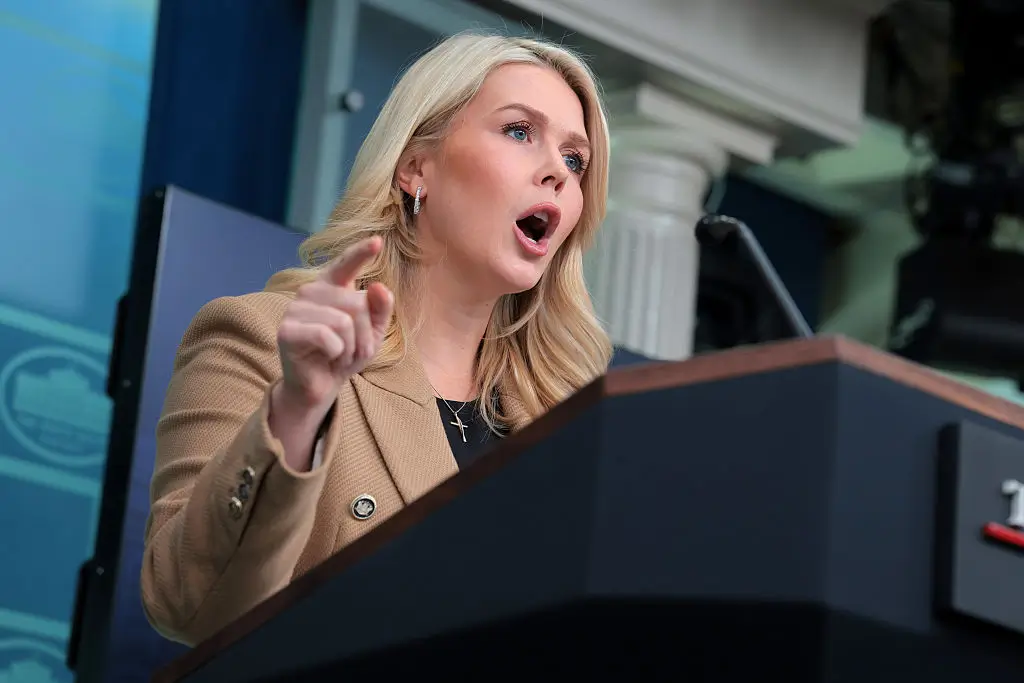
Her answer quickly devolved into indignation and bravado, capped by a promise to produce a “plethora of examples” to prove critics wrong.
But even as Leavitt projected confidence from the podium, a federal court ruling had already complicated the narrative, striking at the heart of the administration’s effort to reshape how America’s history of slavery and segregation is presented to the public.
The exchange began when a reporter asked during the Feb. 18 exchange, “Where or when does the president believe that he has been falsely called a racist?” referencing Trump’s comments a day earlier while eulogizing civil rights leader Jesse Jackson.
“You are kidding, right?” Leavitt replied.
When the reporter clarified he was not, she brushed past the substance of the question and promised documentation.
“I will pull you a plethora of examples. I’m gonna get my team in that room to start going through the internet of radical Democrats throughout the years who have accused this president falsely of being a racist,” she said. “And I’m sure there’s many people in this room and on network television across the country who have accused him of the same. In fact, I know that because I have seen it with my own eyes.”
The timing was awkward.
Just days earlier, U.S. District Judge Cynthia Rufe struck down Trump’s executive order titled “Restoring Truth and Sanity to American History.” The order had led to the removal of an exhibit at Independence National Historical Park in Philadelphia detailing the lives of people enslaved by George Washington. Rufe ordered the exhibit restored and demanded compliance by 5 p.m. Feb. 20.
In a pointed opinion, Rufe framed the dispute as a test of whether the federal government can suppress historical facts when it controls the venue where those facts are displayed. Invoking George Orwell’s 1984, she wrote: “As if the Ministry of Truth … now existed, with its motto ‘Ignorance is Strength,’ this Court is now asked to determine whether the federal government has the power it claims — to dissemble and disassemble historical truths when it has some domain over historical facts.”
“It does not,” she concluded.
The Interior Department has appealed. Meanwhile, additional lawsuits from historians, conservation groups, and LGBTQ+ advocates argue that the administration is scrubbing national parks and federal spaces of what they call “uncomfortable truths.”
Against that backdrop, Trump’s softened tone following Jackson’s death drew attention.
“The Reverend Jesse Jackson is Dead at 84,” Trump wrote on Truth Social. “I knew him well, long before becoming President. He was a good man, with lots of personality, grit, and ‘street smarts.’” He added that he was “falsely and consistently called a Racist by the Scoundrels and Lunatics on the Radical Left.”
Trump then listed what he described as his record of support for Black Americans, including criminal justice reform, long-term funding for Historically Black Colleges and Universities, and the creation of Opportunity Zones.
But critics were quick to point out that the conciliatory message followed another racially explosive episode.
“Leavitt is a babbling idiot,” one Threads user said.
Just two weeks earlier, Trump posted — and later deleted — a video depicting former President Barack Obama and former first lady Michelle Obama as apes. The post remained live for roughly 12 hours before the White House said it had been mistakenly uploaded by a low-level staffer, whose identity was never disclosed.
Leavitt dismissed the backlash at the time as “fake outrage,” urging reporters to focus on “something that actually matters to the American public.”
Trump did not remove the video until after Sen. Tim Scott, the only Black Republican in the Senate, publicly called it “the most racist thing I’ve seen out of this White House” and said the president “should remove it.”
Social media users made clear that particular episode, and others, had not been forgotten.
“She’s such an embarrassment,” one person wrote of Leavitt. “She learned a new word today, ‘plethora.’ He is racist. He can deny it all he wants. Everyone knows it — he proves it every single day.”
Another commented: “Don’t hold your breath on receiving that ‘plethora of examples’ of Trump FALSELY being called racist.”
Others referenced Trump’s past demand for the execution of the Central Park Five, arguing that history speaks for itself.
“It is such a simple question,” one critic said of the briefing exchange. “And very telling in how childish her answer is.”
For critics, the contrast was stark: while the administration promises receipts, federal courts, and the public record continue to tell a far more complicated story.


